Getting closer to an Aperture-Lightroom Decision
I’ve working both sides of the Aperture-Lightroom street as of late and am not totally satisfied with either – yet.
For example, today I shot some RAW images and thought I would use both to see how they come up. Now, I’m not an entirely stupid person, but I did have some trouble working with IPTC data in both apps. In Aperture, I first had trouble even importing the images from a file that already existed on my hard drive (I uploaded the images through Bridge, first). It kept showing me an empty folder until I closed and re-opened Aperture. Secondly, IPTC data I thought I had added during import didn’t show. Adding it afterwards was no trouble.
The trouble I had with Lightroom was that data I entered for one image would not copy to other images – syncing metadata just didn’t want to work. I also had trouble de-selecting images after doing a “Select All”. Very frustrating – especially when doing the same in Bridge/ACR is so easy.
There are a few features that are driving me towards Aperture:
- I love the brighter interface of Aperture – I’ve set it to light grey with a white background. I find that if I use a grey or black background in my images, I don’t brighten them enough. Perhaps it’s my grounding in the wet darkroom, but I want to be able to compare the near white in my image to pure white which I get from the background. Lightroom comes across as “Darkroom” – with its dark grey facade, I feel like I am looking down a tunnel or through a cheap pair of binoculars at my image in middle between the Catalogue stuff on the left and the Adjustment panes on the right. So, for now, I am hiding the Catalogue panes in LR.
- I love how easy it is to switch between Library, Metadata and Adjustments in Aperture. W-W-W – it is also done with no delay, unlike LR which takes its time to switch modes.
 I have found one of the most intuitive ways of adding border and titles to, for my purposes, web images like the one here – a great plugin called BorderFX: http://www.iborderfx.com/. If you are still doing borders and titles with Photoshop – here’s a better way. It was one of the peeves with Aperture that Lightroom seemed to have the edge on (kind of) – but this is even better than LR’s print to file with it’s Identity Plate.
- I prefer Aperture’s adjustments and adjustment brushes to LRs in that you can add a brush for anything without leaving where you are.

However, there are some aspects of Lightroom I like better:
- I like the hide-away panels in LR. I prefer editing in full screen mode with a clean desktop – as few distractions as possible. Aperture also gives me that, but having the hide-away filmstrip at the bottom of LR is helpful.
- I find creating Presets to be more intuitive in LR.
- Also the Print “mode” is wonderful to work with.
One downer about Aperture is the very slow response time (on my Intel MacBook Duo Core 2.4GHz, 4GB ram) when using a number of operations – especially sharpening with the loupe open. OMG it’s slooooooooow!
So, where am I going with this – I don’t know quite yet. Overall, Bridge + ACR is still more intuitive to me than either. I print enlargements using an online service and books using full resolution jpegs I import into iPhoto. My cataloguing systems does need an overhaul. I am still suing folders with YYYYMMDD-DescriptiveTitle despite all of my images being keyworded and described. So I am wasting the keywords if I can’t actually search a database for images with specific keywords – so one or t’other would be ideal for that.
I think I need a few more weeks of playing.
Lightroom 3 and Aperture 3 – Is it time to switch? – Updated
What a dilemma…
First of all, let me explain. For years I have used Photoshop to process my digital photos. Quite simply, it has been the best, albeit not always the most intuitive, method of processing. My roots, however, are as a darkroom practitioner developing black and white RC and fibre-based papers to archival standards as well as colour prints from slides using traditional and Cibachrome processes. In other words, I have a bit of a history but have found that the work I did in the darkroom all those years ago has allowed me to better understand and take advantage of things like colour temperature, colour balance, burning, dodging and , more importantly, layers and masking.
When Photoshop evolved into CS with Bridge and Camera Raw the ensuing improvements in productivity, efficiency and quality for digital photographers was astounding, especially with the most recent 5.x Camera Raw. So now, all my raw images are processed and quite neatly organized in folders by year and by shooting date – YYYYMMDD-DescriptiveTitle – and visually as jpegs in iPhoto. I can find just about any photo in my collection of thousands within a few key strokes and the popping in of a DVD.
TMI – right?!? Perhaps, but it’s important to aware of my journey to this point of considering whether or not to adopt Lightroom or Aperture as my primary agent for processing photos. No doubt, many readers have faced the same dilemma or may be facing it now. Or perhaps you’re trying to decide whether or not to upgrade from iPhoto or Photoshop Elements. I realize that “my system” of Bridge-ACR-Photoshop (although much less of Photoshop with recent improvement in ACR) works well for me right now, but I’m curious to know if there are any additional efficiencies and/or image quality improvements available through the use of Lightroom or Aperture. So for the last couple of weeks, I’ve been both apps through their paces. This coincides with my teaching of a Digital Darkroom course that encapsulates best workflow practices that can be applied to any app for digital editing.
It didn’t take me long to realise the most significant of shortcomings of both Lightroom 3 and Aperture 3. It is, perhaps, the most compelling reason for me not switching previously. I don’t mean to be negative right off the bat, but I don’t want to bore you with the same descriptions everyone else writes of how wonderful the editing features are (and they really are!) only to leave the problems to the end. So here goes…
The deal killer for me is quite simply the complete lack of perspective and lens correction tools – neither Lightroom 3 nor Aperture 3 have them. Now, I don’t shoot a lot of buildings that require “Free Transform”, “Perspective”, “Skew” and the lot, but I’ll be damned if I spend the money on a high level “Pro” app that doesn’t have it when it’s built into the $99 Photoshop Elements!! This goes for Lens Corrections as well. We all have wideangle zooms that would benefit from a little barrel distortion correction to straighten out curved horizons or sidewalk curbs that are near the top or bottom edge. These problems come with even mid- and high-end zooms – so why does the professional photographic community need to rely on a consumer app like Photoshop Elements to correct for something that fundamentally should be correctable from within Lightroom or Aperture.
What I love about both apps are the following:
- having a visual Library or Catalogue of images right at my disposal without having to switch to iPhoto (which I currently use for my visual library since it is free and, actually, quite powerful)
- seamless and efficient development of images using easy to create and save presets – something ACR is lacking
- the previews that are provided when I hover over certain selections (e.g Presets)
- full screen edit modes with few or no distractions
- great spot removal
What is surprising is that 95% of the editing I now do is within Camera Raw 5.x (not the one that comes with Photoshop Elements as it lacks some key controls like Adjustment Brushes, Gradients and Snapshots). I really only go into Photoshop now for initial lens distortion corrections and perspective and some healing brush work that can’t be done in ACR. I also use it, from time to time, to create more striking on-screen and web photos with hairlines, titles and white, matt-like borders around images. But this is a more “graphics” use (as opposed to photo processing) something that PS was designed for.
Could I live without Photoshop CS4? If Lightroom or Aperture included the deal killers I’ve identified – quite possibly. However, I still might miss the Actions within Photoshop that allow me to quickly create the hairline, title and matt borders around photos for on-screen presentations as well as quick jpeg sharpening and a few other things. I can also do some pretty neat things with art filters. But for straight photography, Lightroom and Aperture are almost there. Of course, I could always make the switch to Lightroom or Aperture and keep a copy of Photoshop Elements on hand for the transformations I still use. But what to do about the actions… hmmmmm.
UPDATE
Okay – so I’ve figured out how to output jpegs with a hairline, title and white border – at least in Lightroom. Aperture doesn’t have quite this capability. (Surprisingly, Aperture doesn’t have quite the finesse – unusual for an Apple app – it will put a caption or title underneath, centred but only in black type).

Why Mac?
I have been using Microsoft-based computers since I first started desktop computing back in the late 1980s. I have also been using Macintosh computers regularly since 1990. Over the last 20 years I have seen all the iterations that Microsoft and Apple have brought to the desktop computer. So before you try to tell me I don’t know what I’m talking about and am simply a Mac fan-boy – I have used both systems continually over the last 20 years and have explored a great deal more in computing than the average user.
It’s funny that I don’t actually remember my early experiences with Microsoft except that it was a DOS environment filled with white type on a blue screen and myriad special codes needed to get anything to work. In contrast, I will never forget the first time I sat down at a Mac all those years ago. It was a Mac SE or Classic and it was as much an epiphany as watching that first sheet of exposed photo paper go into the developer blank and gradually appear as a black and white photo. If you’re a photographer and you’ve never experienced a moment like this then – well I’m not quite sure what to write because the days of experiencing a darkroom certainly seem to be numbered.
[Aside: A similar epiphany moment happened the first time I used Google, literally days after it was first “on air” in 1998. I clearly remember marking a student’s term paper – I got the feeling that some plagiarism was going on so I input a phrase that seemed too good for a (then) Grade 13 student into Lycos and found nothing. Then I tried AltaVista. Finding nothing still, I tried Google. It found that exact phrase, and subsequently much of the student’s paper, in milliseconds. I was sold on Google. Google is great because it works and it’s fun – same thing with Macs.]
I remember sitting down at the Mac Classic 20 years ago and discovering how, for the first time, I could actually see on-screen what my page looked like. In retrospect, it seems bizarre how we went backwards from a typewriter – the original wysiwyg device – to a blue screen with pixellated characters that didn’t look anything like the output, then back to true wysiwyg. What’s more bizarre is that the non-wysiwyg blue monster would go on to become the more popular of the two. It is truly amazing how one thing – price – can make all the difference in the world. I am sure glad that Apple has not succumbed to the inane notion that popularity equates to quality (as is all too often the case – tonight being a good example with the Academy Awards!)
And this mouse-thing – what a concept! And fonts galore – cool fonts with Dingbats and things – all without silly cartridges for the printer. I have to admit at being a bit of a font geek since my high school days and Letraset. Sure Macs were twice the price – but I never got tired of computing on a Mac. And now with gestures and trackpads and music and photos and productivity all at my fingertips and anytime. I don’t know how many Windows users still shut down every time they finish. They are amazed that I don’t shut down my Mac for weeks despite intensive computing sessions with 8 or 9 apps open and dragging and dropping and communicating between them. I just do the same thing with my Mac as I do with myself every night – I put it to sleep.
So, why Mac?
Simply – Macs work, Macs don’t get viruses and Macs are fun.
Macs work right out of the box. Macs work whenever I plug something into it. I had my wireless system at home set up in minutes with my $99 Airport Express my printer and two laptops. If,when I plug something in, the driver isn’t “on-board”, my Mac goes and finds it, downloads it and, with my permission only, installs it. No .exe files that carry nasty little bits of code that ruin machines. In fact, Mac’s can’t get infected unless you allow it by entering your password.
Did I say fun? Did I say easy to use? Take this example. As a photographer I like to create slideshows of images. I have two options
- Option 1: the absolutely free, intuitive and excellent slide shows from within iPhoto – complete with Kens burns Effects if I want them, or not;
- Option 2: Open a Keynote template > go to iPhoto and select the photos you want to display > click and drag them to Keynote (Option-Tab will take you there or to any other app immediately) and drop them onto the Slides pane – Voilà – the photos are instantly put in as separate slides that keep all the attributes of the template.
Oh yeah – Voilà reminded me of that other great Mac feature – decidedly unimportant to the vast numbers of unilinguals (read monoculturals) – the easy way that Macs do accents.
A note about Apple Keynote (part of the iWork suite) – I do presentations in lots of different places as part of my photo courses & workshops, at schools, at churches, … and I am always asked what software I used to create them. Invariably those that ask recognize that my presentations aren’t made with Powerpoint, but are amazed when I tell them Keynote is part of a $79 suite of apps from Apple.
I know, I know – by publishing this I’m going to piss-off a number of users who don’t agree and I’m opening myself up to all the users out there who have wonderful things to say about Windoze. But lets face it folks, while Windows does a few things better than a Mac, Macs do a pile of things better than Windows including all the populist things like games and all the highly specialized things like linking hundreds of machines together for super-computing.
But it’s the everyday things that are made easier and more fun like writing an email, word processing and browsing the net. My Mac easily talks to and exchanges photos, music and other files with my wife’s Mac over our home network. I must admit that Windows has caught up to Mac in many ways and they are cheaper. My sister claims that she can buy three Windows laptops for the price of a Mac (not! unless they are three little netbooks) but the next time you want to do a cost comparison, ask yourself how much your time is worth – finding drivers, downloading incessant updates and security fixes, protecting your computer from viruses and restoring data after a blue screen affair or after a virus has wiped access to your hard drive.
Oh and cheaper? I think not. compare the price of OS upgrades even before Snow Leopard ($29). Mac Mail is Free. iChat is Free. iDVD is Free. iLife with iPhoto, iMovie, iWeb and GarageBand is Free. And, unlike most freebies, these things actually work! But what about Office, you say? 90% of what 90% of us use in Office is in iWork – just $79 for Pages, Keynote and Numbers together – and I can vouch for them all being wonderfully easy and fun to use – even for power users like myself.
[Still not convinced, check out the objective reports on productivity differences between the average office worker using Mac vs Windows. Macs are quicker to learn and quicker to be productive with and, because they are fun, people want to use them so they are more productive. IT people certainly don’t want to switch to Macs because it’s been shown that fewer IT people are needed to support the same number of Macs because they have fewer problems. So, the ones making the decisions are perhaps not the most objective. Lastly, looking at total cost of ownership, Macs still come out on top for year-over-year costs.]
Why I like Photoshop Elements 8.0 (PSE 8)
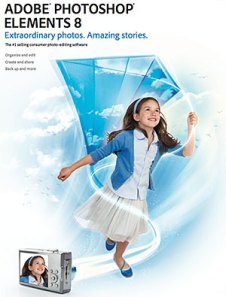 On Saturday morning, I start teaching a 4-session digital editing course for users of Photoshop Elements 8. I first used PSE as version 6 two years ago and used it quite intensively for about 12 months. After that, I was able to upgrade to Photoshop CS4 and left PSE behind. Returning to PSE 8 in preparation for the course has reminded me of just how incredibly useful PSE is.
The beauty of PSE is that its simplicity belies its incredible power. It has an interface far more welcoming and less intimidating than Photoshop yet, for photographers, it can perform, perhaps 80-90% of what Photoshop does. I would even be inclined to use PSE instead of Lighroom. To me, Lightroom is a glorified Adobe Camera Raw developer with a Library Catalogue attached. But what about two key essentials:
- Transformations to straighten building angles (particularly when shot with a wideangle) and
- Lens Corrections to remove the slight curve introduced with wideangle zooms
– both of which are found in PSE but not Lightroom.
But, be that as it may, while PSE has its limitations, I feel that it has more to offer than the average enthusiast can exhaust – especially if you are shooting JPEGs. I am amazed with “EDIT Quick”. A few quick clicks and boom – you’ve got a great looking pic. The “EDIT Guided” mode is a great way of learning what tools will do you. Overall, the “Help” that’s available behind each light bulb is, well, very helpful. Diligent learners will pick up all the nuances of the PSE simply with the various help options.
“EDIT Full” mode is where you can really optimize photos. I like adding adjustment layers and saving as Photoshop files to prevent any pixel destruction. Masks and brushes are available for even greater fine tuning. The nice thing is that converting to black-and-white and even adding a tone to the shot can all be done in PSE. By creating the B&W on a duplicate layer, you can also use the eraser tool to “paint out” some of the B&W to reveal colour beneath. Fun stuff and very compelling.
Two other great aspects of PSE are Bridge and Adobe Camera Raw that are integral parts. Provided you make some heads-up file management decisions (i.e. give your folders proper titles like YYYYMMD-DescriptiveTitle and your images proper filenames like YYYYMMDD-##-DescriptiveFilename), Bridge acts like a library that makes visually locating images very quick. Adding copyright, keyword and location metadata is easy through your own templates and/or by using the IPTC Core panel. From Bridge you can also access Photomerge and Picture Package tools. And through PSE, you can create greeting cards, photo books, prints, collages, even a web gallery i html or Flash.
Adobe Camera Raw is perhaps the most disappointing part of PSE. In Photoshop, I use ACR exclusively for exposure and tone corrections and a lot of fine tuning and it forms the basis of Lightroom. But in PSE, ACR is a bit handcuffed for my liking. It takes us back to CS2 in its lack of tools like Adjustment Brush and Gradient Tool. As well, there are no Tone Curve, HSL or Split Toning tools – all of which can be done through PSE, but I prefer to do this non-destructively in ACR so I’m not accumulating the significantly larger PSD files.
So, PSE is not perfect, but for $99 (1/7 the price of Photoshop and 1/3 the price of Lightroom) it’s amazing how much can be accomplished. All the Resizing, Cropping and Sharpening tools are there plus Art, Texture and Blur Filters, and the all-important selection tools. If you are shooting less than, say, 2000 JPGs per year, PSE is the way to go. If you are delving into RAW then PSE is still the way to go as ACR will get you started and PSE will allow you to finish photos – much like it was with Photoshop just a few years ago. The bonus is that Photoshop Elements is available as a 30-day free trial, so what have you got to lose?
Ontario’s Natural Gems Goes Live!
Ontario’s Natural Gems is a series of nature and outdoor photography workshops that I will be conducting in Ontario provincial parks this summer.
Join me for a weekend of great photography at:
- Killbear Provincial Park – July 16-17
- Grundy Lake Provincial Park – August 7-8
- Rondeau Provincial Park – August 13-14
- Sandbanks Provincial Park – August 20-21
- Arrowhead Provincial Park – TBA
- Bon Echo Provincial Park – TBA
Each workshop includes:
- Friday Evening Introductory Session: 7-9pm
- Saturday Morning Field Session: Dawn to 11am
- Saturday Afternoon Image Review and Wrap-up Session: 1-4pm
During the Field Session, Terry will work directly with participants on creative composition, close-up techniques, landscape photography and making best use of outdoor lighting.
The cost is $175 per person. Pre-register at least one week in advance and pay only $150. There is a maximum of 12 participants per workshop – so reserve your place now by calling Terry at 519-265-4151 or emailing info@luxborealis.com. For more information, visit the website: www.ontariosnaturalgems.com
Hope to see you there!
Please note that the fee is for the workshop only. Accommodations and meals are not included. Please visit www.OntarioParks.com to reserve your campsite.
 luxBorealis Blog