Successful first series of photo courses
This week brings to an end the first series of photo courses for 2010 – and what a success! The Point & Shoot Starter, Digital SLR Starter finished Tuesday and Wednesday and Intro to Photoshop finishes Saturday morning. Some great exploring and discussion of menus, options and technique has made a real impact on those involved.
With March on the horizon and April not too far away, we’re just about ready for the next round of courses:
March 2010
- Advanced Photography – Wednesday Evenings, March 3, 10, 24 & 31
- Photoshop Elements – Saturday Mornings, March 6. 13, 20 & 27
April 2010
- Digital SLR Buying Guide – Saturday Morning, April 10th ($30)
- Point & Shoot Starter – Tuesday Evenings, April, 6, 13, 20, 27
- Fine Art Photography 1 – Wednesday Evenings, April 7, 14, 21 & 28
- Travel Photography Workshop – Friday Evening, Apr 16 + All-day Saturday, Apr 17
- Spring Woodlands Workshop – Friday Evening, Apr 30 + All-day Saturday, May 1
- Grundy Lake Provincial Park – August 6 & 7
- Rondeau Provincial Park – August 13 & 14
Each workshop has three sessions:
- Friday evening Intro Session from 7-9pm
- Saturday morning Field Session from dawn to about 11am or Noon. We’ll concentrate on capturing the glorious morning light with small group hands-on instruction on landscapes, close-ups, metering, lighting, creative composition – whatever the participants needs specific help with.
- Saturday afternoon Image Review & Wrap-up Session from 1pm to 4pm.
This schedule allows you to dedicate some quality time to your photography as well as having some time with your family camping. The workshop fee for Ontario’s Natural Gems is $175 per person. However, if you register at least one week in advance, the price is only $150. Each workshop is open to a maximum of 12 participants so email me to reserve your spot early. Please note that this fee is for the workshop only – you will need to reserve your campsite through OntarioParks.com.
If you have any questions or want more information email Terry at info@luxborealis.com.
I hope you continue to enjoy the winter photography!
Image-A-Week-2010-2
I am so behind on my images-a-week! Sorry about that. It’s been a busy winter getting workshops, courses, photo safaris and cruises up and running.
What do yo think of this?

Ice Wall, Dorset
I was up at Dorset with the grade 10s from St. John’s-Kilmarnock School teaching a unit on Wildlife Population for their Aquatic and Terrestrial Ecology course . It’s a great winter get-away, but I don’t get a lot of photography done. Out for a tromp through the snow on Sunday, we came across a significant “ice wall” or “ice fall”. Two of the students, Natalie and Robin – keen photographers – stayed with me to spend some serious time photographing this amazing feature.
Ice wall are a world unto themselves – so many shapes, textures, patterns, colours – but photographing them is difficult, especially exposure. To increase the brightness of the snow (remember – white snow causes your light meter to underexpose) I used exposure compensation to increase the exposure by one stop. When I started editing in Adobe Camera Raw, I found I could further increase the exposure by another 2 stops and use the Curves Tool to bring up the “Lights” and “Darks” by 75 or so to create the high key image I saw.
Apple iPad – for photographers?
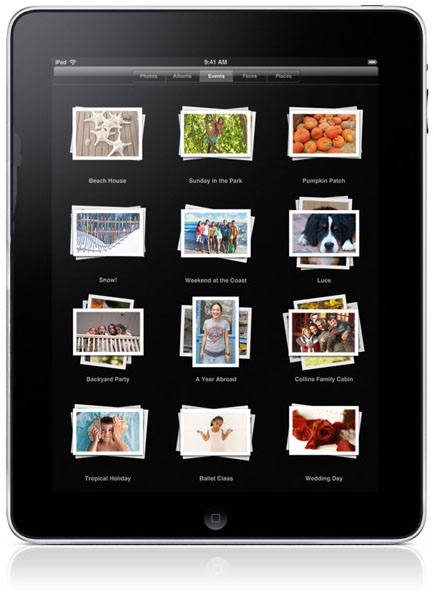 I’ve been away for a week up in “God’s country” – the Haliburton Highlands of Ontario – so I missed the hoopla surrounding the release of the Apple iPad. Some would call it a boring over-dramatization, even gaudy melodrama. I, for one, usually enjoy Steve Jobs delivery of new, revolutionary products. This time, he is showing his age with unnecessary repetition and occasional silted delivery. However, this blog isn’t about Steve Jobs or the launch, it’s about the iPad itself.
The iPad truly is Apple’s
most advanced technology in a magical and revolutionary device at an unbelievable price.
During the launch, I would have thought they would use the Beatle’s Revolution, but I guess things aren’t yet patched up between Apple and Apple Records. That being said, I am greatly excited by the potential of the iPad.
Fifteeen years ago when I was teaching high school Geography, I conceived of a “notebook” somewhat akin to the iPad. Except mine had a stylus and was more productivity oriented than the iPad’s entertainment orientation. I like the iPad and it could certainly find a place in my life for these reasons (without having actually played with one). At the same time, I feel that I will pass on this first iteration, because, for me, it’s not quite there. For photographers as well, I feel it’s not quite there yet. Here we go:
- the screen is gorgeous – the best on the market. Although I am not a fan of glossy screen for doing photo work, this one appears to be a keeper. And the 1024×768 size is decent, however
- I want real estate. I would much prefer to cart around an extra pound of weight if it meant having a 15″ screen. When I move from my MacBook to something else, I don’t want to scrimp. You see, I’m looking at iPad as a way to shed weight and bulk and things. I want it to do what my MacBook does (well, almost) without having to carry my MacBook.
- the interconnectivity is excellent – WiFi on all, 3GS if you want it (although no phone capability – so I still need to carry a phone although Skype might have something to say about that – very soon). Cameras can also be connected via the Camera Connection Kit (thanks, Dennis for pointing that out!). This makes the iPad a good replacement for the Epson Picture Viewer – but not an ideal due to the small hard drive of the iPad – 64GB maximum.
- Productivity for me is the key. As I mention above, the iPad must be able to stand on its own so I don’t need my laptop with me as well. I live by my email, calendar and address book, so I’m pleased to see them implemented so well on the iPad. As well, iWork is an incredibly easy, intuitive and friendly set of apps that I use everyday. Keynote, alone is worth ditching PowerPoint which looks positively archaic next to Keynote. Pages kicks Word’s butt. Numbers is still maturing but still far more useful to me than clunky old Excel. I know Office is the industry standard on “every” computer (and, when needed I can export as Word, PowerPoint and Excel), but I don’t get rave reviews of PowerPoints like I do of Keynotes, and for me, as a photographer, it’s the presentation that counts. For me as a user, it is also the interface that counts and iWork has Office beat to death. However,
- I need to come back to screen size. Sorry to harp on it, but, other than the lack of a USB, it’s the deal-killer for me. No doubt, Microsoft will come out with an Office version for iPad and there will be a whole slew of further offerings, but they will need to be workable on the 10″ screen. Maybe I need to get an iPad in my hands to see how well I can work on a small screen, but from first look, I’m skeptical.
- the battery power is phenomenal. At 10 hours – even they overestimate by 20% – the iPad can work through a full day of use – nicely done, Apple!
- the Apps have huge potential. I can easily see Adobe putting out a Photoshop for iPad. Being able to edit and manipulate photos on a touch screen would mean a Wacom Tablet at $200 is no longer needed. But again, the small screen size is getting in the way of real productivity
The other potential deal-breakers for photographers and others – besides the lack of a USB – are:
- the size of the hard drive. At only 64GB (the largest HD and most expensive iPad) is potentially 1/4 of what it needs to be. Heck, I have 12GB of music alone. And, I don’t want to just show photos – I want to upload the RAW images from my camera and at least start the file management process and perhaps some initial editing. Not impossible with only 64GB, but definitely limiting. You see, my laptop is my office – it has all the files I need to be productive anywhere. I don’t have time for the level of entertainment offered by the iPad – great if you are stuck on a commuter train for an hour everyday. But at only 64GB, I would be spending too much time swapping files rather than working on them. Let’s see, what files do I need today to be productive on the road…oops I forgot that file on my laptop…
- the lack of multi-tasking. Why has Apple taken a step back from its leadership in multi-tasking. I am shocked by this, actually. I don’t want to close an app (like a photo, Keynote or Pages doc) just to search for another song or check my calendar or my emails
The bottom line question for me is, can I get away from carrying around my laptop by using an iPad? Almost. The killers are:
- screen size – it’s too small to be truly productive;
- small hard drive – too small for RAW and manipulation;
- lack of multi-tasking – who doesn’t multi-task these days!; and
- lack of USB to upload photos.
If I have some downtime after a shoot on the road, I want to go beyond just looking at my photos. And if I can’t be truly productive then I need to carry my laptop. If I need to carry my laptop then I don’t need an iPad. I would gladly pay $1000 for an iPad that had even a 14″ screen, 250GB hard drive and USB connectivity – something that would be more productive than entertaining. There’s my wish-list, Steve!
Photo Safaris Tanzania Site Launch
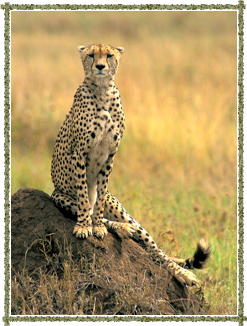
Cheetah, Serengeti
www.photosafaristanzania.com is live!
We are ready to go with our photo safari schedule for the coming year. Set aside dates in October 2010 or February 2011 for the best photo safaris available. Seven days tracking the amazing and diverse wildlife of the Serengeti Plains, Ngorongoro Crater, Lake Manyara and Tarangire National Parks. We’ll also visit Olduvai Gorge and visit with the Maasai who live around Ngorongoro.
The safari starts with a flight from Arusha, across the Great Rift Valley and Crater Highlands to the Serengeti. We’ll spend the next 7 days making our way back to Arusha by following the chain of parks and wilderness areas. It will truly be a memorable experience with photo opportunities around every bend.
We’ve teamed up with Allan Phillemon. Allan is a Tanzanian who is best known for guiding the IMAX and National Geographic film crews up and safely back down Mt. Kilimanjaro to make the IMAX film Kilimanjaro: To the Roof of Africa. He will outfit us in his safari Land Cruisers with his best guides and we will be staying at both luxury tented camps close to the wildlife and lodges with the best views in East Africa.
Now that I’ve whetted your appetite, visit the website for the details – www.photosafaristanzania.com – or email me now with your questions or booking.
Oh yeah – you’ll want to know about the price. Allan has priced this really well for us on a sliding scale based on the number of people. All transportation, accommodation and meals and a few extras (like wine on every dinner table) are included – basically everything except personal spending and your flight to Arusha (Kilimanjaro International Airport – JRO – KLM flies daily from Amsterdam). By the way, we are using a minimum of two trucks to give everyone the elbow room they need for great photography. The fewest people we’ll go with is 4.
With 4 people split between two trucks, the price is US$ 6695 per person. If there are 5 or 6 people, the price drops to US$ 5695. With 7 or 8 people (which is the maximum) the price drops again to US$4995. Why the big gap in price? Having more people reduces the cost per person so we prefer to pass the savings on to you. I invite you to have a look at other safaris offered around the web. We are not a discount safari, nor are we scrimping on accommodation, meals, trucks or location. That being said, you’ll find these prices as good if not better than most other Tanzanian safaris.
For me, there is no better place in this world than being on safari in East Africa. It is absolutely exhilarating! I hope you’ll be able to join me. Have a look at the site and drop me an email if you have any questions.
Travelling to Africa is like going back in time…
Wildlife like you’ve never seen before.
Wide open spaces that seem to go on forever.
Photo ops around every bend in the road.
It’s the Africa you’ve dreamed of…
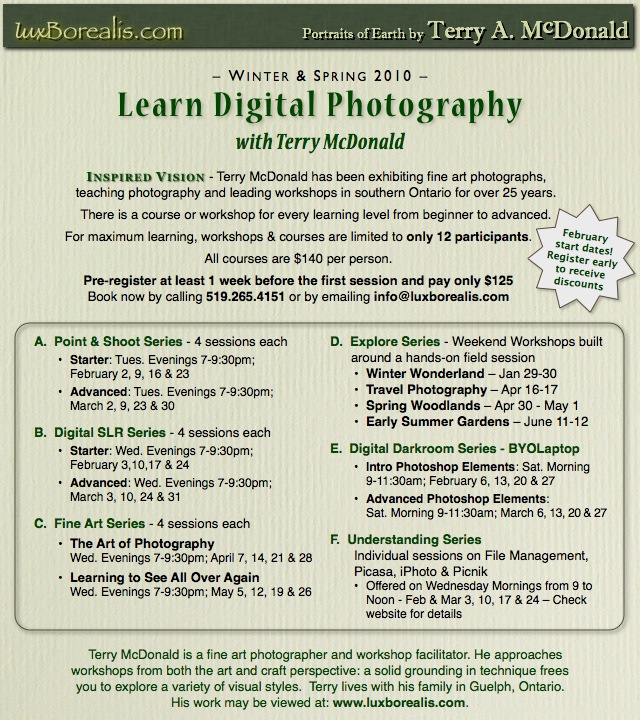
Photo Workshops and Courses
Point-and-Shoot–Digital SLR–Digital Darkroom
–Explore Outdoors–Fine Art Courses and Workshops
Through the advent of digital, I’ve noticed some significant trends in photography.
- photography has become much more available to people. By using cell phones and inexpensive compact cameras that do not require the expense of film developing and printing people are freer to shoot anything (for better or worse!);
- photography has become much more technical. Yes, you can still “point & shoot”, but there are many more buttons on the average camera today than at any time in the past;
- people are able to produce more higher quality images on a regular basis, due to the accuracy of auto exposure, autofocusing, face detection, image stabilization and the improvement of program modes and auto ISO;
- unfortunately, there are still huge technological barriers to people actually enjoying the photographs they take. It’s easy if you only want to see your photos on the LCD screen of your camera or mobile, and while uploading and printing may seem easy, it is more complex and time -consuming then dropping off a roll for printing. As well, storing photos so that you can find them again is an even greater headache.
Cameras, however, are still far from perfect, and the decision-making technologies in them still allow significant room for user error. For me, this is a good thing because if cameras were perfect, I would be out of work.
Point and Shoot: The average point & shoot user still ends up with a number of photos that are, at best, only average. Many are still poorly exposed – not due to user-error but rather camera-error. In the end, cameras are just machines (computers, really) that simply respond to commands. Luckily, with just a few hours of coaching, virtually anyone will see dramatic improvement in the photos they take. And, by extending that coaching to the on-screen editing of photos even more dramatic improvement are possible.
The bottom line is that with a few evenings of hands-on practice, you will see marked improvement in your pictures. If you’re new to photography, take a Starter course t really understand what’s happening when you take a picture and what you can do to ensure greater success. For those who feel more confident, take the Advanced courses starting in March.
Digital SLR: Over the years, with improvements in camera technology, I’ve often wondered if demand for photo courses and workshops would decrease. It hasn’t and I credit this to those who have this burning desire to create. Each of you are experimenting far more than ever and discovering new ways of using photographic technology to produce images. This is great. You are pushing your equipment further and demanding more. However, despite this amazing technology, there are still gaps between what you see and what you get and that’s where a photo course or workshop comes in.
The DSLR courses are also split into Starter and Advanced. With a much more advanced piece of technology in your hands, there is more to consider so we’ll start with the basics and move into the complex.
Digital Darkroom: Photography doesn’t end with taking pictures. Even more can be done to enhance great images through the use of a good photo editing program like Photoshop Elements. For this reason, I offer a 4-session course to get you immersed in digital editing. Alternatively, you can get your feet wet with the Understanding series – one-session mini-courses on File Management, Picasa, iPhoto and Picnik.
Explore Series: Getting outdoors with a field session is the best way to learn nature photography. We’ll start in two weeks with a Winter Wonderland workshop and continue in the spring. The outdoor field session is bookended with classroom sessions to introduce and wrap-up our shooting weekend.
Lastly, the Fine Art Series will challenge you to start looking at the world in a different way. Photography is, ultimately, an art form that allows you to visually express yourself. Confidently expressing that vision is helped with specific exercises and assignments that force you to actually “see” and not just “look”.
Join me for a great winter and spring of photography and begin turning snapshots into photographs you are truly proud of.
 luxBorealis Blog