A Week in Killarney Provincial Park—2.4 billion years in the making
1114 words; 14 photographs; 6 minutes
For the past week, I’ve had the pleasure and honour of being the Friends of Killarney Park Artist in Residence.
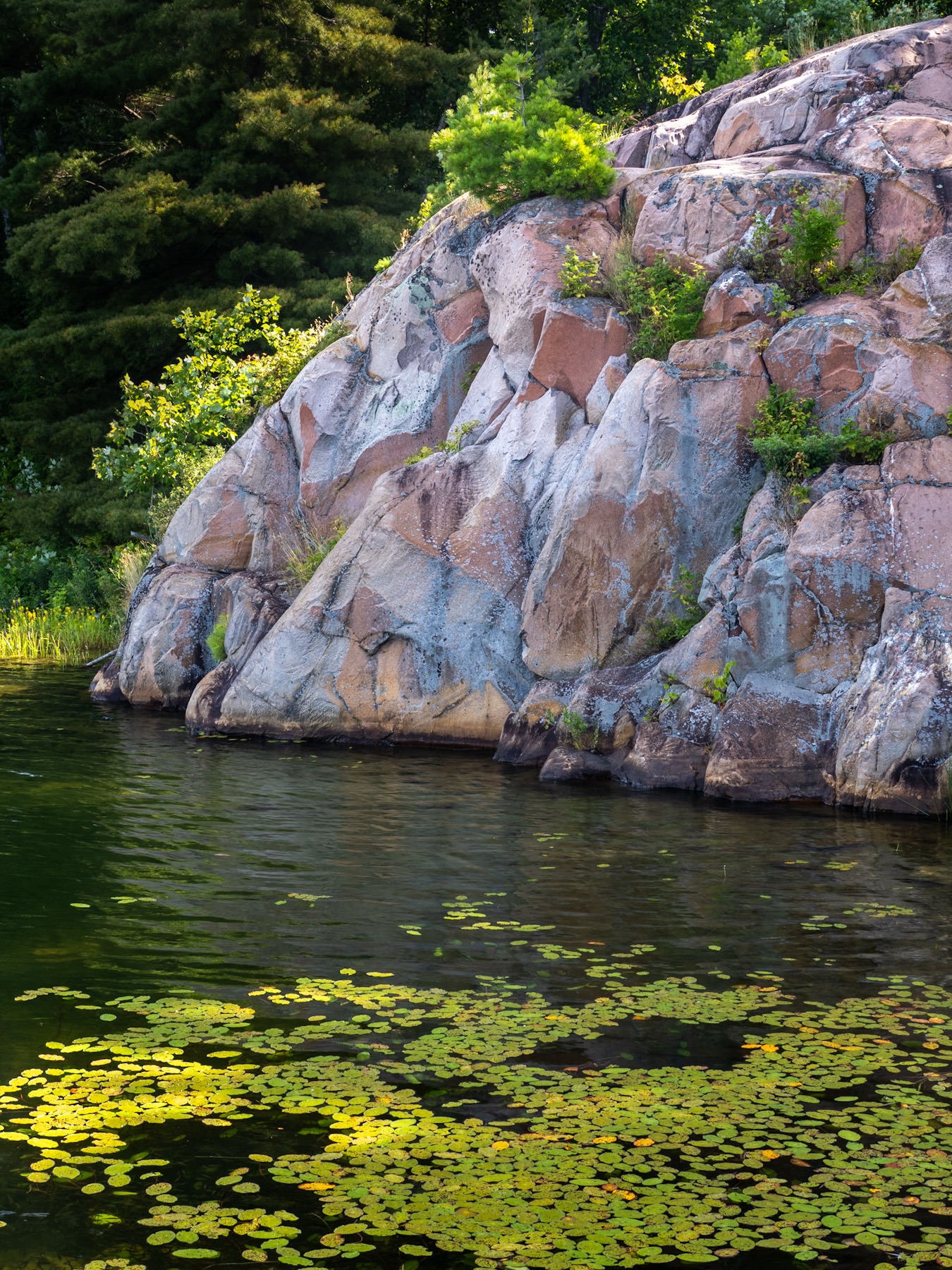
Killarney Provincial Park is truly a gem in the crown of Ontario Parks. From a landscape photographer’s perspective, the unique juxtaposition of the pink granite of the Killarney batholith and the white quartzite La Cloche Range mean more than simply colourful rocks. The two rock types are crucial in determining the biology going on at the surface as well.
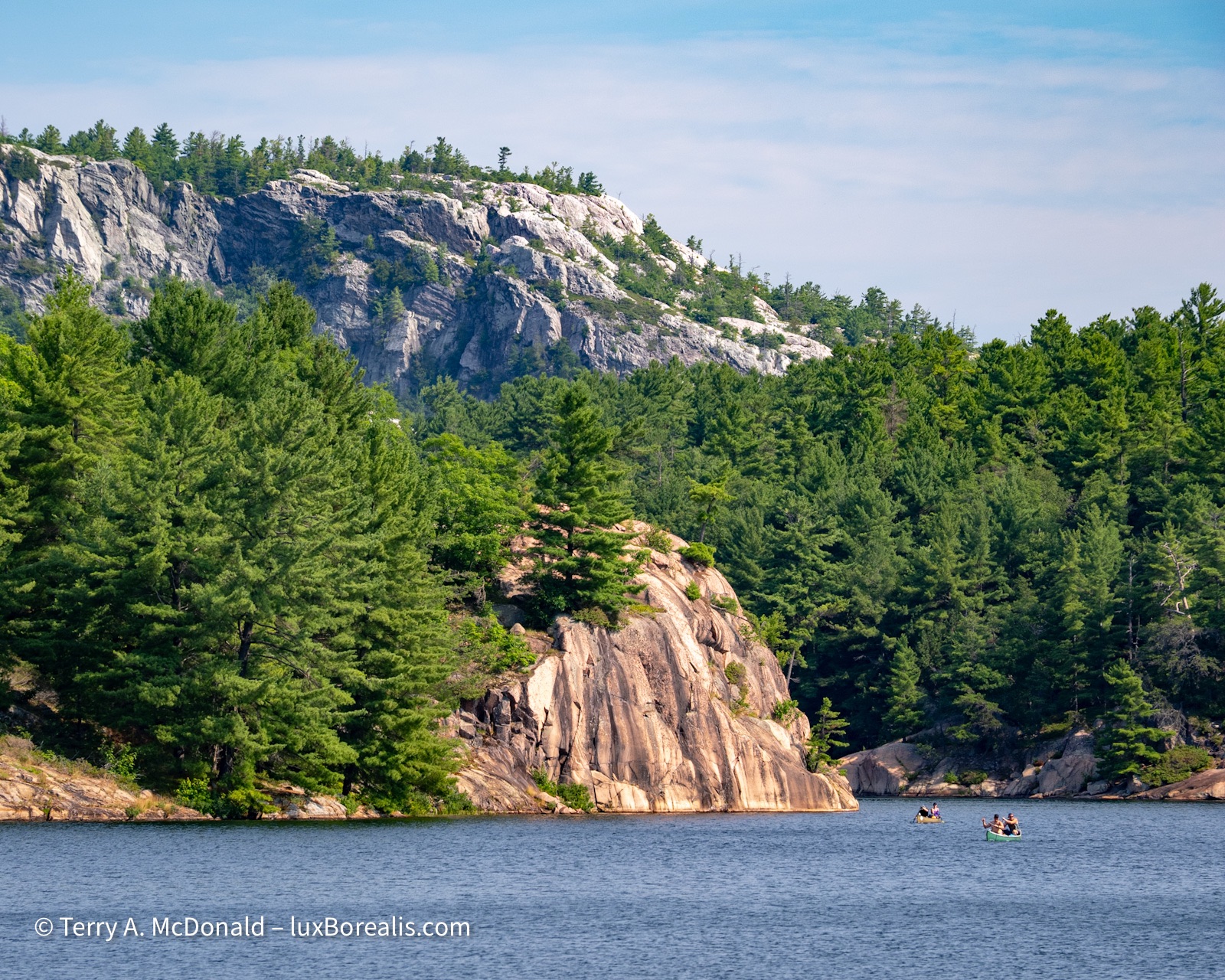
Scale, perspective, juxtaposition, and timing make this the quintessential view of Killarney Provincial Park: billion-year-old pink granite backed by 2.4 billion-year-old white quartzite.
OM-1 | 100mm (200mm efov) | POL | ƒ5.6 @ 1/125 | ISO 200 | Lightroom
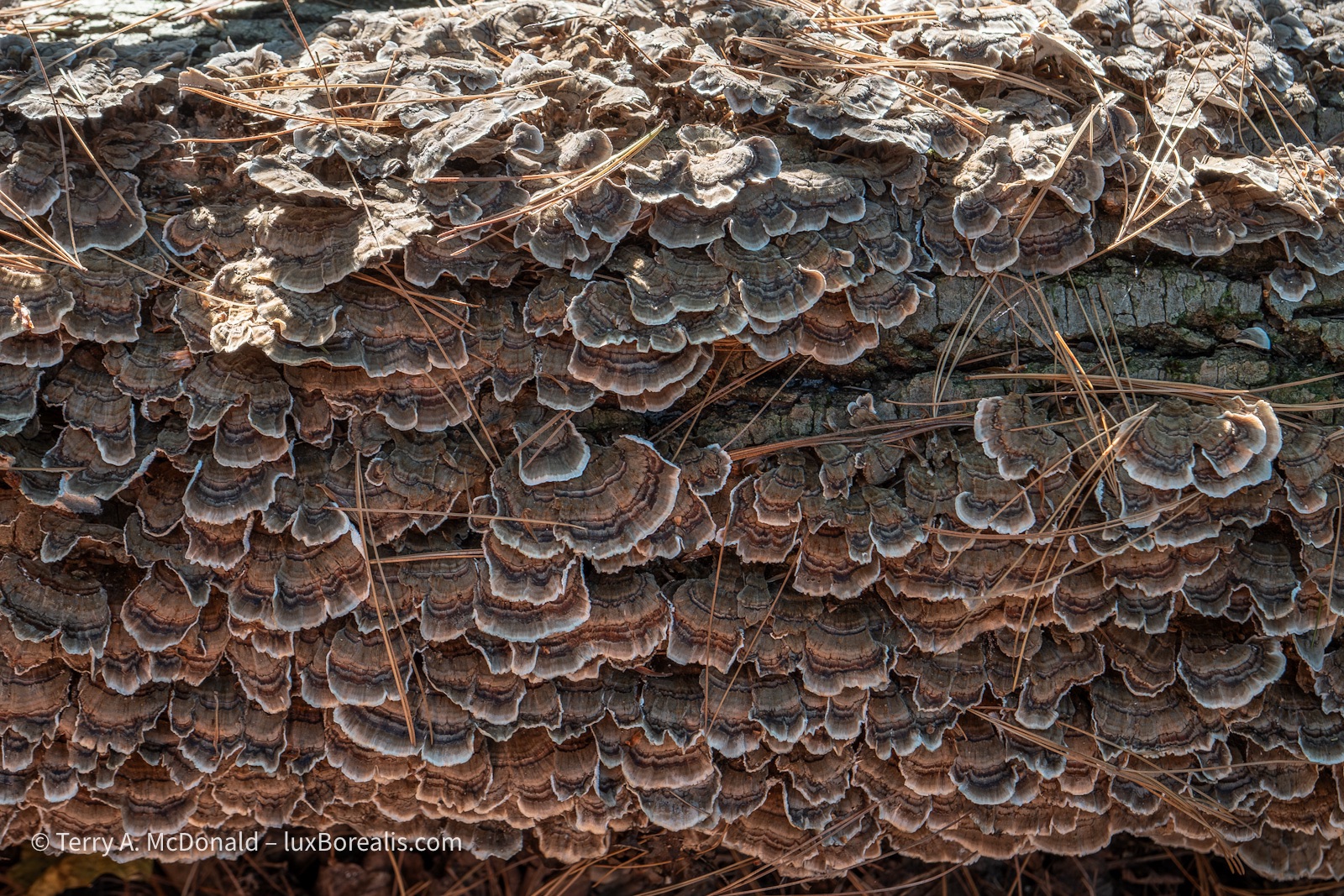
This week, I was overwhelmed by the variety of colourful fungus/mushroom species on display along all of the trails. Rain from the previous week must have triggered them as many were new emergents. My 60mm Macro lens teamed up with in-camera focus-stacking were essential for capturing the depth necessary for clear, crisp photographs.
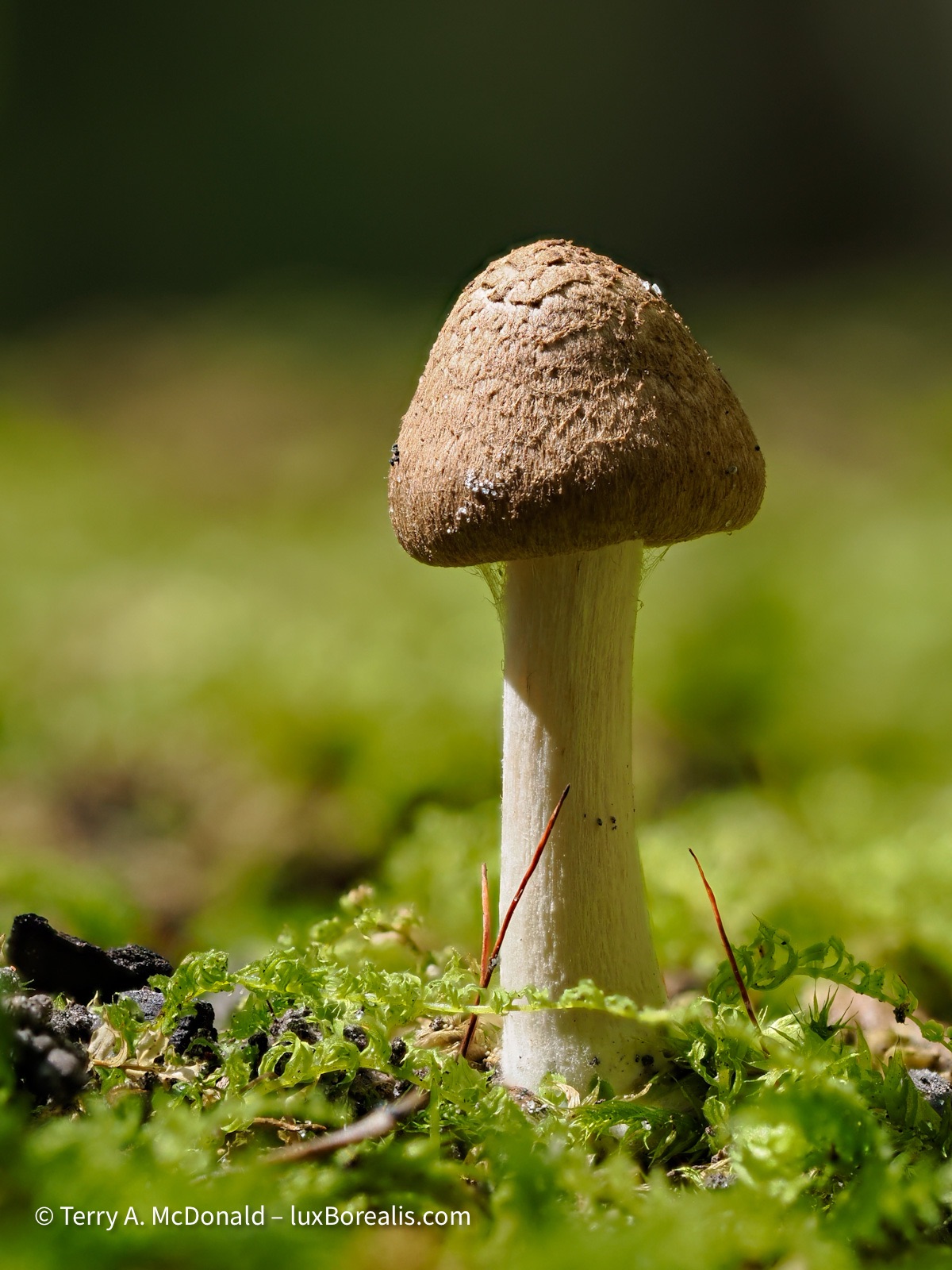
At just 3cm high, this diminutive mushroom was right in my campsite.
OM-1 | 60mm Macro (120mm efov) | ƒ4 @ 1/60 | ISO 200 | 10x in-camera focus stack | Lightroom
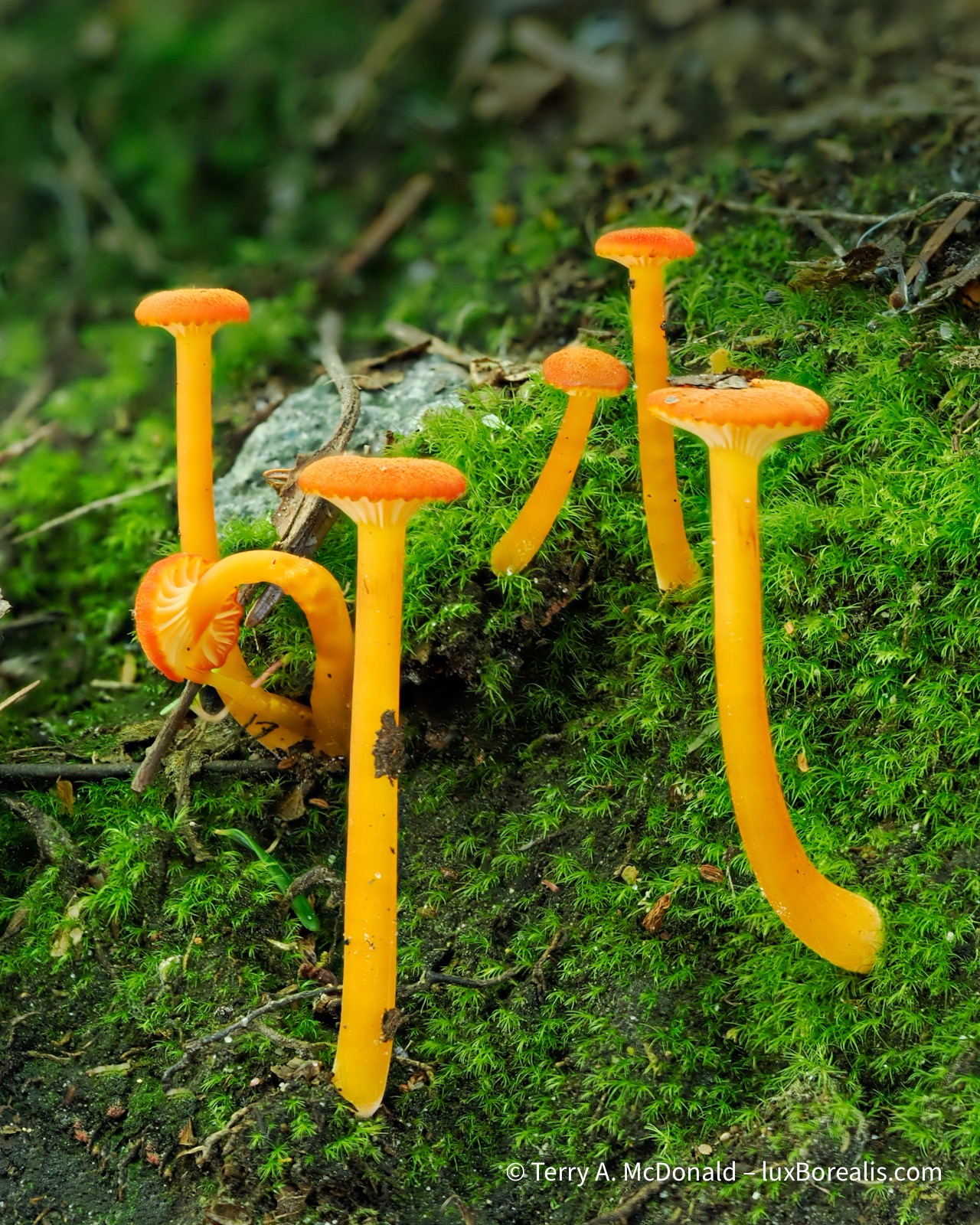
These long, slender mushrooms, found along the campground road, were just 4 to 5cm in height.
OM-1 | 60mm Macro (120mm efov) | ƒ4 @ 1/6 | ISO 200 | 10x in-camera focus stack | Lightroom
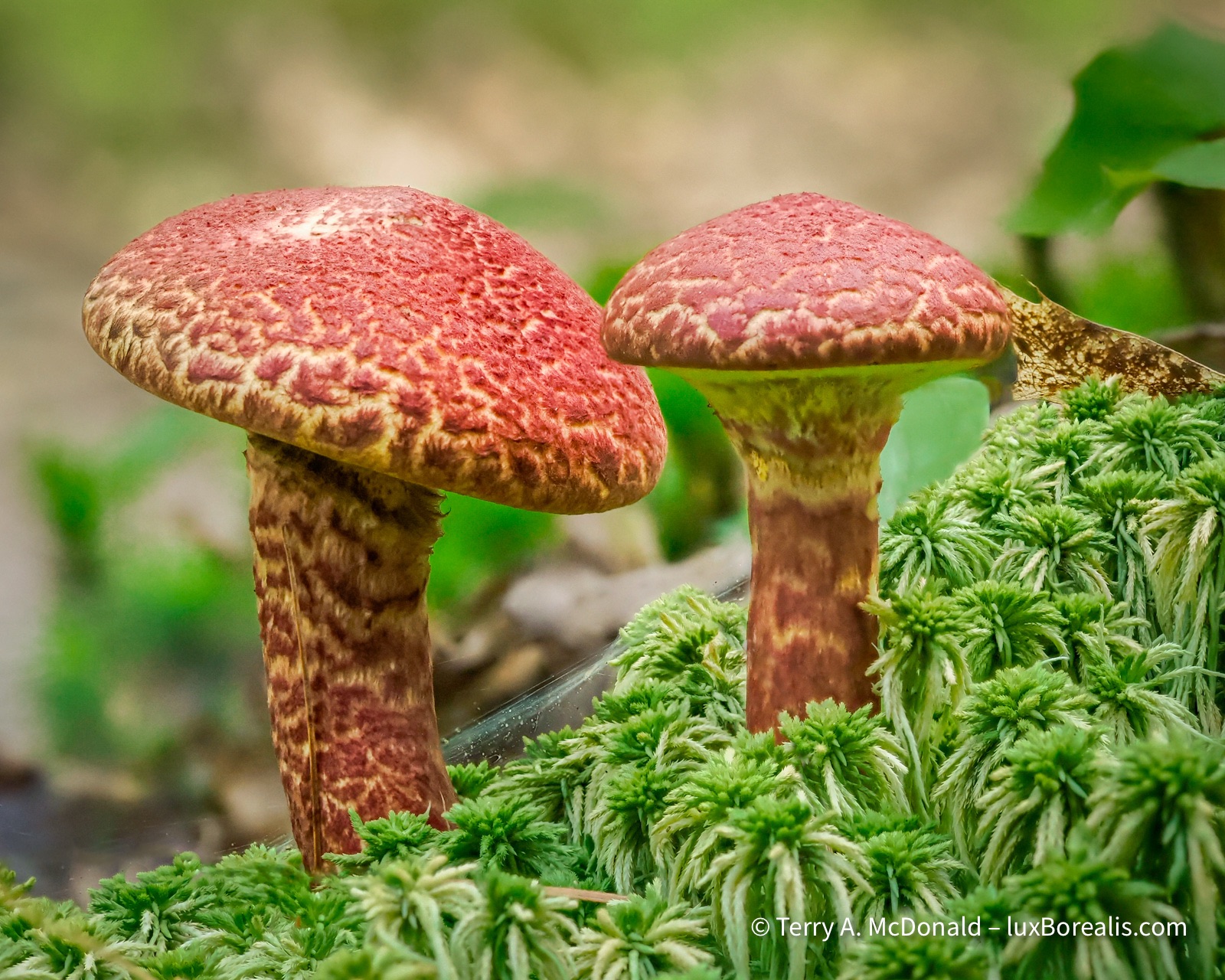
Found in the deep shade along the trail to A.Y. Jackson Lake.
OM-1 | 60mm Macro (120mm efov) | ƒ5.6 @ 1/60 | ISO 200 | 10x in-camera focus stack | Lightroom
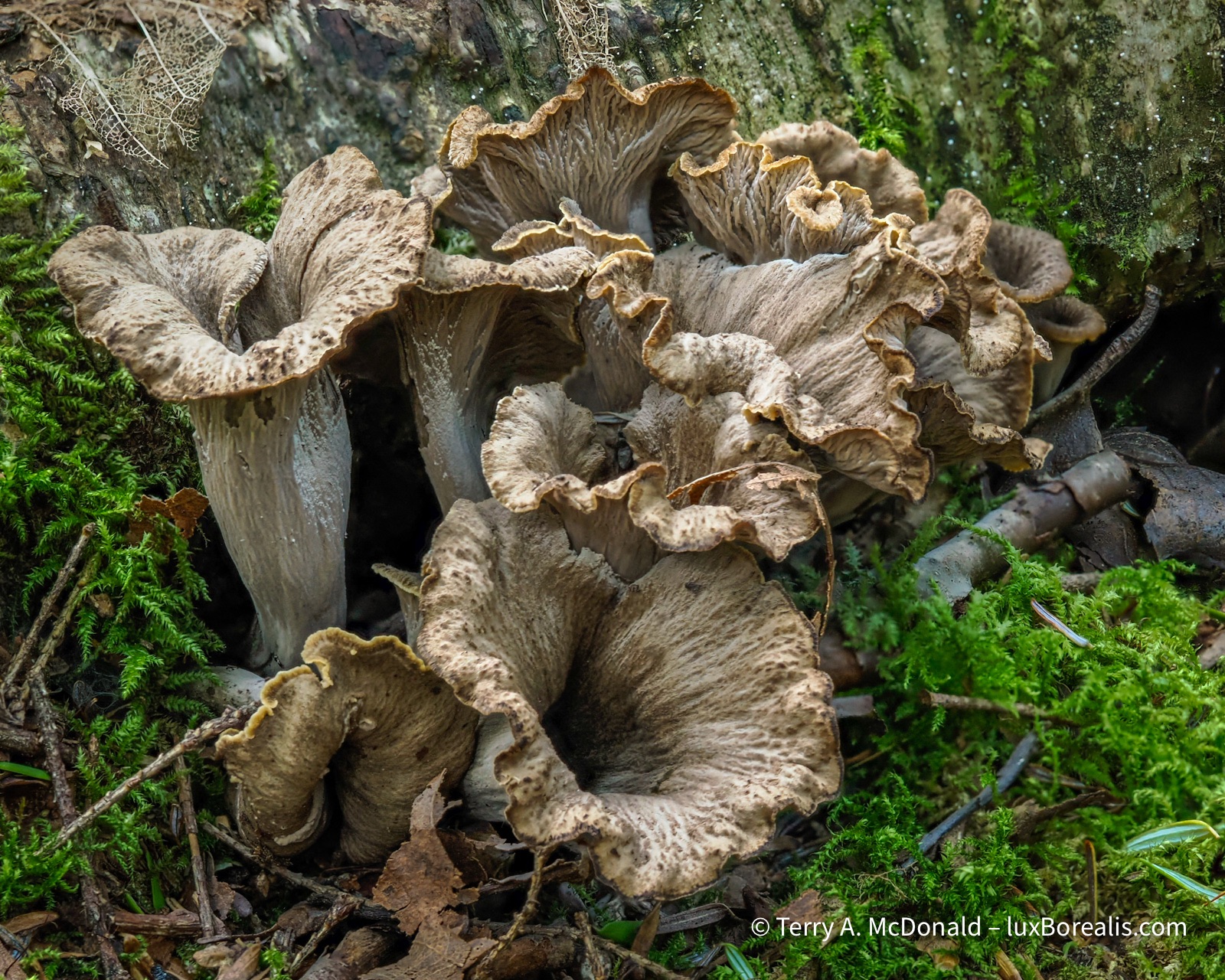
I found these unique fungi along the Lake of the Woods Trail and the Cranberry Bog Trail.
OM-1 | 60mm Macro (120mm efov) | ƒ4 @ 1/50 | ISO 1600 | 10x in-camera focus stack | Lightroom
Aside from determining the names of the different mushroom, the difficulty with mushrooms is that they are at ground level. Despite having a ground sheet, my knees and elbows took a beating. Then, keeping still for 10 consecutive exposures while crouched on all fours isn’t easy! For some, I improvised, resting my hands and the camera on my waist pack camera bag, using it like a bean bag on the ground for support. I’m sure people passing by had a good laugh at this old man with his butt in the air looking at mushrooms!
Using a tripod was certainly an option, but, in the summer heat, I was feeling lazy and didn’t feel like lugging it around with me. Once again, I was pleasantly surprised, shocked even, at how well the internal stabilization of the OM-1 worked. I realize now that I could have (should have) bumped the ISO up for focus stacking to at least 400 if not 800.
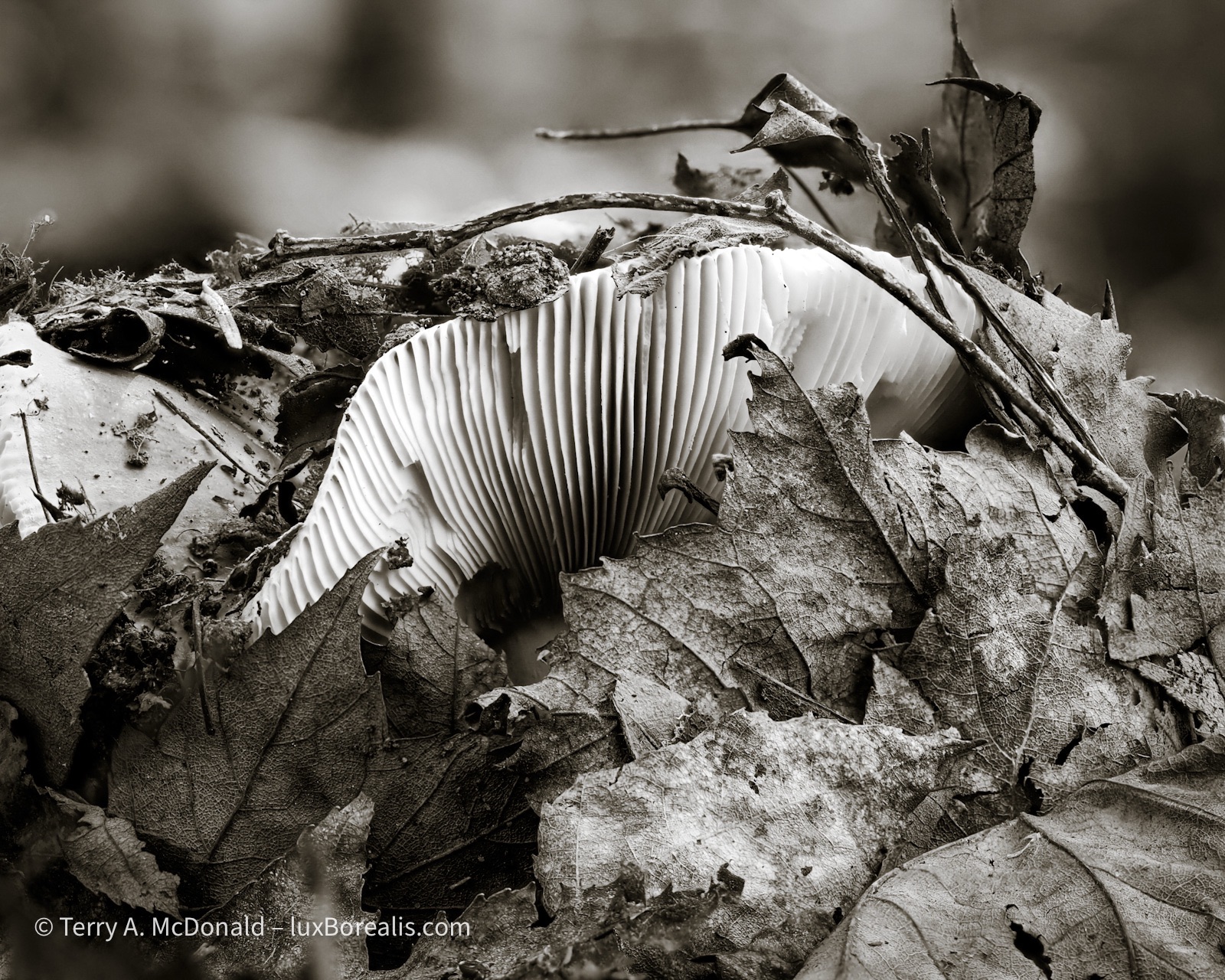
OM-1 | 60mm Macro (120mm efov) | ƒ4 @ 1/25 | ISO 200 | 10x in-camera focus stack | Lightroom
Landscapes lagged behind somewhat. In the early part of the week, we were plagued with high temperatures and humidity, turning the blue skies milky, rather than filling them with fair-weather cumulus. Smoke from western wildfires also contributed to the haziness.
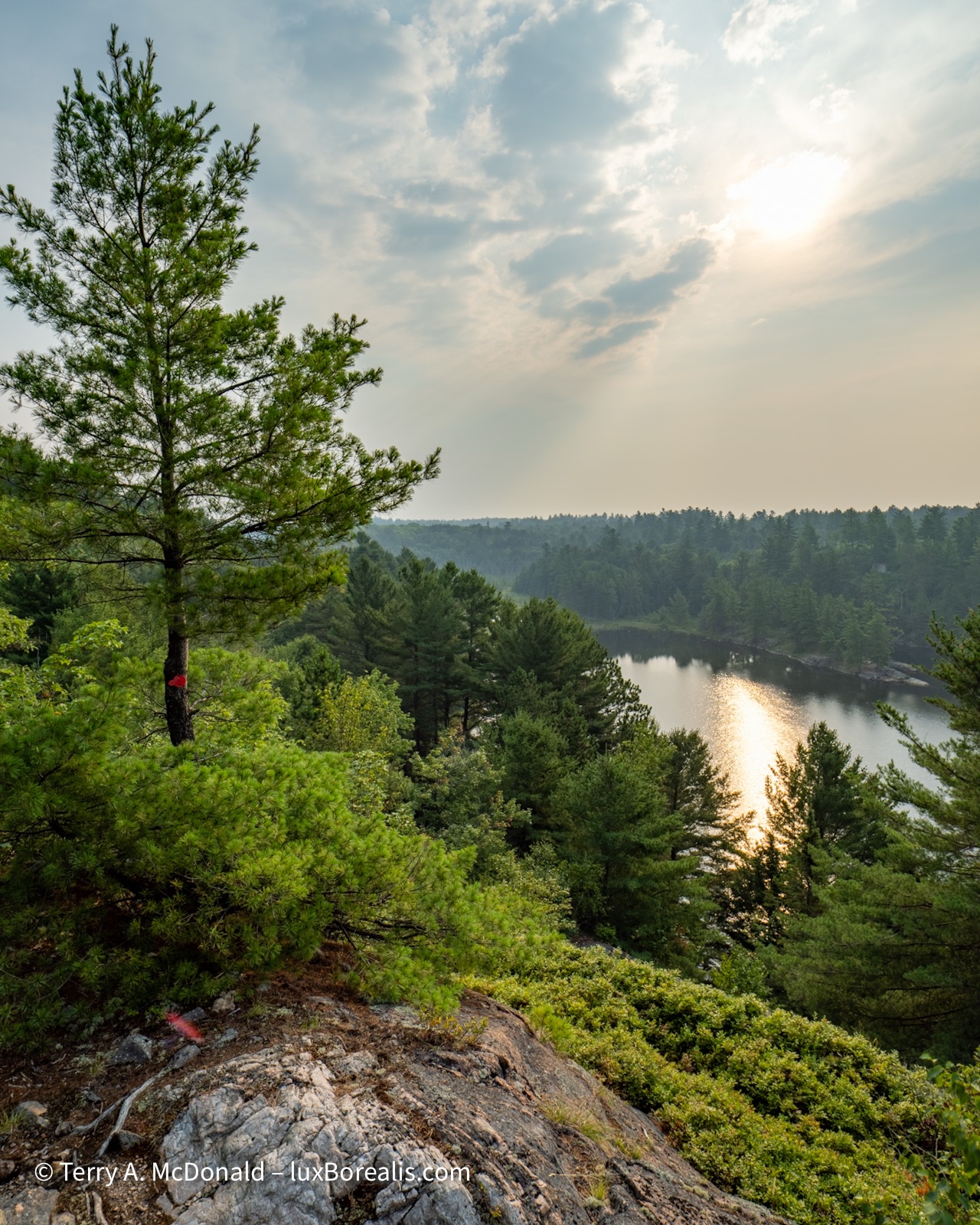
OM-1 | 8-25mm at 10mm (20mm efov) | POL | ƒ5.6 @ 1/250 | ISO 200 | HHHR | Lightroom
From a workshop perspective, things were slow at the beginning of the week. However, after my slide presentation Wednesday evening—Ontario’s Natural Gems: Nature photography in our own backyards— attendance picked up for the Thursday and Friday programmes. We had a great range of abilities—from beginners to seasoned photographers—and cameras—phones, point and shoots, DSLRS and mirrorless—and ages—from under 10 to over 70. The best part was everyone was patient, inquisitive and wanting to put into practice new techniques and new ways of seeing.
OM-1 | 60mm Macro (120mm efov) | ƒ4 @ 1/125 | ISO 800 | 10x in-camera focus stack | Lightroom
I presented each ‘Walk, Talk & Shoot” as an outing dedicated to sketching. Our goal was not to make masterpieces, but rather to discover and make photographic sketches of how light creates shape, texture and colour, and how perspective changes from standing to crouching to putting the camera right down on the ground for a worm’s eye view; how vertical can be made horizontal or even square, and how to zoom using your feet to get closer and closer and closer. I related how I came to this idea of sketching after viewing a sketch book of renowned artist Robert Bateman, during a presentation of his many years ago; it has stuck with me since.
OM-1 | 12-100mm at 28mm (56mm efov) | ƒ5.6 @ 1/40 | ISO 200 | Lightroom
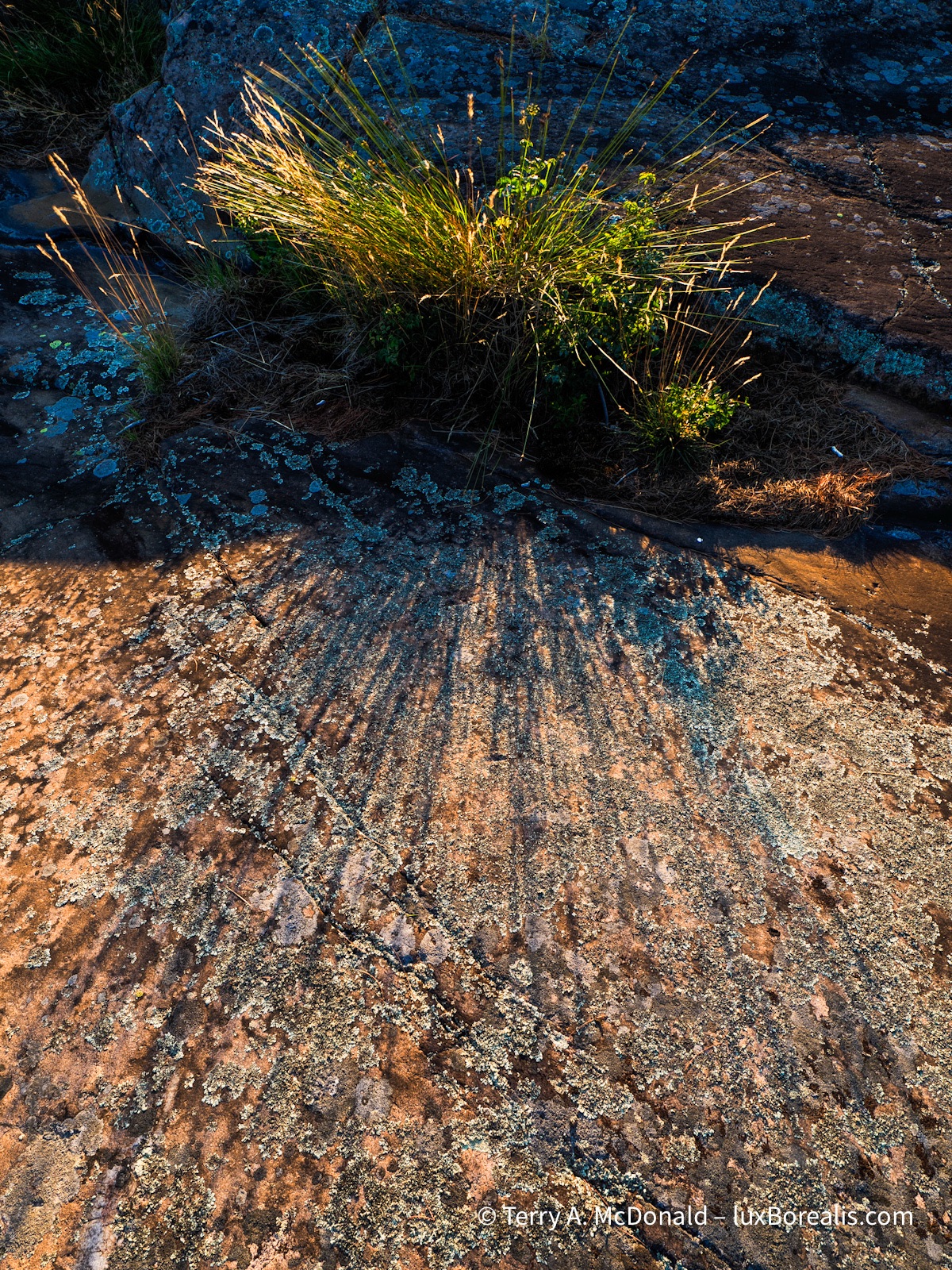
OM-1 | 8-25mm at 9mm (18mm efov) | POL | ƒ8 @ 1/320 | ISO 800 | HHHR | Lightroom
We worked on techniques for phone cameras, as well; for example, rotating the phone upside down to place the camera right at ground level; switching on the Rule of Thirds grid; and using Live Photos set to Long Exposure to capture moving water.
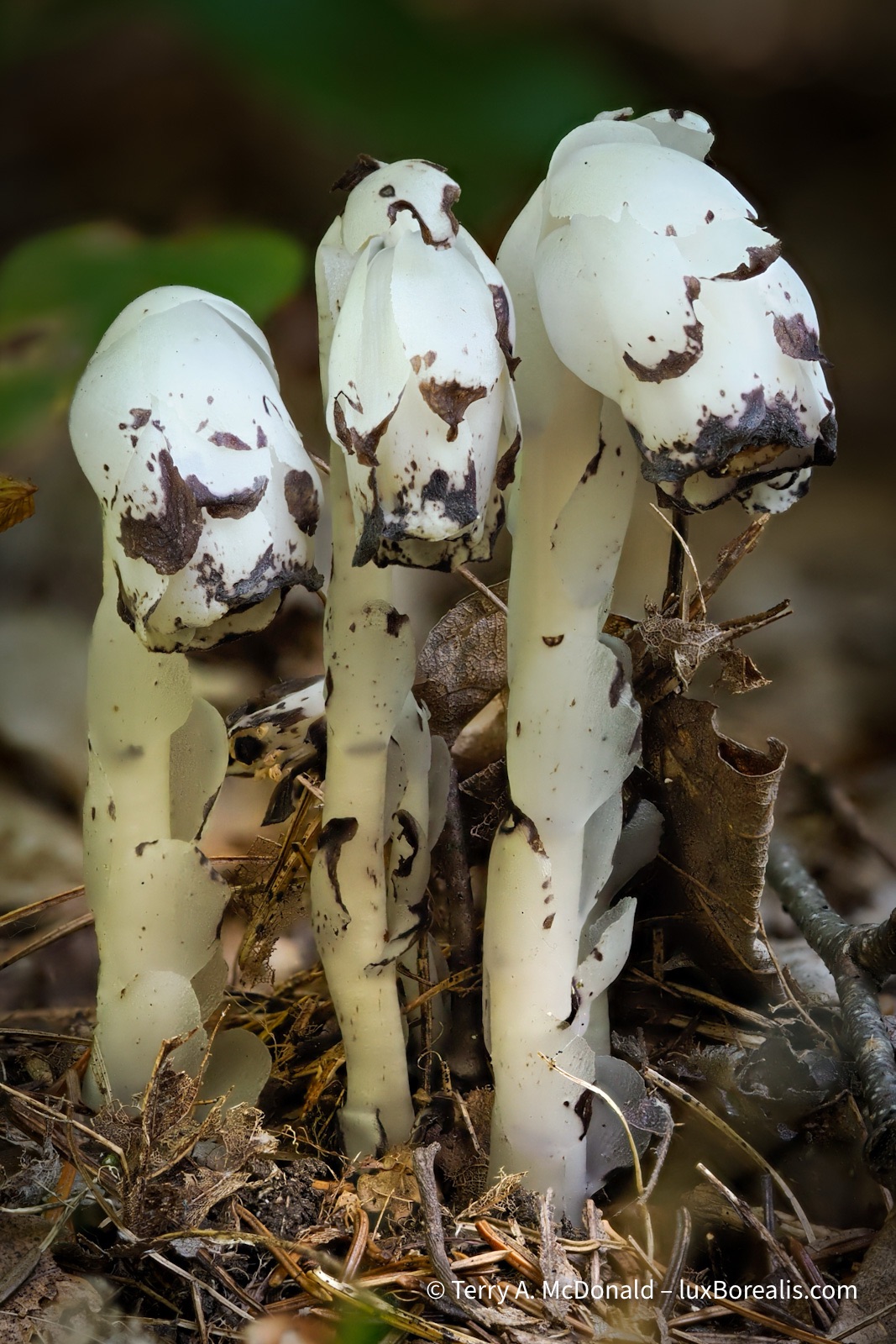
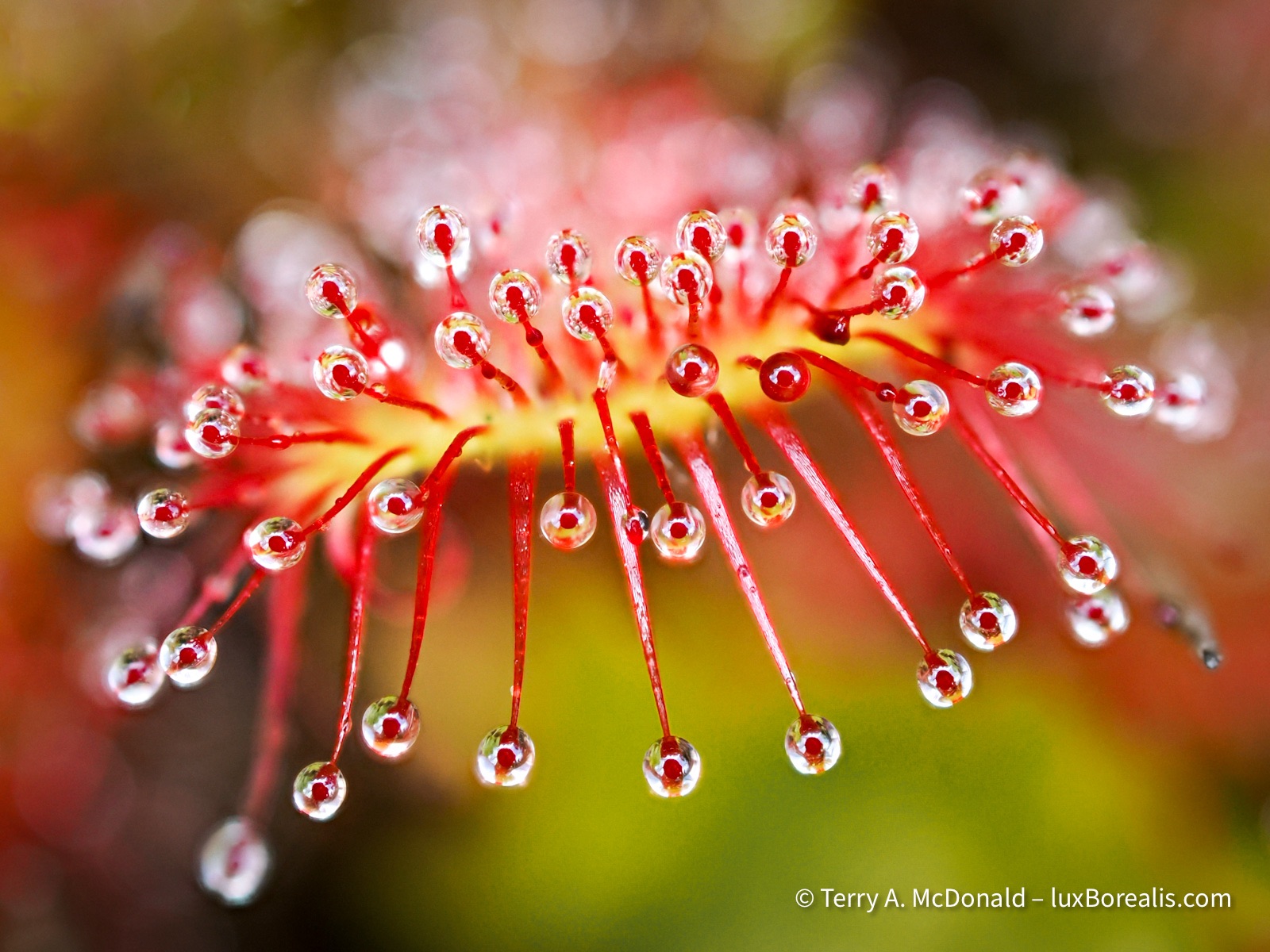
I find it impossible to visit the north and not photograph these unique plants. (Yes, they are plants, not a fungus!)
OM-1 | 60mm Macro (120mm efov) | ƒ4 @ 1/30 | ISO 200 | 10x in-camera focus stack | Lightroom
The added value of the Artist in Residence programme is that it also gives each artist plenty of time on their own to explore the park and their art. I pre-hiked each of the trails my programmes were using, plus I got out to a new trail to me, Lake of the Woods, off the Bell Lake Road.
I also returned to a couple of favourite places: a late evening dash down the Chikanishing River Trail to catch the sun over the water, as well as an evening spent paying homage to A.Y. Jackson at his namesake lake and nearby Lake Sheguiandah, whose cliffs come alive in the late day sun.
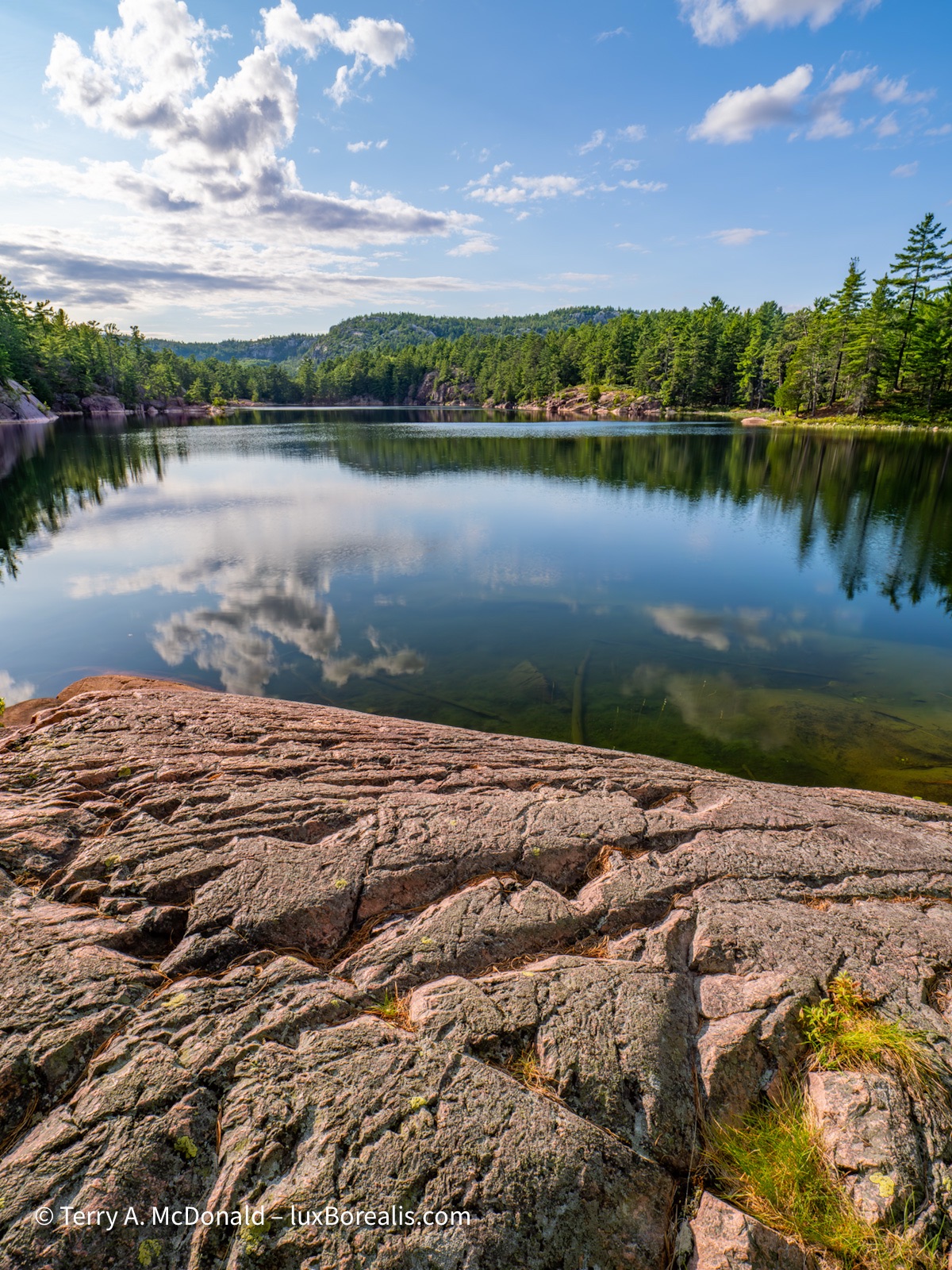
OM-1 | 8-25mm at 9mm (18mm efov) | POL | ƒ11 @ 1/125 | ISO 200 | HHHR | Lightroom
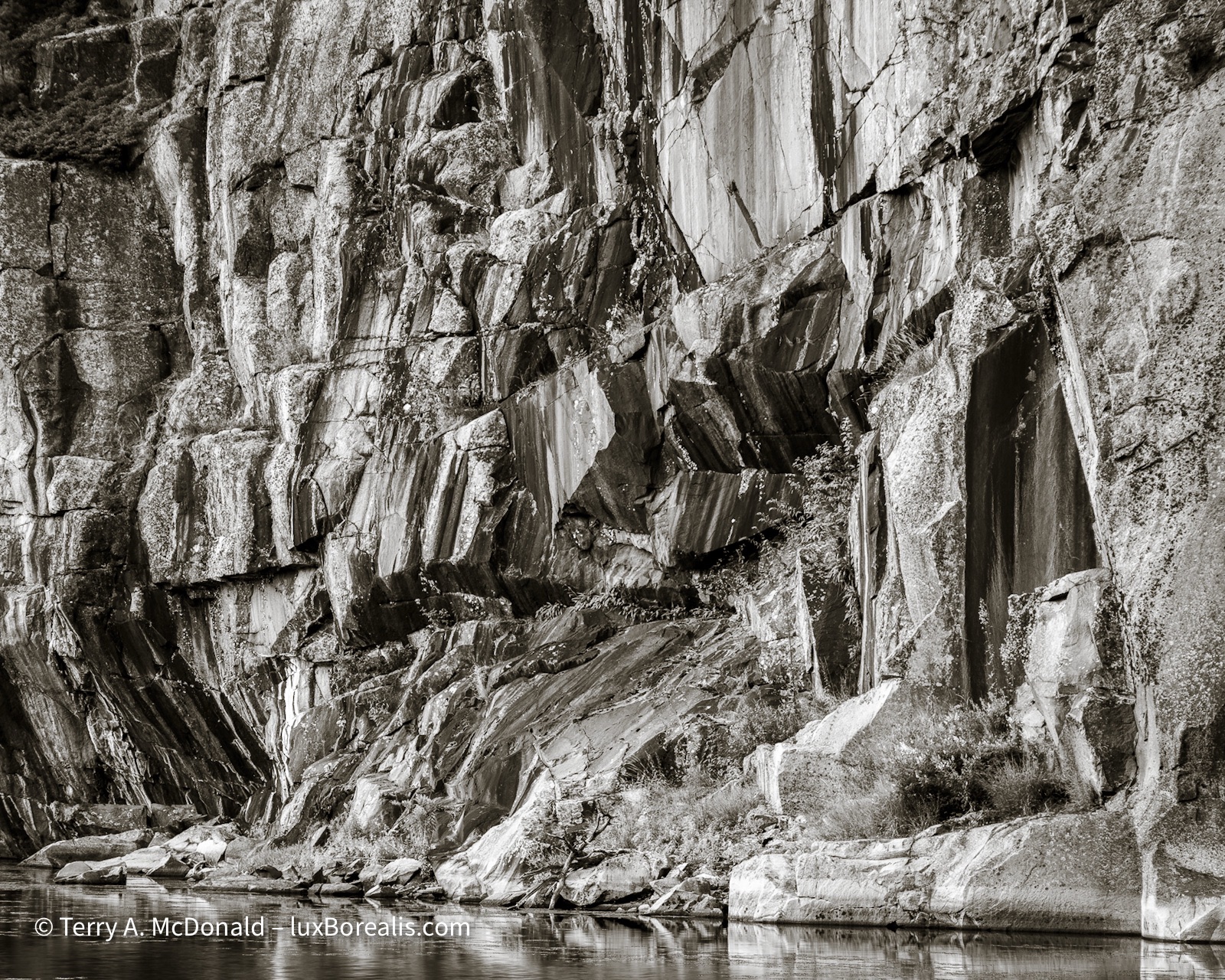
OM-1 w/ 12-100mm at 80mm (160mm efov) | POL | ƒ5.6 @ 1/80 | ISO 400 | Lightroom
Many thanks to Ontario Parks staff and the Friends of Killarney staff for a great week in Killarney Provincial Park and for your helpful insights and guidance. I’d name each of you, but I’m afraid of leaving out one or two, so suffice it to say, each of you made meaningful contributions, for which I am grateful.
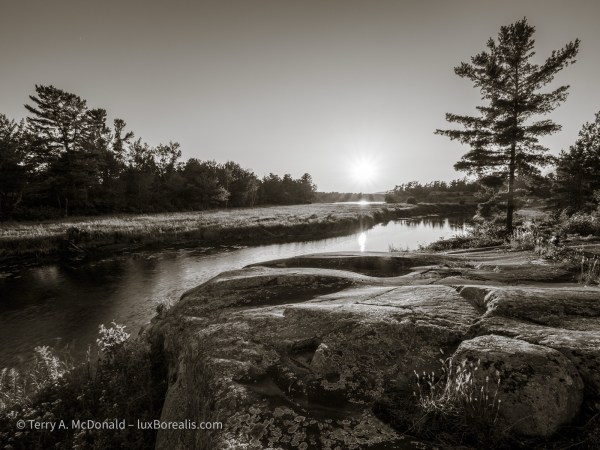
OM-1 | 8-25mm at 8mm (16mm efov) | POL | ƒ8 @ 1/2500 | ISO 800 | HHHR | Lightroom
Thanks for reading! Be sure to add to the discussion with a question or COMMENT about equipment, techniques or locations.
Killarney! Artist in Residence
As of Monday 28 July, I’ll be taking up my post as Artist in Residence for a week at Killarney Provincial Park in Ontario. Organized by the Friends of Killarney Park, I am thrilled and honoured to be their first photographer in the programme.
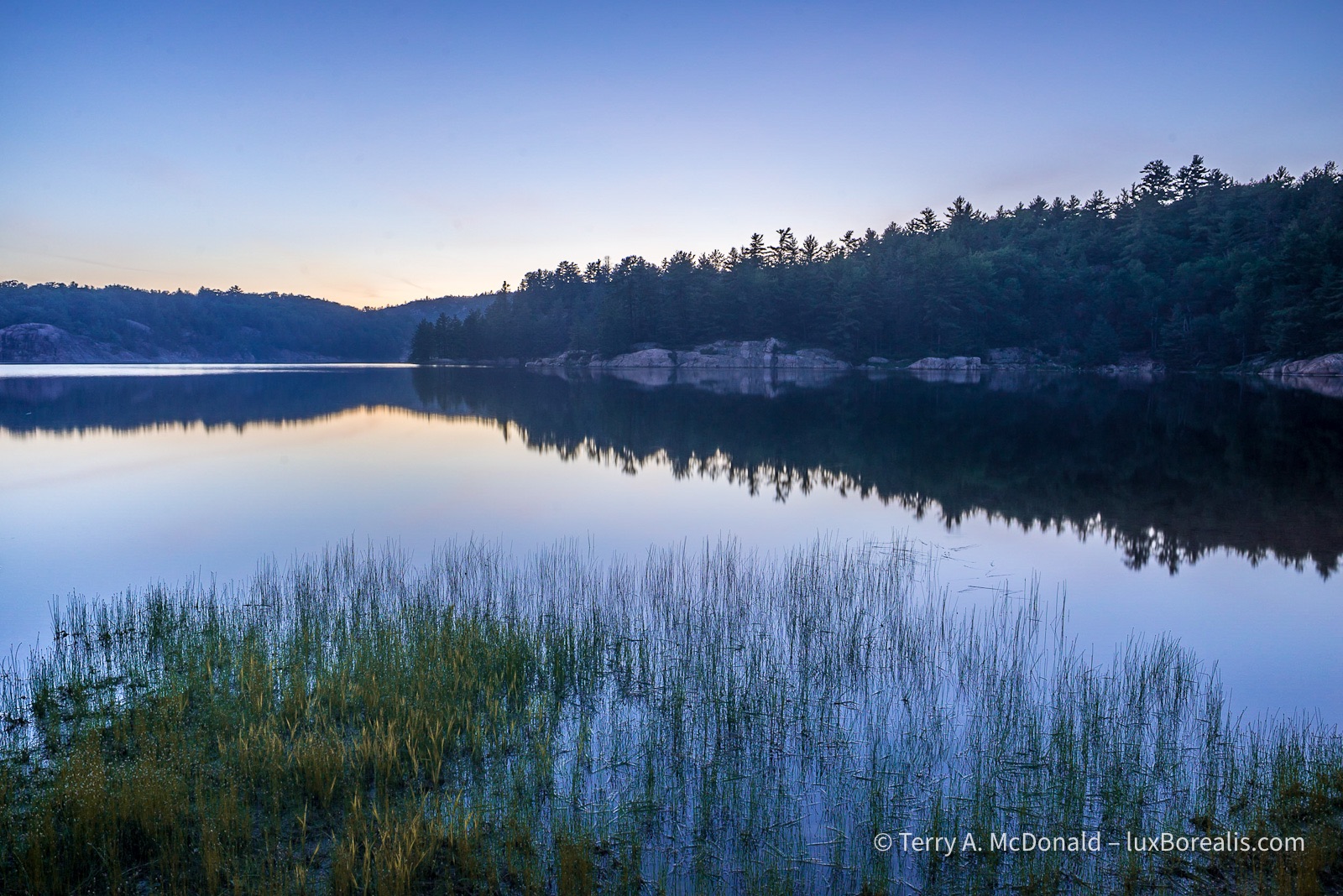
24mm | ƒ11@30sec | ISO 100 | Lightroom
Killarney is one of Ontario’s true gems of a provincial park. It is classic Canadian Shield: ancient rock billions of years old, hundreds of lakes and rivers with a mix of rocky outcrops and hills covered in northern Great Lakes mixed forest, verging on coniferous boreal in places. Killarney began life billions of years ago with what is now the LaCloche range of low white quartzite hills, once the core of mountains higher than Everest is today. A couple of billions years later, the Grenville Orogeny (mountain-building) shoved the pink granite into place along the southern edge of the park, providing the startling contrast of billion-year-old pink granite and 3-billion-year-old white quartzite.
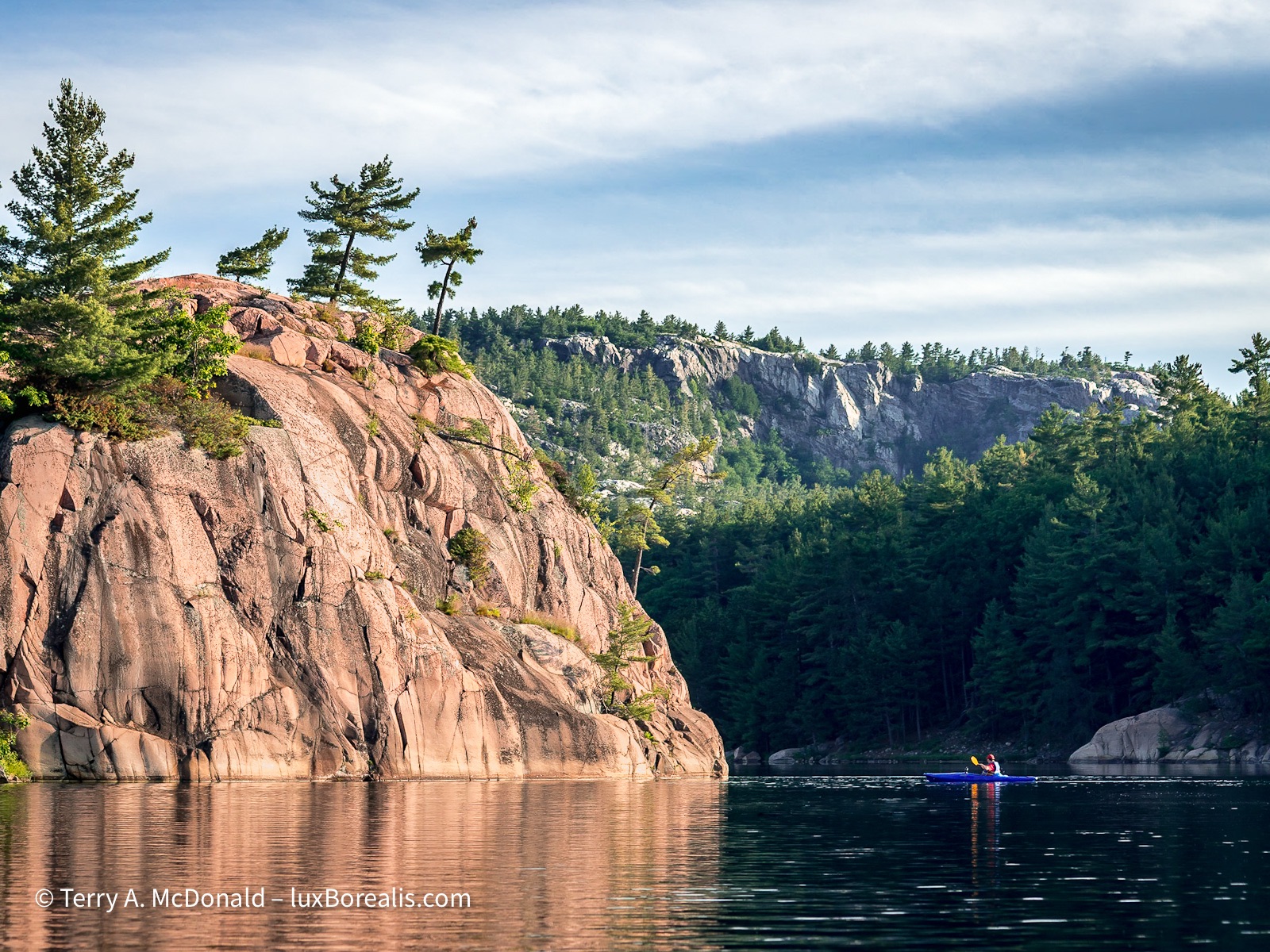
105mm | ƒ 5.6 @ 1/200 | ISO 200 | Lightroom
In the billion years since then, there have multiple and long periods of glaciation which further shaped Killarney: carving deep valleys, polishing the rock smooth in some places and etching the rock in others with chatter marks, deep gouges and smoother scour marks caused by flowing water.
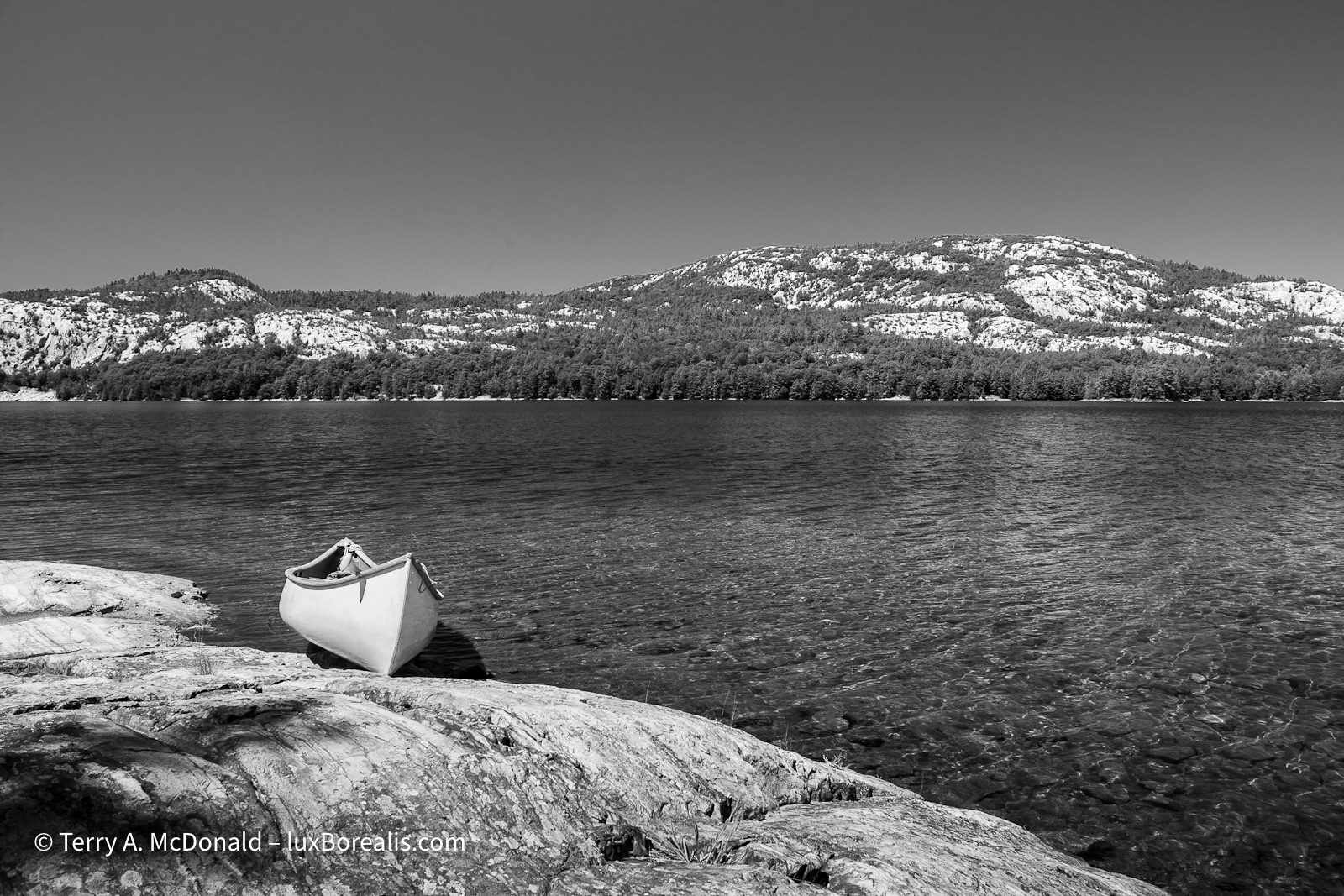
24mm | ƒ11 @ 1/125 | ISO 200 | Lightroom
I’ve visited Killarney a number of times over the decades, twice in the depths of winter. Between the biota and the landscapes, there is always more than enough to keep an outdoor photographer busy. This goes right back to the Group of Seven. A.Y. Jackson along with members of the Ontario Society of Artists lobbied the Ontario government for protection, which was achieved in 1964.
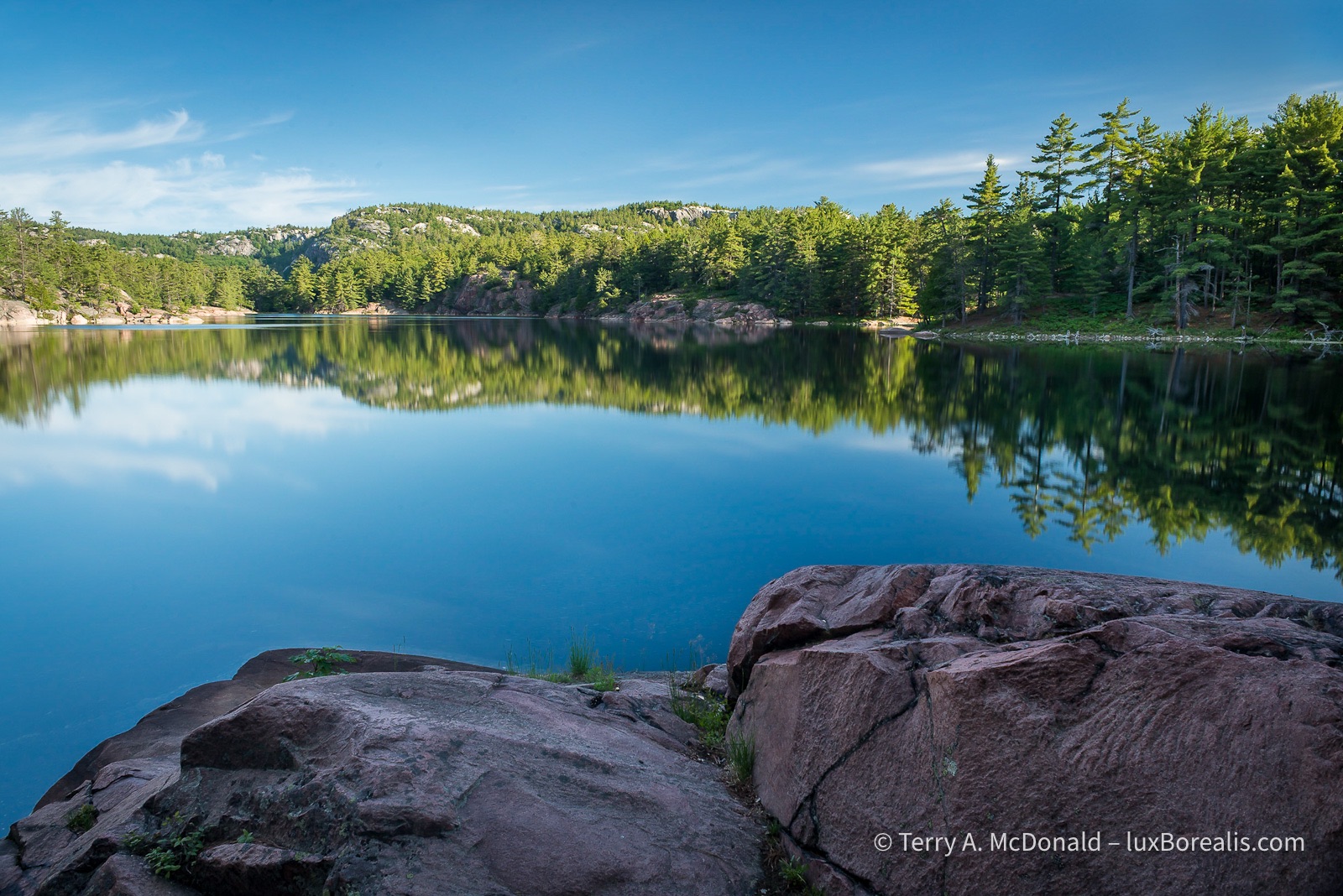
24m | ƒ16 @ 5sec. | ISO 100 | Lightroom
Sadly, some of the lakes still feel the effects of ‘Acid Deposition’ (a.k.a. Acid Rain) from the 1960s and 70s. Emissions from the Sudbury Superstack and coal-fired generating stations wreaked havoc throughout the region. The lakes are perfectly clear and blue due to the lack of biota and fish in the lakes.
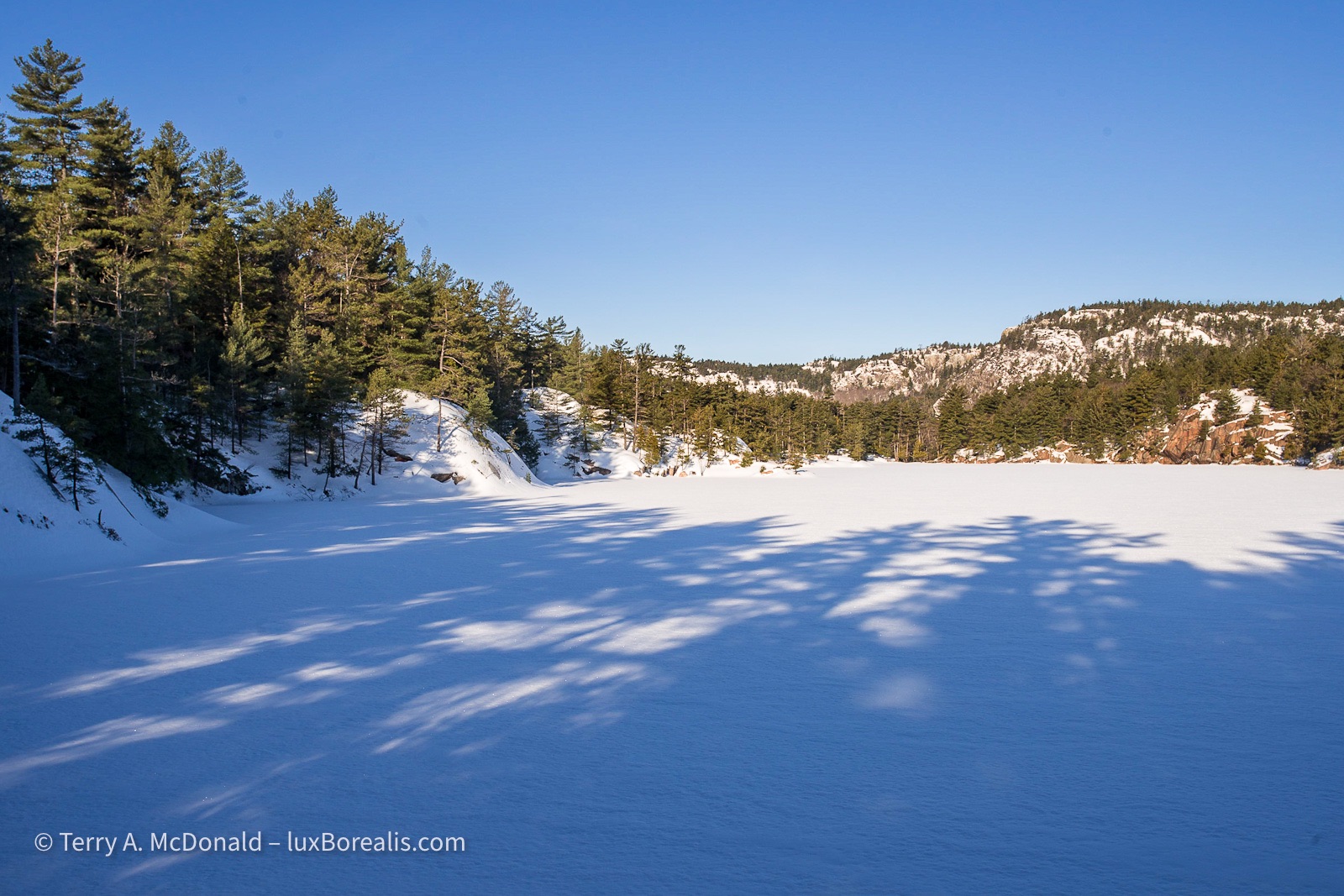
35mm | ƒ11 @ 1/160 | ISO 100 | Lightroom
Artist in Residence
Each of the outings (see below) will be an informal “Walk, Talk & Shoot” session. We’ll take advantage of photo ops along the way for instruction and guidance, with a bent towards nature, outdoor and landscape photography. The goal won’t be finishing the trail but rather capturing some engaging photographs. We may go 500m, we may only go 5m—it all depends on what there is to photograph.
The programme is as follows:
- Monday, 10am to Noon: We’ll meet at the Nature Centre and have a look along the Trout Creek Trail + bridge over to start of La Cloche Trail;
- Tuesday, 10am to Noon: We’ll meet at the Main Gate and Walk, Talk & Shoot along the Granite Ridge Trail
- Wednesday, 7pm at the Amphitheater: I’ll be presenting Ontario’s Natural Gems: Nature and Outdoor photography in our backyards—an inspirational look at photographing the beautiful places close to home
- Thursday, 10am to Noon: We’ll meet at Second Beach to discover photographic gems along the Cranberry Bog Trail
- Friday, 10am to Noon: We’ll meet at the Nature Centre and have a look along the Trout Creek Trail + bridge over to start of La Cloche Trail;
Everyone is welcome, though I’m sure there is a sign-up list at the Park Office. On a personal note, I’m greatly looking forward to meeting people who want to take their photography further. Photography is all about seeing, so, whether it’s a phone camera, a DSLR, mirrorless or a point-and-shoot, the best camera is the one that’s with you!
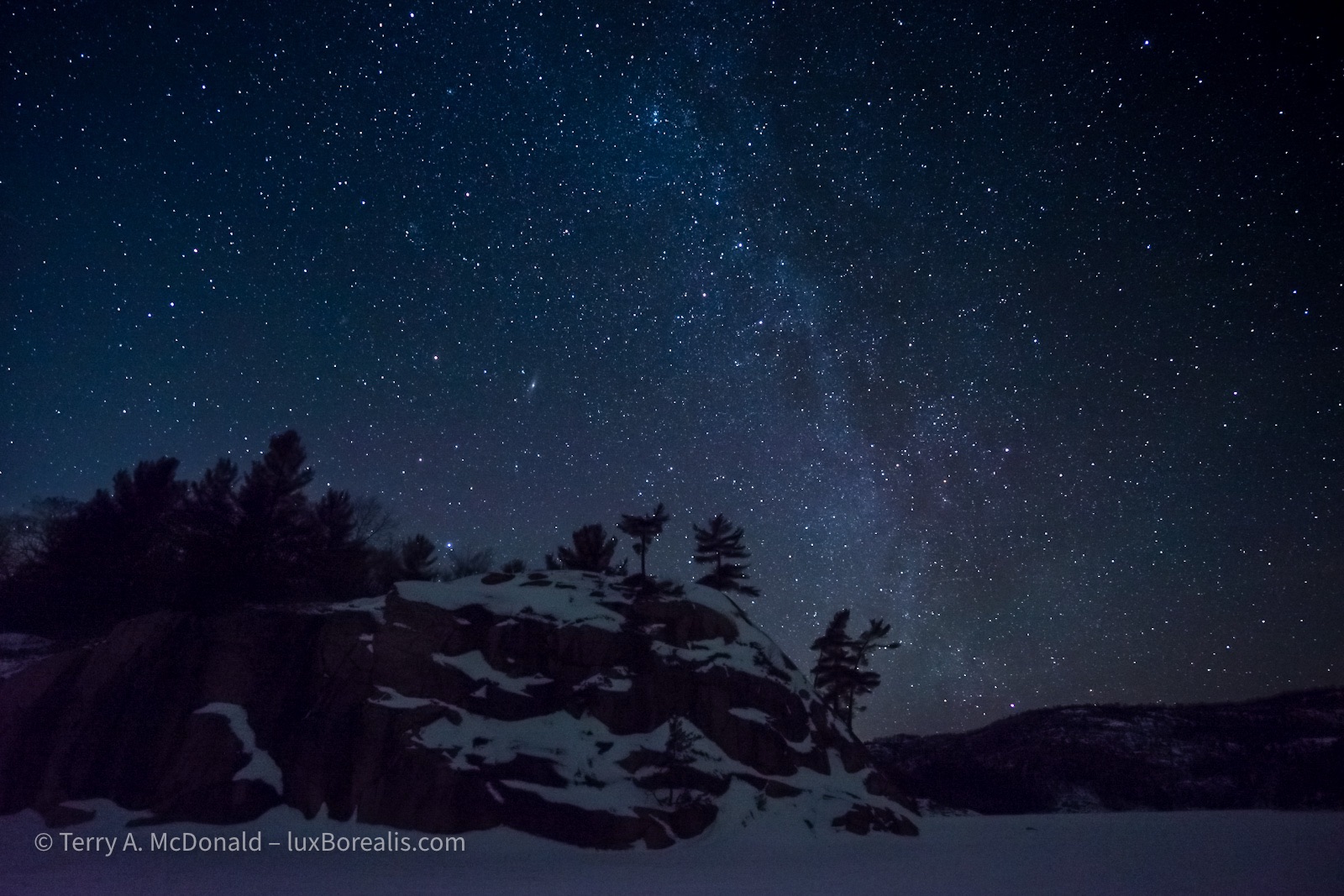
18mm | ƒ4@15sec. | ISO 3200 | Lightroom
I’m also looking forward to discovering Killarney in the summer, from the early morning blue and golden hours, right through to the dead of night. Yes, that includes working on some astrophotography. I’ll be working on both colour and black-and-white photographs, as always, trying to capture the essence of place and the art inherent in nature.
So, join me at Killarney!
Recommended reading:
Killarney GeoTour (OMNRF PDF): I find that the more I know about the place I’m photographing, the more meaningful and informed my photographs are. This an excellent overview of how the landscape of Killarney became what it is today.
Killarney’s Beating Heart: The Park Which Painters Saved: Blog Post by Zac Metcalfe
PhotoGeo Trip Down East: Part 6 – Fundy
2453 words; 13-minute read
My trip is winding down. This is the last ‘photo stop’ and it has proven to be a good one.
Fundy National Park is yet another gem of a Canadian park. Thick Acadian forests, sheer cliffs plunging into the Bay of Fundy, vast tidal flats, sometimes fog, and always, the world famous tides—the highest in the world. Given the twice daily rise and fall of 10m or more, you can imagine much of life here is driven by the tides.

OM-1 | 25mm | ƒ8 @ 1/200 | ISO 200 | Lightroom

OM-1 | 21mm | ƒ5.6 @ 1/250 | ISO 200 | Lightroom
Just like the changes from summer to winter and back again, tides dramatically change the landscape. As the tide recedes, wide, muddy-brown rivers become narrow, clear streams with lots of empty real-estate on either side. Beaches can completely disappear at high tide only to be converted to hundreds of metres of red mud flats at low tide.

OM-1 | 25mm | ƒ8 @ 1/500 | ISO 800 | HHHR | Lightroom

OM-1 | 34mm | ƒ5.6 @ 1/640 | ISO 400 | TripodHR | Lightroom
For photographers, this daily change is both a blessing and a curse as much depends on how the tides line up with state of the weather and the time of day. You can make your luck, but as the photos will show, the stars aligned on my behalf.

OM-1 | 17mm | ƒ5.6 @ 1/500 ISO 200 | Tripod HR | Lightroom
Sackville Waterfowl Park
On my way to Fundy, I stopped overnight in Sackville at the old and charming ‘Marshlands Inn’. In its heyday, Marshlands catered to the well-heeled. As I messaged back home, “Given its dated furnishings and decorations (our grandparents would approve), I was thinking it would be a great place for a murder mystery à la Jessica Fletcher, but I may be the only guest at dinner!” And sadly, I was. They have a wonderful, plush restaurant that served the best seafood platter I had the whole trip.
The next morning, down at the Waterfowl Park, I was curious to see how things changed over the few weeks since Dan and I had visited. How is the grebe nest doing? Are the songbirds still as active?

OM-1 | 400mm | ƒ8 @ 1/800 | ISO 3200 | Lightroom

OM-1 | 400mm | ƒ8 @ 1/250 | ISO 3200 | Lightroom

OM-1 | 400mm | ƒ8 @ 1/640 | ISO 3200 | Lightroom

OM-1 | 400mm | ƒ8 @ 1/640 | ISO 3200 | Lightroom
The grebe nest was doing quite fine with five hatchlings that are already taking to the water. Mom and dad are very busy going back and forth finding food and feeding the youngsters.
The swallow was equally busy, but the songbirds were more elusive, with only a Cedar Waxwing and fledgling Red-winged Blackbirds putting on a show.
Cape Enrage
In the afternoon, I arrived at Hopewell Rocks Provincial Park, one of the premiere places on the east Coast to get a real sense of how significant the tides are. It’s billed as a place to ‘Walk on the ocean floor’ and you can, twice a day, provided low tide occurs during opening hours. Wisely, the entrance ticket is for two days, so you can come back and see Hopewell at high tide.
However, it is 30 June and it is a gorgeous day. The multiple parking lots, while not full, indicated the heaving mass of people that were enjoying the park. I took a pass, reserving it for tomorrow, Canada Day, even busier, yes, but I doubt first thing in the morning. Low tide is at 11:38am, so arriving by 8:30 should place me on the sea floor before the crowds.
Instead, I headed for Cape Enrage, about halfway between Hopewell and Fundy. How could I not visit Cape Enrage. The name alone is worth the drive. I had visions of monstrous waves pounding the shore cliffs, sending huge sprays of sea foam skyward. Sadly, that wasn’t the case. I guess it helps to have an imagination.
Not only was it a $10 charge to go into the private park, it was late in the day and I was feeling too cheap to pay that much for an hour of photography. So I went to the cobble beach outside the park and was not disappointed. While there were no huge breakers, there were still dramatic cliffs and boulders, which inspired me to get out the tripod and get my feet wet.

OM-1 | 12mm | ƒ11 @ 1.3sec | POL | LiveND64 | Tripod | Lightroom
I used the polarizing filter to reduce sky glare from the water. ISO 100 was chosen to reduce shutter speed further than ND64 allowed.
That’s the thing about high tides—they rise very quickly. After all, a 10m tide still has only 6 hours to come in—that’s about 1.5m an hour or 9” per minute! No sooner had I set up and made a few exposures, trying to catch the movement of the water at just right instance, when the waves, pushed by the rising tide, were suddenly around my feet and covering the very rocks I was photographing. Even when I took into account the rising waters, I was still caught short two or three times! Oh well, good fun!
Behind the multiple mounds of cobbles, built up as raised beaches from the various heights of tides, I found an oasis of green in these beach peas. The greens seemed so bright and full of life compared to the masses of grey cobbles along the beach.

OM-1 | 12mm | ƒ11 @ 1/400 | ISO 3200 | Lightroom
The photographer’s conundrum: this scene demanded a great depth-of-field, yet I couldn’t use focus stacking because of the wind. ƒ11 covered the depth, but at ISO 200, a shutter speed of 1/25 was too slow. In the film days, this shot would have been an impossible 1/6 using ISO 50 Fujichrome Velvia! Enter the amazing quality of OM-1’s sensor producing superb quality even at ISO 3200, helped along with Lightroom’s Noise Reduction. Problem solved.
On the way to Fundy, I found a couple of scenes that captured my imagination.

OM-1 | 12mm | ƒ8 @ 1/500 | ISO 800 | TripodHR | Lightroom
This is not a reflection of the East Coast in general as there are plenty of new builds in, for example, Moncton, near where this photograph was made. Rather, my intent was to capture the change in the region as people leave the more rural areas behind for towns and cities.

OM-1 | 17mm | ƒ5.6 @ 1/400 | ISO 800 | TripodHR | Lightroom
I will never turn down fog for creating mood. Add in the sun, in its attempt to break through, and a whole new dynamic is created. All I needed was a foreground, supplied by the Salmon River at Alma.
After setting up my campsite, I went back down into Alma for a delicious seafood dinner at The Boathouse —highly recommended, not as fancy as some of the other restaurants, but great food. I made a few evening photographs along the river then packed it in early, hoping the clear skies above the fog would continue through the night.

OM-1 | 100mm | ƒ5.6 @ 1/250 | ISO 400 | HHHR | Lightroom
Fingers of Fundy fog reach inland, up the valleys between the hills.
Canada Day

OM-1 | 100mm | ƒ9 @ 1/2 | ISO 200 | LiveND | Lightroom
I’m beginning the celebration of my 63rd Canada Day at Fundy National Park by capturing some iconic Canadian landscapes. My day started at 1:30am to pursue some Astrophotography. Arriving at the Fundy Viewpoint, I was bewildered by hundreds of fireflies, their bright green pulses lighting up the field below. They were magnificent and I knew they had to be a part of what ever photograph I made.

OM-1 | 9mm | ƒ2 @ 15sec. | ISO 3200 | Tripod | Lightroom

OM-1 | 9mm | ƒ2 @ 40min | ISO 400 | LiveComp | Lightroom
The red chairs? They are a trademark of sorts of Canada’s National Parks. Red chairs have been brought into a number of significant viewpoints in all the parks and have become an icon.
After a few hours of sleep, I was up again, at 6am, this time to the sound of two of our favourite songbirds: a Junco, who spends every winter with us in Guelph, and a White-throated Sparrow, known for its song, “Oh, sweet Canada, Canada, Canada”
Then I was back to the Fundy Viewpoint enjoying brilliant sunshine gleaming over a fog-filled Bay of Fundy.

OM-1 | 100mm | ƒ5.6 @ 1/2000 | ISO 200 | HHHR | Lightroom
The heavy fog didn’t bode well for the sea coast, which was my next destination. By 6:30, I was down at Wolfe Point to check out the covered bridge where the views were just opening up. With the fog playing tag with the morning sun, the conditions were hit-or-miss. I managed a couple of ‘hits’.

OM-1 | 25mm | ƒ5.6 @ 1/320 | ISO 800 | HHHR | Lightroom

OM-1 | 24mm | ƒ5.6 @ 1/400 | ISO 800 | HHHR | Lightroom
By the time I reached Herring Cove the fog had receded somewhat, giving way to direct sunlight—a real challenge, which demanded careful exposure. Knowing there was additional dynamic range with HHHR mode, I was able to tame the brightness and maintain open shadows while keeping the offshore fog in balance. Too many internet pundits just don’t understand how versatile and capable the OM sensor is!

OM-1 | 12mm | ƒ8 @ 1/640 | ISO 200 | HHHR | Lightroom

OM-1 | 12mm | ƒ8 @ 1/1250 | ISO 200 | HHHR | Lightroom
By now, the tide was receding quickly—about 20m of beach was exposed in half an hour—so I decided to forego breakfast and head straight to . . .
Hopewell Rocks
I arrived around 8:30am, not long after opening but before the Canada Day rush. Hopewell is such an engaging place. It’s a unique experience wandering around one of the wonders of nature, seeing first-hand the erosive force of the tides and the fascinating sculpted sea stacks. The provincial park is well-organized to receive thousands of visitors without feeling overly touristy. Credit for that goes to the wide stone dust paths (not paved!) and the excellent interpretive centre which provides geographical and geologic context to the tides, the sea stacks and the Bay of Fundy itself.
Along the 750m trail from the entrance to the grand staircase down to the sea floor, there were a few view points. This photo is from one of them. And yes, they really are Peregrine Falcons.

OM-1 | 100mm | ƒ5.6 @ 1/640 | ISO 200 | HHHR | Lightroom
Unexpectedly, one of the first images I made down on the sea floor was almost identical to one I made 15 years earlier: the ‘classic view’, I guess.

Olympus E-30 | 20mm | ƒ11 @ 1/100 | ISO 200 | Lightroom (12MP file).
Despite being a few techno-generations old, this file stands the test of time.

OM-1 | 12mm | ƒ5.6 @ 1/800 | POL | ISO 800 | HHHR | Lightroom (25MP file cropped from 50MP)
Importantly for me, I managed to make a number of significant landscape photographs before and after the fog had lifted and before the crowds forced me back up the stairs. It was still hours before the rising tide would close over the ocean floor, forcing everyone back up.

OM-1 | 12mm | ƒ11 @ 1/320 | ISO 800 | HHHR | Lightroom

OM-1 | 24mm | ƒ11 @ 1/320 | ISO 800 | HHHR | Lightroom
Back at the car, I had a picnic breakfast then was off back to Fundy with a couple of stops along the way to check out places I had stopped at the day before. So far, the day was going well but I still wanted to get to another favourite, Dickson Falls. With tomorrow and Thursday being driving days, and wanting to make the most of today, I had a quick snacky lunch followed by some downloading and editing at my campsite and, by this point, a nap.
By 4pm, I was thinking that if I want dinner and some photography, I’d better get down to the Boathouse, eat first, then have the rest of the evening for photography. Perfect. Before it got busy with the Canada Day crowds, I had my last fresh seafood dinner back at the Boathouse, then was off to Dickson Falls.
The Acadian forest in Fundy is so lush with bright green ferns and moss in abundance and Dickson Falls shows it off well, Once the morning fog had burned off, we were in bright sunshine. The last thing I wanted were contrasty shadows, so I was pleased to see some cloud roll in.
However, I hadn’t planned on it raining! Halfway through my exposures, a gentle rain began then tapered off, only to increase again. Worse, I had left my tent open for airing and some of my equipment out. Oh well. I wasn’t going to rush my time here in this beautiful forest.

OM-1 | 20mm | ƒ5.6 @ 2sec. | ISO 200 | TripodHR | Lightroom
The only trouble with Dickson Falls—from a photography point of view—is the boardwalk. Not only is extensive as it wraps its way around the falls and up the other side, forcing difficult compositions to exclude it, the boardwalk bounced every time someone walked close by. And, as it turned out, I wasn’t the only one enjoying an after-dinner stroll down the many steps to the falls. I lost count of how many times I had to pause what I was doing until everyone had passed by and the boardwalk settled back down.

Now wet, but elated with the Dickson Falls experience, I headed back to my campsite to begin drying out. The next morning, I stuffed the wet tent and fly into its stuff sack and was on my way westwards, back to southern Ontario, by 6:45am.
With a good Anthony Horowitz detective audiobook playing and the 16 hours of driving up the St. Lawrence split over two days, I was good to go.
Looking back, I can only see successes. Sure, not everything worked out perfectly, but I was in the right headspace to create, what are to me, some very memorable photographs that capture the essence of place and the art inherent in nature.
Thanks for reading. Please continue the discussion by adding your questions, comments and observations to the COMMENTS section. As well, I invite you to SHARE this post with others.

OM-1 | 210mm | ƒ11 @ 1/100 | ISO 3200 | HHHR | Lightroom
PhotoGeo Trip Down East: Part 5 – Cape Breton Highlands
2,283 words, 12-minute read time.
Wow! I’d forgotten how beautiful the Cape Breton Highlands are: steep-sided, glaciated flat-topped hills with deep valleys, green with mixed forests plunging down into an ocean so clear and blue. Geologically it’s a smorgasbord of pieces of Earth’s crust jammed together over the last billion years: ancient Canadian Shield in the northwest from the formation of the Laurentians; part of a volcanic belt formed off South America in the centre; and a section of a volcanic belt from what is now North Africa in the southeast; along with a smattering of granitic plutons from 500mya.

an overview
As Captain Kirk would say, ‘Fascinating, Jim.’
Okay, I know, TMI. But you must admit that it’s cool to be at the epicentre of where the North American plate and the Eurasian Plate and the African Plate repeatedly smashed together to form first the supercontinent of Rodinia, then the supercontinent of Pangaea and the Appalachian Mountains, with all these bits of continents and volcanic arcs thrown in for good measure, followed by the subsequent rifting, about 200mya that produced what is now the Atlantic Ocean. Yes, truly fascinating. A billion years worth of continental drift in one sentence! FMI, see Parks Canada’s excellent web page describing these processes. Or, try it yourself at this website—simply enter ‘Sydney, Nova Scotia’ and use your cursor keys to navigate through time.

OM-1 | 20mm+POL | ƒ5.6 @ 1/200 | ISO 200 | HHHR | Raw | Lightroom
After all the crashing around of plates, this scene is simply bucolic.
But what does this have to do with photography?
I’m making landscape and nature photographs. I simply can’t divorce the geography and geology from what I’m seeing and what I’m making of what I see. Both the landscapes and the photographs somehow feel more real when I can connect the natural processes going on around me with the images I’m making—and vice versa.
Of course, the objective viewer couldn’t care less (other than Geo-Geeks like me, my wife Laura, and my friend Dan with whom I started this journey a few weeks ago). In other words, in the minds of the viewing public, the processes that formed the landscapes are irrelevant. Yet, being informed and interested about how these places came to be may just be the little extra that helps me to ‘see’ the photographs I’m working to create.

Made after sunset using LiveND
OM-1 | 12mm | ƒ4 @ 0.8sec | ISO 800 | Raw | Lightroom
Change is still happening as the landscape is further weathered and eroded, day-in, day-out, year-in, year-out.
I’m making portraits of Earth. The first rule of making intimate portraits is to know your subject. Celebrated Canadian portrait photographer Yousef Karsh knew this well. ‘Yousef Karsh?’ you ask. Whether you’re shooting landscapes, nature or portraits, his work, his methods and his career are all well worth studying. Not only that, but as an addendum to my previous post, Africville, Karsh was a refugee from the Armenian genocide, arriving in Halifax in 1923 at the age of 15 and went on to become a portrait photographer sought by the well heeled the world over. Fascinating!

The kaleidoscope of colours reflects the very long and tumultuous journey these rocks have made over the last 500 million years.
OM-1 | 47mm+POL | ƒ5.6 @ 1/250 | ISO 3200 | Raw | Lightroom
Perhaps it’s my Scottish blood that causes this place to resonate with me, as it did with the earliest Scottish settlers. Tossed off their land by the English during the Highland Clearances, they ended up here in Cape Breton and to them it not only felt like home , but it looked like home too. Funny thing is, that was before anyone realized that, in fact, much of Cape Breton Island is made of the same stuff as the Scottish Highlands before the formation of the Atlantic. Yes, truly fascinating!
Astrophotography
On our first night in Cape Breton, I (finally) had an opportunity to work on some astrophotography. At 1:30am I headed down to the beach with my tripod, my folding chair and equipment—OM-1 with the Leica DG Summilux 9mm/1.7 on, and an extra battery. I didn’t bother to attach the HLD-10 Battery Grip. Given the chill temperature, the core and sensor wouldn’t heat up too much from battery drain.
Having scouted the location earlier in the evening (see Wave Wash I above), I had a few ideas of where to set up. Upon reaching the beach, I was greeted with a very obvious Milky Way arcing up from the south. Wow! With crystal clear skies, and the temperature a chilly 6°C—the conditions were perfect for a million billion stars.
The trouble, as always, was with lights. Along the coast, they are unavoidable except in the most remote places, and at 1:30 in the morning, I didn’t feel like more driving after a day of it. Oh well, ‘Do the best with what you’ve got.’
From my earlier practice session, I knew ƒ2 @ 15sec would work very well, as the shutter speed was below the ‘400 Rule’ limit (400 ÷ focal length in 35mm terms; for me 400 ÷ 18 = 22 sec.) Note: in the same blog post, I list all the settings I use for Astrophotography.
After my first exposure, I was thinking ‘Wow!’, again. Except for a few adjustments (like remembering to not just set Starry Sky AF, but to activate it as well!—duh!), the photo was bang on, using ISO 3200. I was confident that any noise at that ISO would be beautifully cleaned up in Lightroom. Note: if you haven’t recently used Lightroom’s Enhanced NR, you’re in for a treat as now it’s built right in to the raw processing workflow so a separate DNG file is no longer produced. Wonderful!

OM-1 | 9mm | ƒ2 @ 15sec | ISO 3200 | Raw | Lightroom
My preferred image, though, is a vertical:

OM-1 | 9mm | ƒ2 @ 15sec | ISO 3200 | Raw | Lightroom
One thing I didn’t do, was to make multiple images that could later be combined into a single image. This improves image quality and allows for a separate image of the foreground to provide better balance with the star exposure. However, that said, astrophotography is a work in progress with me and I am very pleased with the results.
My next undertaking was to weather the cold and make a LiveComposite image. Again lights plagued the view. As I looked over my shoulder I noticed the striking orange crescent of the waxing moon rising just above the horizon. It is this brightening glow that is captured along the eastern (right) horizon of the next photograph. Some of the glow is also from the pre-dawn glow of sunrise, which is at 5:09am (!!), less than 2 hours from when the photo was made.

OM-1 | 9mm | ƒ2 @ 30x60sec | LiveComposite | ISO 3200 | Raw | Lightroom
The novel I was reading while waiting (iPhone in dark mode!) helped to take my mind off the cold, but after 30 minutes the star trails looked good, and I was shivering. I’m not at the point of leaving my gear and going back to warmth then coming back an hour or so later. Perhaps that will happen once I’m in a place without anyone else around. I know, ‘Who’s up at 3am?’. Still . . .

OM-1 | 20mm+POL | ƒ8 @ 1/500 | ISO 200 | HHHR | Raw | Lightroom
Almost
Is it possible to have conditions too perfect for photography? For the last couple of days, I’ve felt this pull to make some significant photographs in this place that has such an amazing geography and geology, but I’m failing.
The days have been beautiful summer days. Sunny for the most part, and I mean brilliant sunshine from dawn to dusk—great for those ‘on vacation’, but not ideal for landscapes. Blank skies just don’t cut it and, no, I don’t ’swap skies’, the latest rage in AI photography.

OM-1 | 12mm+POL | ƒ8 @ 1/250 | ISO 200 | HHHR | Raw | Lightroom
So, for the last few days, I’ve feel like I’ve been making a series of ‘almosts’. The light is almost right. The waves are too tame. My compositions are almost there. I’m almost close enough.

OM-1 | 14mm+POL | ƒ8 @ 1/800 | ISO 800 | Raw | Lightroom
Also, I’m kicking myself for not paying closer attention to the limitations of HHHR with moving water. I knew faster shutter speeds were a problem as they show a ‘chattering’ pattern with moving highlights. I have a dramatic low-key photo of a rock fall along the coast, shot at 1/50, which produced chattering wave wash. Chalk it up to experience, I guess. I should have used LiveND or, when using HHHR, thrown on an ND filter.

OM-1 | 57mm+POL | ƒ8 @ 1/50 | ISO 100 |HHHR | Raw | Lightroom
A slow shutter speed should blur the water when used with HHHR, but the shutter speed is not slow enough, leaving a ‘chatter’ pattern in some of the highlights.
But there were many places and views to celebrate. With my daughter’s get up and go, we hiked up Broad Cove Mountain early one gorgeous morning—a 20-minute constant uphill for which we were awarded not only this great view, but the continuous and melodic call of a Hermit Thrush.

OM-1 | 12mm+POL | ƒ5.6 @ 1/500 | HHHR | ISO 800 | Raw | Lightroom

OM-1 | 60mm+POL | ƒ8 @ 1/320 | ISO 800 | Lightroom
Bunchberry (Cornus canadensis) and various ferns carpeted the wooded slopes of Middle Head.
We made trips up to the north end of Cape Breton, to Bay Saint Lawrence and Meat Cove and around to the even more dramatic western coast. But even with the direct wind across the Gulf of St. Lawrence, the rollers coming ashore at Meat Cove, were not the dramatic crashing waves that would have added to this photo.

OM-1 | 75mm+POL | ƒ5.6 @ 1/250 | HHHR | ISO 200 | Raw | Lightroom
French Mountain Bog
Always a highlight is a visit to a bog; in this case a bog-like sloped fen. The Bog Trail at Cape Breton Highlands National Park is exceptional, not just for its extensive boardwalk, but also for its wonderful diversity. Besides all the usual pitcher plants, tamarack, sphagnum moss, etc., there were a few new species of orchids plus a completely new discovery for us: a fungus that invades a plant and turns the green leaves to a soft coral pink.


Focus Stack of 10 images
All photos were made with the 100-400mm. While it may seem overkill to use an 800mm equivalent focal length lens for close-ups (why not the 60mm Macro?), working from a boardwalk is restrictive, soi welcomed the extra reach. As well, the close focussing distance of 1.3m at 400mm offers exceptional closeness.
The challenge was the wind. Being at the top of a flat-topped hill over 400m in elevation right next to the sea means all that wind at sea level gets squeezed as it’s forced up and over the hills. So, yes, wind was a challenge. Thank goodness for high ISOs and fast shutter speeds. There was one lull in the wind that allowed me to make a Focus Stack of the White Fringed Orchid. But, the wind can also provide a creative advantage.

OM-1 | 300mm | ƒ13 @ ⅛ | ISO 80 |LiveND16 | Raw | Lightroom
This was not a ‘one-off’ but the result of a number of trial exposures at different shutter speeds and wind speeds.
Flash back
One of the highlights for Laura and I was re-photographing a photograph I made 37 years ago on our honeymoon. The west coast of Cape Breton is particularly dramatic with the Cabot Trail winding its way up and down and around each headland. There are a number of pull offs with panoramic views but one of our favourites is this one near La Bloc Beach. The Cabot Trail is truly one of the most spectacular drives in North America.

OM-1 | 12-100mm/4+POL | ƒ5.6 @ 1/320 | ISO 200 | HHHR | Raw | Lightroom

OM-1 | Zuiko 100mm/2.8 +POL| Digital scan from Fujichrome Velvia 50
The trees have sure grown, making the scene appear more natural.
One final photo is a view we passed a few times, commenting each time on how beautiful and pristine this creek and valley look, and hoping a moose might poke its nose out of the bush. Sadly, we didn’t see any moose during our whole trip, but the view is still worth enjoying and one I could stare at forever.

OM-1 | 38mm+POL | ƒ5.6 @ 1/160 | ISO 200 | HHHR | Raw | Lightroom
This brings to an end the Cape Breton portion of my trip Down East. After the family wedding we’ll be attending, I’ll be driving back to southern Ontario will add a post about my stops at Sackville, Hopewell Rocks, and Fundy National Park.
Thanks for reading! Please add to the discussion with a COMMENT, photo or travel questions or observations. Be sure to SHARE with other photographers, travellers, nature-nuts, geo-geeks and with your camera or nature club.
Africville
Tucked beneath the MacKay Bridge to Dartmouth on the Halifax side is a lovely, green city park down by the waters of Bedford Basin. Despite its great location right on the water, it is completely cut off from the rest of the city by industry and railway tracks—accessible only by car or bike, and not by public transit. There is a museum, lots of green space, a ball diamond and children’s play area, but it has no sidewalks, no water, no sewage connections. It is all that remains of a once thriving community.
Where the sidewalk ends, Africville begins.
Imagine being granted land by the Crown for remaining loyal during the Revolutionary War and the War of 1812—just like thousands of other Loyalists: combatants, non-combatants and their families. But, unlike all the other Loyalists, you were never given a deed to your land. And, unlike everyone else in Halifax, you are never provided with water and sewage infrastructure; no electricity, no garbage collection, no street lights, no police, fire or ambulance services—basically nothing. How could this be?
Then, on top of having no services, busy railway tracks were put through the middle of your community right next to the houses. Then, the city decides to put the municipal dump right next to your church. Then a prison. And a slaughterhouse. And an infectious disease hospital. And, the city’s sewage outlet is put into the Bedford Basin right at your community and where you fish for a living, and swim for recreation. Being Baptist, you are baptized by full immersion—in the same water.

Despite all of this a thriving, loving, vibrant community developed. This was Africville. For over a hundred years, the community not only existed but flourished. The residents may not have had much, but they provided for themselves by themselves, opening small businesses and running small farms. A real community of people developed, people who looked after and looked out for one another.
Then, along comes the city in the 1960s and deems the land ripe for ‘urban renewal’—not for the folks living there, but for industry. The 80 families totalling 400 people were forcibly evicted from their homes, their gardens, their small-holding farms, their businesses, and the centre of their community, their church, all of which was then bulldozed. Then, the city never ended up using the land for the purposes it was confiscated for.
Their land was not ‘expropriated’ as only a few ever received any compensation for their losses. Most were carted off to government housing, their belongings thrown into garbage trucks to be taken with them.

This is Africville. Loyalists, just like every other Loyalist community across Canada, with every right to live out their lives and the lives of their descendants—except for one key difference. Need I tell you that these Loyalists were Black?
After the Revolutionary War, formerly enslaved people from across the new USA who were loyal to the Crown, swarmed to the dockyards of New York to be added to the Book of Negroes, then transported to the British colonies, now known as Canada, with the promise of land and government assistance to get started farming. Needless to say, for this group of Black Loyalists, and a great many others, the promises were hollow. They were left wayward until the land at what came to be known as Africville was provided to them—but not until 1849, decades after the War of 1812 and almost 75 years after the Revolutionary War.
Injustice anywhere is a threat to justice everywhere.
— Dr. Martin Luther King, Jr.
As a descendent of immigrants, this story is significant to me but I found it impossible to capture this injustice as a photograph or photographs, especially with such a bright blue-sky day. While Canadians like to celebrate the role of Upper and Lower Canada as termini to the Underground Railroad, it is just as important to recognize the series of injustices that were occurring at the same time and afterwards.

Pier 21
It was a very different story for our ancestors. The day before visiting Africville, we visited the Canadian Museum of Immigration at Pier 21 on the Halifax waterfront, where over 1 million immigrants arrived to Canada between 1928 and 1971. They were white immigrants as that was Canada’s official policy up until the late 1960s.
Though my Grandfather, at age 3, and Laura’s Grandmother, at age 6, arrived to Québec 20 years prior to Pier 21 opening, visiting the Pier and seeing the exhibits was an emotional reminder of how many Canadians arrived and began their new lives here.
Not so for the Black Loyalists of Africville and their descendants.
For many of us—Scottish, English, Irish, Dutch, German, Czech, Polish, Italian, Greek, and other white Europeans—it is a shared history, a shared heritage. As Canadians of European heritage, we might come to believe Canada is somehow immune from the racism exhibited south of the border.
Not so. Just ask a person of colour.
Friends of ours have too many stories to tell of both subtle and blatant racism by individuals, and the systemic racism that still pervades Canadian society. You may be thinking ‘What racism?” Exactly. As whites, we have the privilege of being blissfully ignorant of it, unless we know people of colour.
Our history classes in school only ever spoke in broad positive ways of the opening of Canada, the great railroad connecting the continent coast to coast, the ‘opening of the west’, the farming prosperity of the Prairies, and the endless forests for timber. It was never phrased as a ‘conquest’. No, that was for the Spanish down in Mexico or the Americans who shot bison from railway cars by the thousands.
Yet, it was, clearly, a conquest—of the original inhabitants of this land. The Canadian government set out a programme of forced assimilation through starvation, using children in experimentation, and the loathful system of residential schools, which have left thousands of indigenous people in Canada with generational trauma. Those decisions, those attempts at forced and legislated elimination of indigenous cultures are now considered a form of genocide.
If you’re feeling uncomfortable with this, well, that’s a good thing.
Being offended is part of learning how to think.
—Robert Fulford
As immigrants, we might well feel offended to think that the Canada we knew and were taught about, one which we have built our history around, is not really the Canada that was. Even at the time, people spoke out in protest and in opposition to the decisions taken by the government, but their protests fell on deaf ears.
Peace by Chocolate: One peace won’t hurt.
So, stopping in Antigonish today, on our way to Ingonish in the Cape Breton Highlands, was important for the three of us (we picked up our daughter, Allison, two days ago from her flight to Halifax).

Antigonish is the home of the Hadhad family. They immigrated to Canada in 2015, fleeing the civil war in Syria. Their chocolate factory in Damascus had been destroyed, so they were starting over again, with very little. Perhaps you’ve seen the movie or read about their Peace by Chocolate success story.

For us, it was the realization of finally visiting the ‘home’ of their success story, their shop in downtown Antigonish. The best I could do was to take a few snapshots to convey their core value of promoting peace, multiculturalism and inclusiveness through the sale of their chocolate and philanthropy through their non-for-profit organization Peace on Earth Society.

Other than Indigenous peoples in Canada, we are all immigrants. As immigrants, being aware of our collective failures as well as the successes of Canada’s immigration story is an important part of being Canadian. To paraphrase Spanish philosopher George Santayana, if we don’t understand our history, we are doomed to repeat it.
Thanks for reading! Be sure to add to the discussion with a question, comment or observation in the COMMENTS section. Here’s a photo of Cape Breton to whet your appetite for the next post.

OM-1 | 20mm | ƒ5.6 @ 1/200, ISO 200, POL, HHHR | Lightroom