The importance of Raw
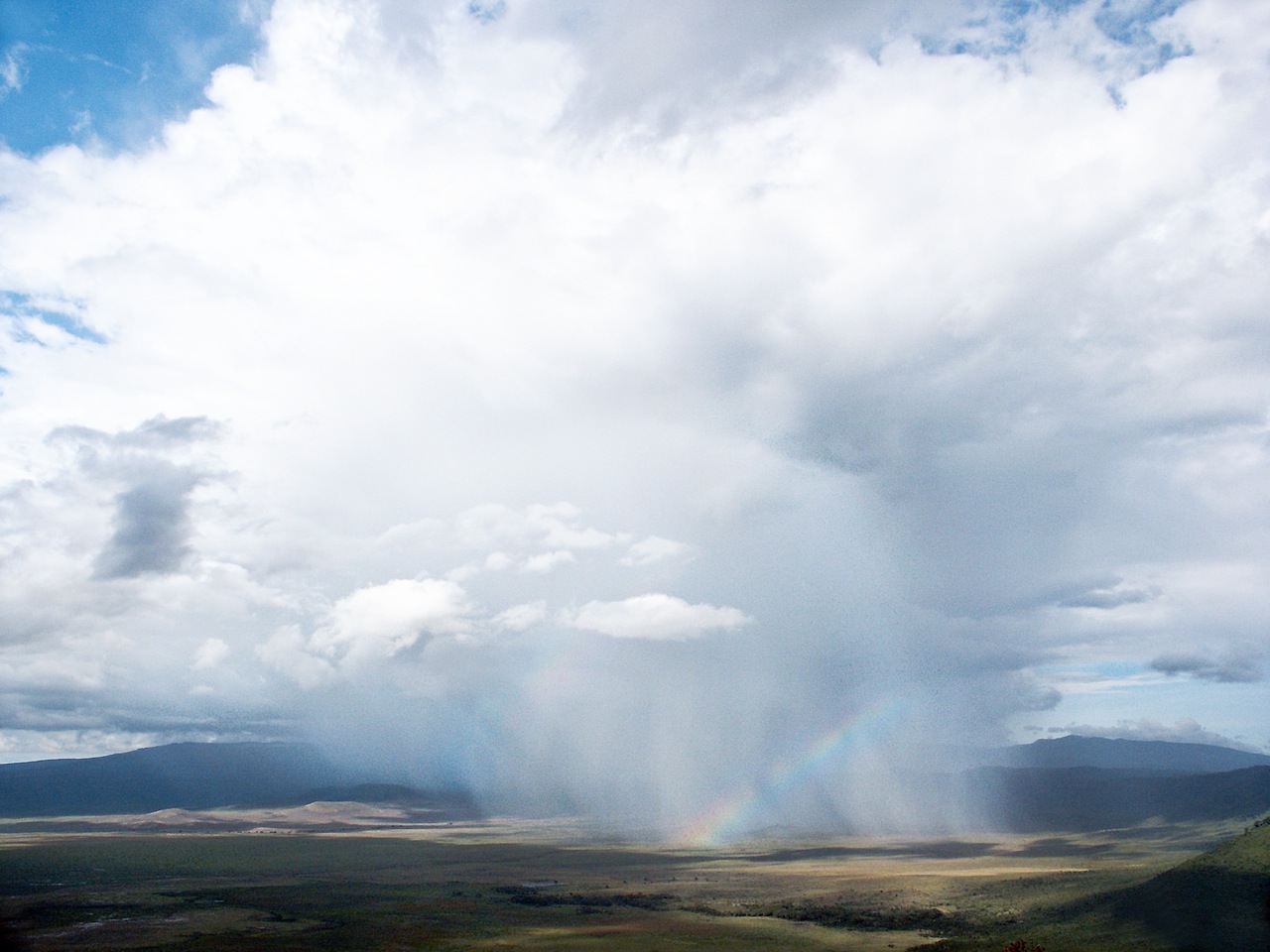
Thunderstorm, Ngorongoro Crater
It’s been a bright and sunny autumn this year in southern Ontario. Today is the first day of rain in weeks, it seems. At the same time, its been a busy autumn with guests, my book launch and the website overhaul (still on-going but will shortly be finished).
I think I need to work on streamlining image processing. I have a good system – one that I will write about one day – but it seems that for every hour I spend photographing, I spend at least an hour working on processing: editing, numbering, past-capture processing, organizing. It takes forever. I’m sure there are efficiencies I can start to use.
Right now I’m processing everything using Adobe Camera Raw. I am still in awe of what can be done using 5.5. For many images I don’t even open Photoshop at all, but just do everything through Bridge and ACR. I take half the time now compared to one or two years ago, but, at the same time, features like Adjustment Brush and Spot Removal mean that I am taking longer with each image due to the finessing that is now possible.
I have also been revisiting images taken years ago as I prepare my Tanzania book and have reaffirmed the importance of shooting Raw. Loading up and processing 7-year-old raw files from my Minolta Dimage 7i has been a wonderful experience. Yes, they are grainy-looking, but the power of ACR now compared to then has led to the same images being revitalized and reinvented in a new way.
Image quality is absolutely key for me and although I can’t afford full frame – I’m going to work as hard as I can with what I have to maximize image quality – something I have always believed right back to my film days. It is for this reason I have always shot raw – even when the write times were 20 to 30 seconds per shot. It is certainly paying off now!
_____
If you’re looking for something photographic to do, visit the dpReview Challenge page and enter a few photos.
My Art of Earth series continues with “My Own Backyard” opening for entries Thurs 26th Nov.
Good luck, have fun – and learn from viewing photos by other photographers!
Autumn is alive with colour
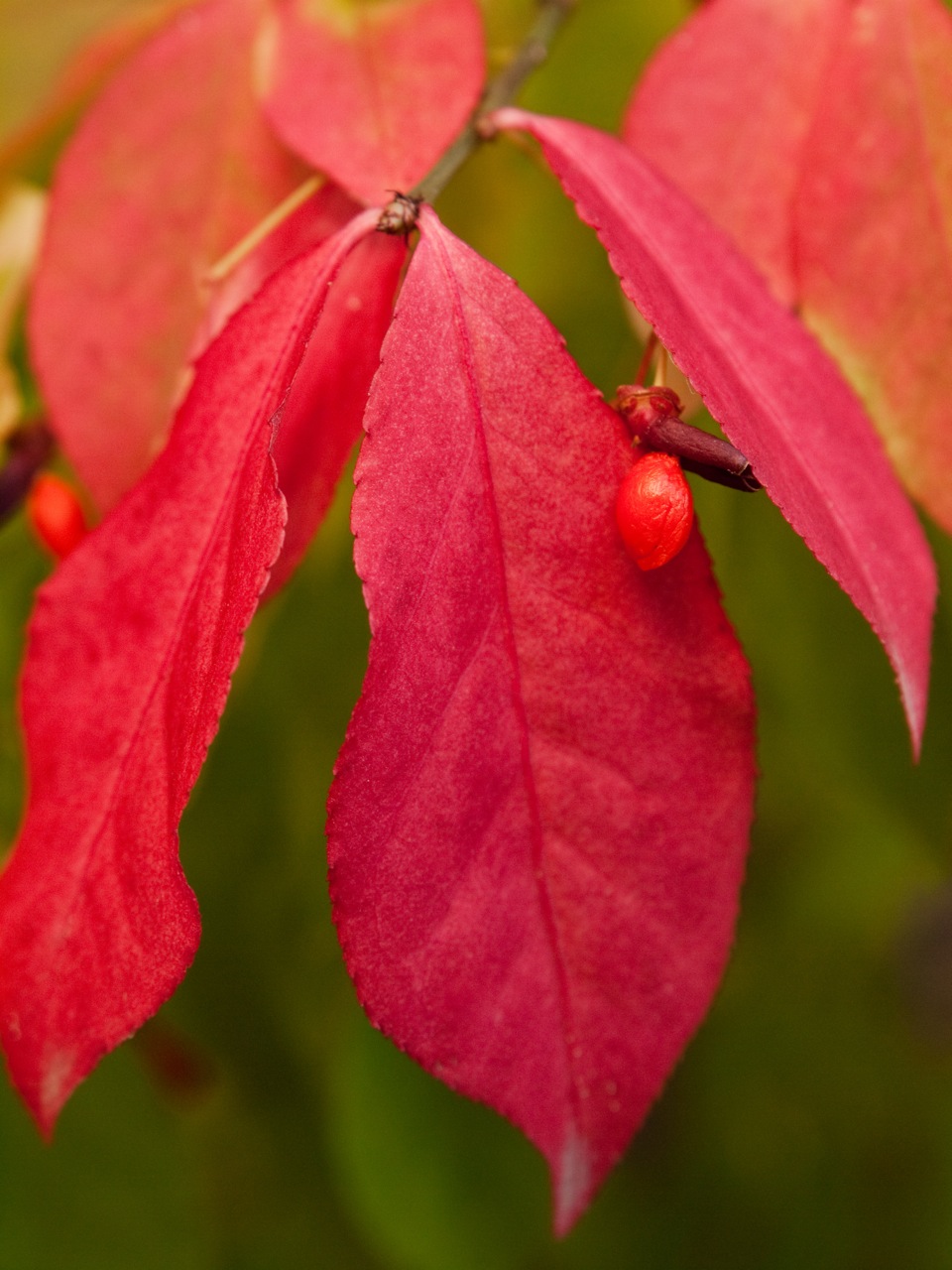
Autumn Colours - Red
Just because the leaves have dropped and the trees are bare, doesn’t mean the colour is finished. We’ve been out in the
garden over the past few days cleaning things out and planting some recently acquired plants. i couldn’t help but grab my camera and make some images. The sun broke through for a little adding some additional texture, but it was the subtle ochres and oranges and hints of scarlet that made the day – sun or not.
I found that the key to stronger images was getting close-up to eliminate the distractions of bare skeleton-like twigs. I looked for textures and shapes in the leaves I photographed as well as colours unique to autumn. In my search for perfection i was constantly distracted by the rot that

Autumn Colours - Gold
started – small holes and disturbing wilting – definitely outside of my comfort zone. So i stopped looking for perfection (that didn’t take long) and began to ignore the ravages of death. Once I got over it, I found strangely liberated and began actively seeking examples of how nature recomposes itself. I’m not sure I succeeded as well as I hoped, but I have come away with new confidence in showing a different side of
nature. As well, I have a number of sketches that have helped me learn to see differently.
But that’s part of the reason I spend time photographing – to discover new things about nature and to discover new ways of seeing. I need to challenge myself more in different situations and with different expectations.

Leaves on Rhubarb
Get Out and Photograph!
For too many days this autumn I have had commitments which have kept me indoors. I’ve caught “glimpses” of
autumn through the lens while conducting workshops and when out for family hikes, but I’ve not had the chance to move slowly and think about the images I’ve made. I’m that kind of photographer – slow and purposeful, working on a tripod, waiting for the light and the wind. I need to spend time with my subject familiarizing myself with its nuances, changing my composition inching closer, slightly to one side and a little lower. American photographer Fred Picker looks for the place where the subject “is looking back at me”.
-

- Goldenrod, Starkey Hill

-

- Golden Autumn, Starkey Hill

-

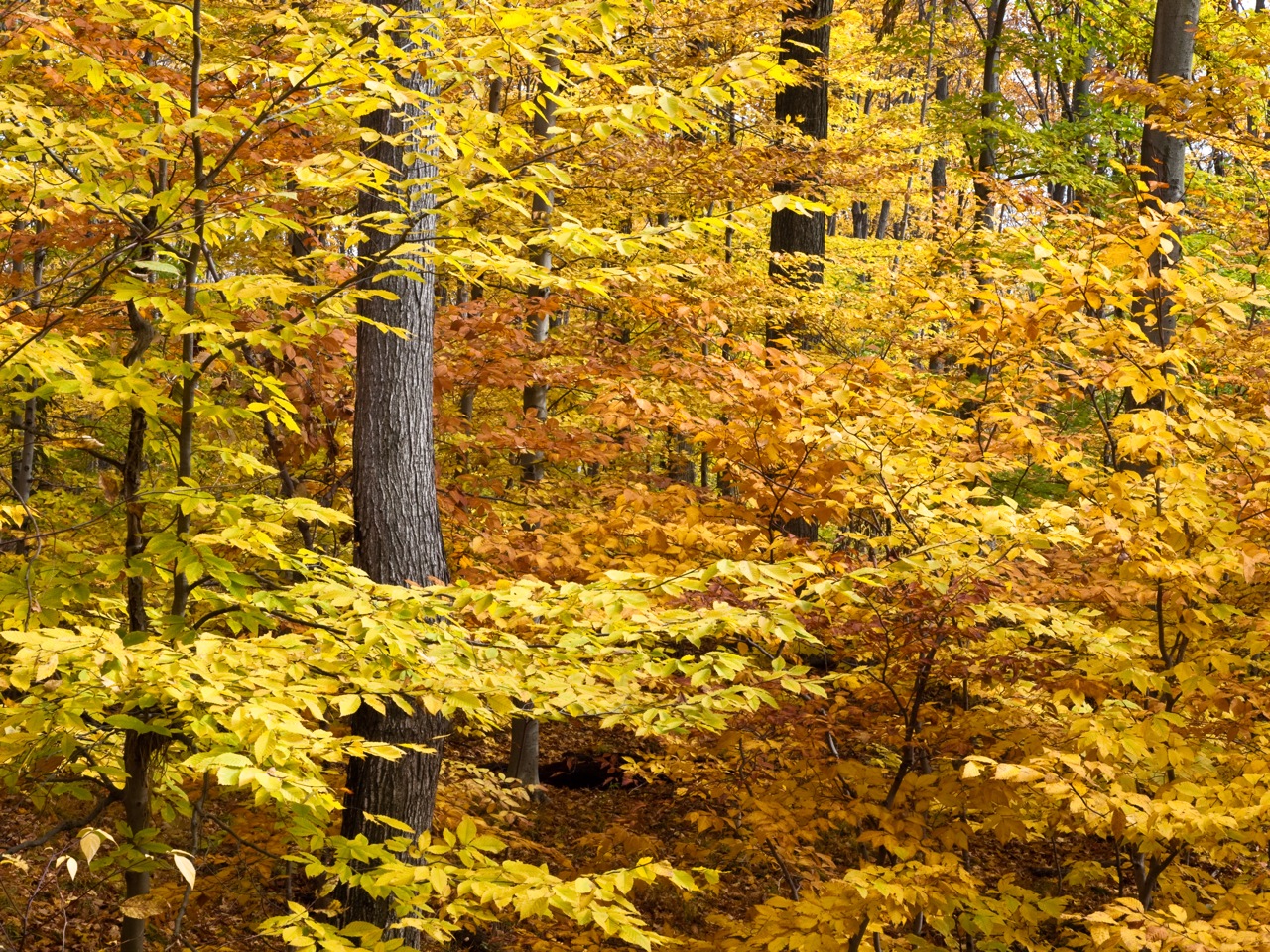
- Maple-Beech Forest, Starkey Hill
I’ve come to learn exactly what he means. The composition needs to feel right. I need time to photograph without distractions and this morning is just that time.
As I got out of the car, I suddenly realized how quiet it was here. I could hear the morning rush of the city over to the west, but here at Starkey Hill, I could hear the birds sing and the wind rush through the now brown goldenrod. The grey sky seemed to be keeping the sound in .
Autumn is now weeks old, and the best of the colour long-past, but that’s not what I’m here for. I’m want to celebrate the subtle ochres, yellows and browns that grace the latter part of autumn. The wind won’t help things, though. I like small apertures and long exposures. Shooting at ISO200 will help. This is a recent change up from the base ISO of 100. On the E-30, dynamic range is about 2/3s of a stop greater at ISO 200. I want to take advantage of that. I’ve also reduced the contrast to allow the histogram to show me every detail.
It’s so easy to ignore colour after the peak yellows, oranges and reds of the maples and birch throughout Ontario. There is still plenty of colour in herbaceous plants and wildflowers that fill the fields, There is even the odd purple aster to provide contrast to palette of warmth that is everywhere. The goldenrods first catch my attention. The warmth of the various browns contrasts nicely with the cold grey of the leafless shrubs in the background.
As I hike along, stopping to set up and make a few photographs, the path transitions from field into pine plantation. Finally I crest the moraine and look down into a sea of golden yellow. Of course, the maples have all dropped, but the beech trees are now broadcasting their autumn glory. Soon the sun starts peaking through the morning cloud and the forest becomes a fireworks show of colour. The subtle colour I came out today to photograph have erupted. What a treat.
After a few more images, I realize that it is about noon. At this time of year, here at this latitude, the sun is low enough that one can photograph all day and still have great light. But other commitments beckon. These three hours have been the most artistically productive three hours in months. It’s a rare day for outdoor and nature photographers to have all the elements woking together in one;s favour. Of course, that being said, if I get out more often, then I just might be surprised at what I can make of the ambient conditions on any given day.
Landscape Photography
We are half-way through the Landscape Photography course I am teaching at Mohawk College in Hamilton, Ontario. I

Hermitage Creek, Sulphur Springs
am so energized by the 15 students, our hands-on field sessions and the classroom sessions where they work magic on their images. Despite the threatening rain each time we’ve been out, students are managing to produce some incredible photographs. I will be sure to highlight their work as a collection that can be viewed online.
Like any other style of photography, producing quality landscapes is a craft. Ideally, you want to create the feeling that viewers feel a part of the photograph so they can “walk into the image”. To create a classic landscape – often called the grand vista – you want three elements:
- the image portrays the surface of Earth;
- the horizon is apparent or perceived; and
- there is a progression from foreground through to midground and background.
Now, these are not hard and fast rules. Landscapes can involve a whole lot more and a whole lot less.
One method involves getting down close to a strong foreground element – rocks or foliage, for example – with a wideangle lens set to a small aperture (f/16), can be the start of creating a truly three-dimensional image. Of course, landscapes can also be made with telephoto lenses.
As with any artistic endeavour, photographers are most successful when they have a clear sense of what they are trying to say. So work on your craft by looking carefully at your successes and failures to help clarify your vision and style.
Website Makeover

Websites are a lot of work to maintain and keep fresh, so a makeover was long overdue It’s tough enough keeping up with all the processing and archiving of images, not to mention teaching Landscape Photography and actually spending time photographing! Hopefully, you will find something here to keep bringing you back.
My goal is to make this a regular part of everyday – images, thoughts, ideas, commentary, wish lists… all things photographers find useful on regular basis. – Enjoy!
 luxBorealis Blog