December Photo Newsletter is hot off the press!
This Month’s Article
It’s that time of year again – time to look back over the past 12 months to reflect on what you’ve accomplished and what you’ve left undone. I’m going to do a little of that here, but with a twist.
One of the great features of Lightroom, besides its intuitive Develop, Web, Print and Slideshow modules, is the Metadata section of the Library Module. I’ve been accused of over-analyzing situations, but this is one of those times when I think it’s helpful to throw a bit of analysis into an area that we’ve never really been able to before.
Up until the release of photo library applications like Aperture and Lightroom, photographers could only get a rough idea of “how” they shoot – the lens or focal length and aperture used most often. Now, that data can be quantified.
Read on >> luxBorealis December Photo Newsletter
November Photo Newsletter
Have a look at the November Photo Newsletter. You will find the second part of the article on exposure where I talk about the advantages of checking the histogram and highlight clipping warnings. Also I announce the two dates and locations for my Winter Nature Photography workshops: Jan 15 and Feb 12, 2011.
You’ll find it HERE – which is http://www.luxborealis.com/newsletter/2010-11-luxBorealisNovNews.pdf
Pushing Yourself – Visually
This past Saturday morning I led my Landscape Photography class on a morning field session down in the hamilton Beach area. We started off right under the Skyway Bridge at the canal leading from Burlington Bay to Lake Ontario – not the prettiest place at the best of times and this was October 30th: grey skies with the temperature at about 3°C, and few leaves left on the few trees in the area which was mostly aged cement and steel.
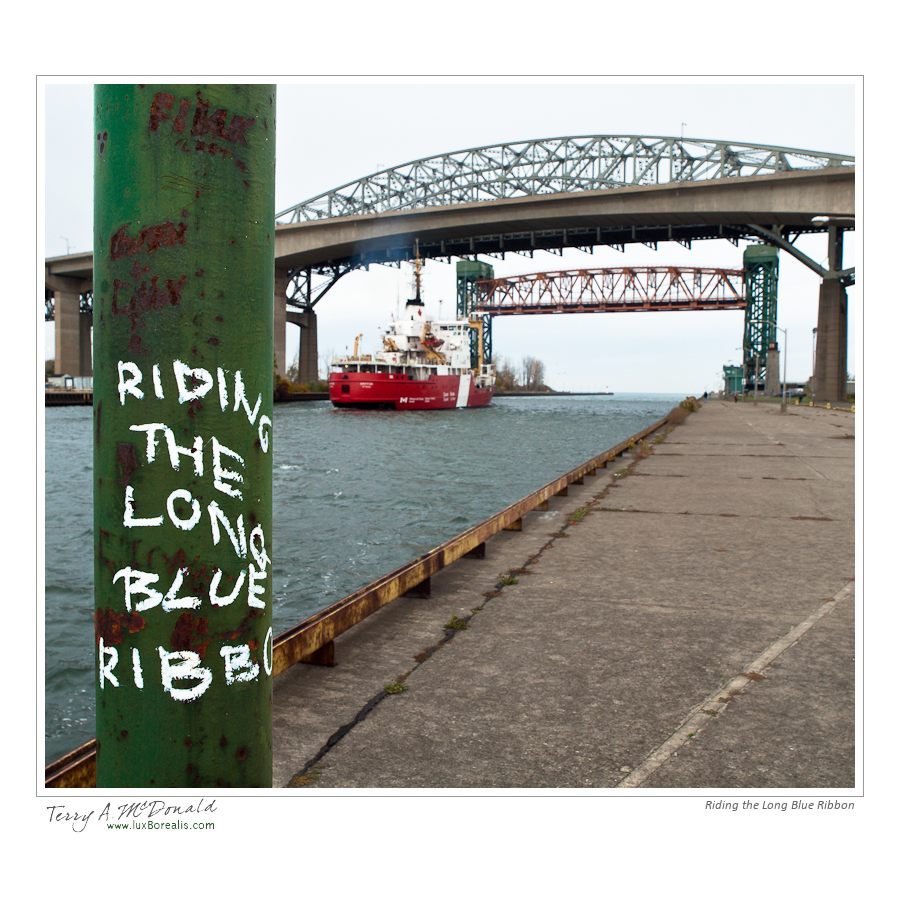 “Why are we here?” was the first and often-repeated question.
I believe that if you want to stretch your vision, you must work in visually challenging places. Once you have the technique down, it is relatively easy to make great landscapes in beautiful places. But are they visually dynamic images? Perhaps, if you have learned to create visually dynamic images. That only happens when you have truly challenged yourself.
What do I mean by “visually dynamic images”. These are images that visually “pop”. Images that show a different perspective, a different way of seeing. Images that make use of visual elements in the landscape and portray them in a creative way.
You can do all this in pretty places, but often we don’t because we are not forced to. There are plenty of beautiful photos that you can take just by standing there. Visually dynamic images often require a different perspective, a perspective that we may not consider if we are busy capturing the obvious.
I try to get photographers to think in terms of good, better and best. In a beautiful place, you can take good to better photos without working very hard, but what about the best photos – they are the ones that require a new and different perspective.
 Going to a location that is visually challenging to begin with forces you to go beyond the obvious because the obvious is not very photogenic. Consider it a “sketching” outing: you may not come away with a photo contest winner, but what you are doing is exercising your brain, forcing it to see beyond the obvious. I tell my students that this is the practice that allows you to hone your visual skills so that when you get to that grand location, your images will be well beyond the snapshots everyone else is taking.
While I generally prefer to photograph alone, in this case it helps to go in a group so that you can feed off the different ideas and perspectives that others think of.
So, find a nearby location that is not visually stimulating and see what you come up with. Try going back more than once at different times of day and throughout the seasons.After a couple of years of this I will bet that you have more than few images worthy of showing.
Salzburg, Austria Stock Photos uploaded
I’ve just uploaded stock photos of Salzburg, Austria. What a beautiful city – historical buildings with lovely gardens and everything “Mozart” or “Sound of Music”. – Enjoy the pics!
dpReview – Dismay at poor photo quality in Challenges
Posted today at dpReview…
Today I went through and voted on the 116 shots for the Western Canada challenge. There are some lovely images that truly convey the characteristics of Western Canada. Unfortunately, I must admit to some dismay over the poor quality of the majority of the entries. First of all, to get only 116 entries for such a vast and truly beautifully photogenic area is disheartening in itself. But the quality of many entries was substandard for a Challenge open to photographers the world over.
I am not trying to be a troll here. Nor am I trying to be self-important in critiquing the work of others. My hope with this post is to encourage dpreview users to work a bit harder on carefully selecting images and carefully processing them before entering. Here are some specific comments/concerns:
- Too many HDR-style/look photos when HDR is not required, nor is the look adding to the aesthetic of the image;
- Not enough critical cropping. There are a couple of photos which make excellent use of negative space, but many others would benefit from a proportion other than the 3:2 or 4:3 that the camera dictates. Crop to fit your subject, not the camera format!
- Too many blown-out highlights. When you make your exposure – carefully check your histogram to ensure you haven’t lost detail in clouds/sky. When you are processing, toggle on highlight/hot & cold clipping to reduce the chance of burning out the highlights.
- Not enough careful composition/cropping to eliminate unnecessary distractions. This is of even more importance before you take the picture. Check the corners and the edges of the frame. Find the distractions then eliminate them – maybe you need to move from where you set up. More often then not, taking a few steps forward will solve many problems (provided you are not already on the edge of a cliff, lake or river!)
I realize many of the users here may be new to photography, but when you enter a Challenge, you should be posting your absolute best work. Perfect exposure, composition and focus are just the beginning of excellence in photography. It’s not helpful to put up poorly exposed and composed photos as this is not a critique session where you receive active and helpful feedback – it’s only a Challenge based on votes.
Take a look at some of the high quality photography sites around the net to see what the standard is. Learn the basics of good post-capture processing to enhance your images. Keep working towards achieving a high standard and blow us away with your best work!
 luxBorealis Blog