Fine Art Print Service now available
It’s time to move your best photographs
off your hard drive and onto your walls!
As of today, I am now offering a fine art printing service dedicated to photographers who want to get the most out of their digital files. Your photographs will be custom-printed to your specifications using archival pigment inks on 13×19 or 17×22 fine art paper.
The process starts with an assessment of the image followed by a test strip which you will evaluate and provide feedback on. Then a custom print will be made on beautiful 100% cotton rag paper and, if you choose, conservation matted and prepared for framing.
While this service is ideally suited to those living in the Guelph, Kitchener, Waterloo and Cambridge area, I also offer a mail service to virtually anywhere in the world.
As an added bonus, anyone who subscribes to my “mostly monthly” newsletter will receive 20% off their first print order. So start looking through your digital files to consider which ones should grace your walls. And, don’t forget, Christmas is on the horizon – there may just be other who would enjoy your photographs on their walls.
To learn more about the Fine Art Print Service, visit my website: www.luxborealis.com/printservice.html
Steve Jobs, visionary extraordinaire, has passed away.
It is a truly sad day for computer aficionados everywhere, Mac and PC and Linux alike. With the passing of Steve Jobs – a unique and creative visionary – the world has lost a truly gifted person. I am not one to lament the passing of billionaire CEOs and celebrities, but Steve Jobs was different. Maybe it’s his Buddhist faith or that he was a vegetarian or perhaps it’s his success from humble beginnings – not just the invention, out of his family’s garage, of a whole new way of computing, but that he was an adopted child which has its own difficulties. He was a brilliant thinker and was willing to stick to his vision despite the monolithic domination of Microsoft and Windows. We’ll miss you Steve!
Landscape Photography off to a good start

Dawn, Birch Tor, Dartmoor – a classic landscape.
Last Thursday was the first session of the 10-session continuing educationLandscape Photography course I teach at Mohawk College in Hamilton. The class is full and there is a waiting list, so, if you’re interested, you’ll have to wait until next Fall when it’s offered again.
The course is comprised of 8 classroom sessions plus two field sessions. We explore the techniques required for producing “classic landscapes”: 3-dimensional “grand vista” portraits of Earth with a strong foreground anchor and a real or apparent horizon. The two field sessions are devoted to natural landscapes and urban landscapes to provide wide and varied experiences. Three of the classroom sessions are spent “processing” landscapes using ACR and Photoshop (and, if you have a laptop, Lightroom). By the end of the course, students are producing compelling landscapes – the kind you feel like walking right into.
Mohawk College has an excellent continuing ed. photography programme, offering two certificates, one in Applied Photography, the other in Art Photography (see their page here). I also teach the Lightroom course for this program. If you are already proficient in some areas of photography, you can apply for “Prior Learning Assessment and Recognition” where you submit the requirements for a course, pay a lower fee than taking the full course, and, if successful, are granted credit for that course.
A successful day…
 On Saturday I attended a small art show and craft sale in Mississauga at Applewood United Church. I was very pleased with the response to my work and ended up topping my sales targets by 15%. While the notecards sold well, people were really taken by the fine art prints – in particular April Storm, Yorkshire Dales; Treeline at Dawn, Bruce Peninsula; and First Light, the Massasauga. What is especially interesting is that I used April Storm to illustrate the Moab Entrada post a wrote on Thursday (see below) and it was the biggest hit of the show.
Thanks to everyone one who dropped by. I’ll be sure to let you know about the next show. In the meantime, visit my gallery online at QuietLight.ca

Moab Entrada Rag Natural 300 – Absolutely Gorgeous
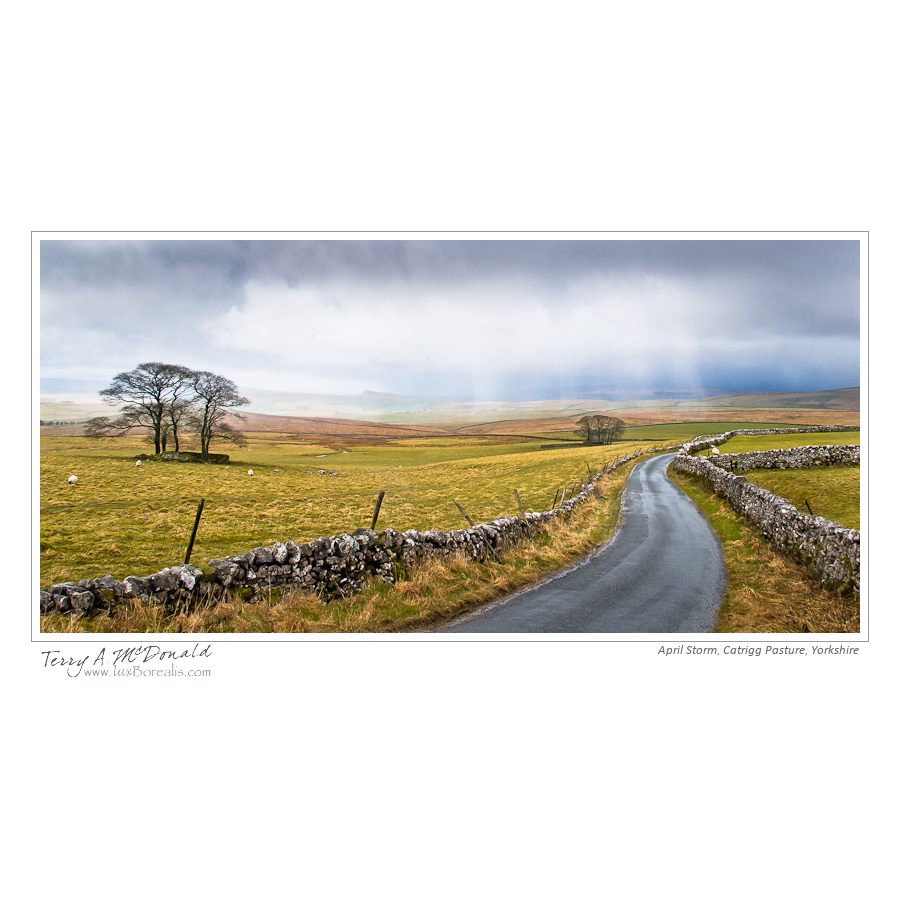
April Storm, Yorkshire Dales
In my final push to have some large, matted photographs for sale on Saturday** (see below), I started printing with the Moab Entrada Rag Natural 300 paper today. As I said in the title: Absolutely Gorgeous!
Entrada is a 100% cotton rag paper with no optical brightening agents (OBAs), hence the “natural” designation – the “bright version has brighteners. The 300 refers to its weight – 300 grams per square metre or gsm. A 190gsm version is available, but I prefer the heavier weight.
The first thing I noticed upon opening the package was the smell. It smells like a high quality, natural paper. The same pure smell as when I’m cutting mats. Sounds strange, doesn’t it, but smell is as evocative as sight and taste. (No doubt, someone will email to tell me the smell is actually a by-product of the manufacturing process and not the paper itself – I hope not!)
The paper has a great feel to it as well; heavy enough for handling easily but not stiff. The texture is beautiful – a lovely wavy stipple as beautiful as any watercolour paper, which is what this paper is. It’s not pure white (thank goodness!) but has a warm creaminess to it. All of my photographs are of the great natural world around us, so it is fitting that the paper is not stark, “machine” white, but warm like the beautiful light I am most apt to be photographing in.
Printing with Moab Entrada requires Matte Black ink which meant the big switch-over from Photo Black. that went smoothly enough as soon as I hit print. I had previously changed the print setting sot reflect the Entrada paper, so the driver picked up on it and after 5 minutes or so, it was done. Yes, it means losing about 6mL of ink, but it’s done.
I was pleasantly surprised at how similar the Entrada Matte Black ink prints are to the ones printed on Galerie Gold Fibre Silk and Canson Platine Fibre Rag in that the colour profile maintained the identical colours. Although the dmax of the Entrada prints is not quite as great, there is beautiful pastel-look to the prints. Yes, they are still photographs, but they have a much more organic look to them, less “machine-like” and more natural – which is the whole intent of my photography. The Entrada prints benefitted from an increase of about 20 in Contrast and 0.1 to 0.2 in brightness (Lightroom settings).
I just checked the printer to find ink usage for the prints that ranged between 12×20- and 16×20 and found it ranged between 1.0 and 2.0mL – very respectable. The cost of the paper is reasonable as well – I paid $4.80 per sheet and needed just one or two test strips to verify colour balance and brightness.
One interesting feature of the Entrada 300 is that it is “double-sided”meaning it is coated on both sides for fine art printing. Bizarre, or so I thought, so emailed Moab and got this reply from Nick Therriault:
I can see how it can be perplexing from your traditional presentation [matted and framed], but being double sided gives you the flexibility to either present your work traditionally or in a portfolio and limited edition books. Being double sided will allow you to double the amount of work in your portfolio in the same amount of space. Now all we have to do is invent a double sided frame lol. Anyhow the 290gsm Entrada is actually single sided and probably more cost effective for your use.
As it turns out, the 290gsm paper is just over a dollar cheaper on a per sheet basis and certainly worth considering, but it is only available in rolls which the Epson Pro 3880 cannot directly handle. Something worth considering, though, when I start printing panoramas.
I can see that I’m really gong to enjoy printing with this paper. I thought I would settle on Platine, but the organic beauty of the Entrada just might be what I settle for.
**By the way – I’ll be at Applewood United Church on Stanfield (south of the Quensway) in Mississauga on Saturday 1st October selling my wares. Drop by and have a look and a chat.
 luxBorealis Blog