Lightroom 4 is now available!
 After a number of weeks of beta testing, Adobe has released the full version of Lightroom 4 – the most widely anticipated upgrade for digital photographers around the world.
Lightroom has become the industry standard application for managing small and large catalogues of digital photographs and has virtually replaced Photoshop as the “darkroom of choice” for processing digital images. As well, Lightroom’s superior printing capabilities have made it the mainstay of fine art photographers who regularly make fine art prints.
Lightroom 4 adds a number of capabilities to what is already an excellent product. Perhaps the most significant is the new Develop module. At first glance, the adjustments will appear the same. This is because LR4 loads your images into LR3’s 2010 Process Version. But you will notice an exclamation point icon down in the bottom right (when in the Develop module). Click on it and you can convert the image to Process Version 2012.At the same time, the Basic palette of the Develop module is also converted to the new adjustments. These new adjustments – Exposure, Contrast, Highlights, Shadows, Whites, Blacks – provide for even greater “accuracy” to specific tonal regions within each image. Basically, Tone Mapping – which offers much more precise control – comes to Lightroom! As you drag your cursor over the different adjustments in the Basic palette, note how the Histogram highlights the areas that will be adjusted.
But I’m getting ahead of myself… Lightroom 4 is coming in at a lower price point – only $149 for the full version and $79 for the upgrade or education versions. Once you’ve purchased and downloaded LR4, expect to take a few minutes to install it. Then, when you first open it, LR4 will upgrade your LR3 catalogue and previews. Note: you will still be able to use LR3 after the upgrade; LR3 will just need to re-create the previews in it’s own preview format. When you open LR4, you may also need to update your plugins to a version that will work with LR4. This process is straightforward with dialogue boxes to prompt/remind you to do so.
I will provide more information about LR4 over the next few days and weeks. It is exciting to have yet more creative power at our fingertips, so stay tuned!
Winter at Bark Lake

Bark Lake
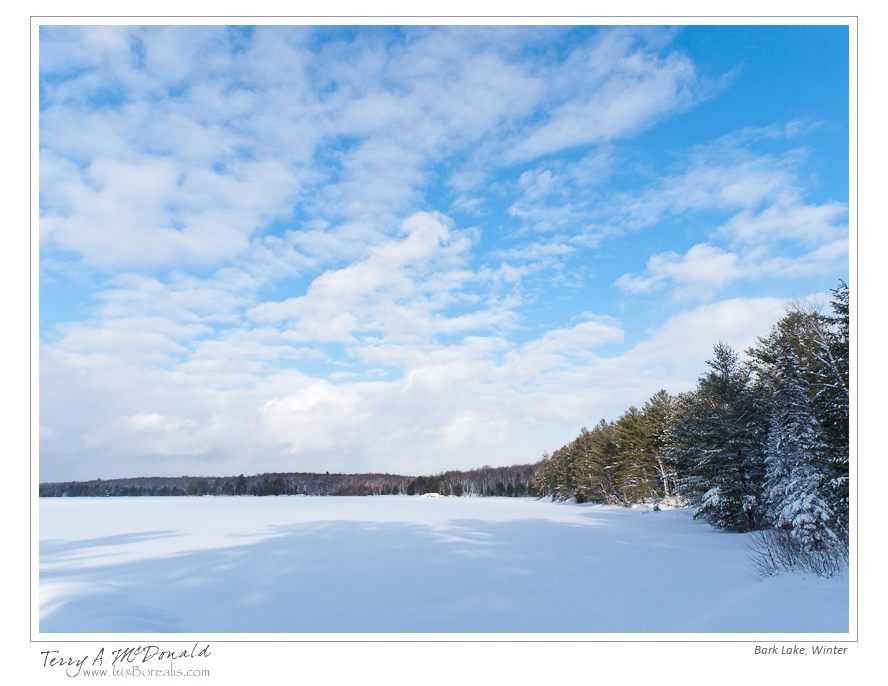
This past week, I was up at Bark Lake teaching Wildlife Population and supervising 30 grade 10 students from St. John’s-Kilmarnock School. SJK is an independent school near Maryhill, Ontario between Guelph and Kitchener-Waterloo with wonderful students and staff to work with. Most days during the Bark Lake week are quite full with classes indoors and out from 9am through to 10pm. Amazingly, the students are engaged and energetic throughout it all, which leaves only a few hours of downtime for the teachers. However, I did manage to take advantage of the few hours of sunlight we had Sunday afternoon and at dawn Monday morning.
I’ve been to Bark Lake Leadership Centre three times now with SJK, once in Autumn and twice in Winter. The staff there are very knowledgeable and the meals very good – more than enough to eat with lots of fresh fruit and salads. They have very comfortable accommodations in a beautiful setting surrounded by white pines, beech, maple and a beaver pond “out back”. I am considering teaming up with Bark Lake to offer weekend nature photography workshops in Spring, Autumn and Winter – if you’re interested, send me an email.
I’ve been quite pleased with the opportunities that exist for photography without straying too far from the Centre (spare time is at a premium when one is supervising high school students!). That being said there are kilometres of hiking and nordic ski trails that I’ve not had an opportunity to fully explore. As well, there are a number of rivers and lakes that provide a myriad of opportunities.
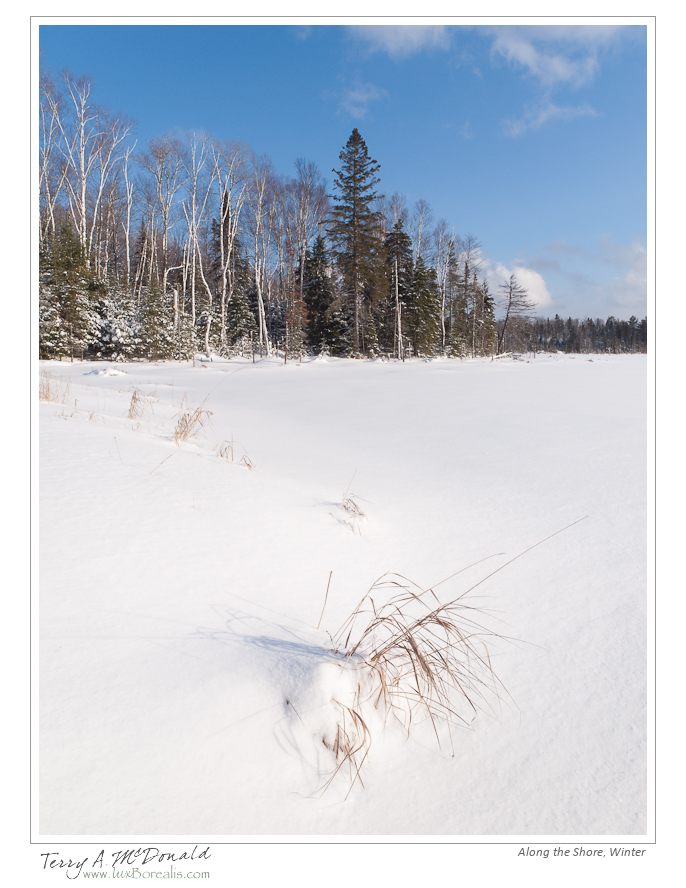
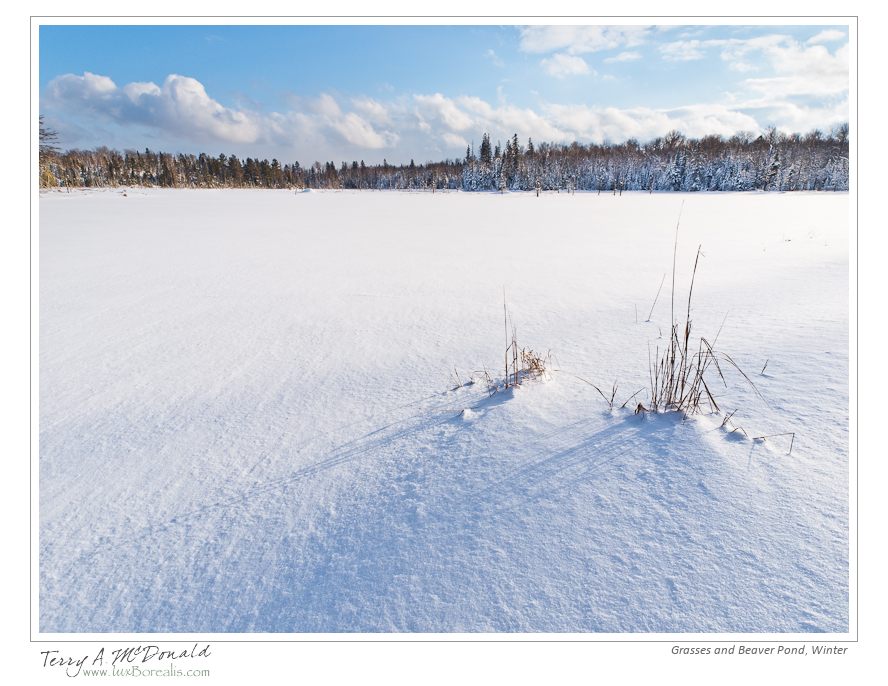
Here is a gallery of photos from the past week – not too many, but enough to give you a sense of how beautiful winter can be when there is some decent snow and lighting!
-

- Bark Lake
-
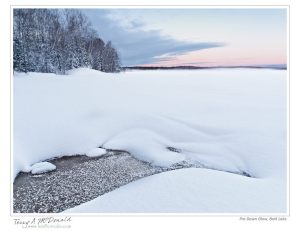
- Pre-Dawn Glow, Bark Lake

-

- Milkweed, Winter

-

- Along the Shore, Winter
-

- Grasses and Beaver Pond, Winter
-
- Bark Lake, Winter
-

- Afternoon Brilliance

Classic Landscapes in Photo Life magazine
When you are next at a news stand or book store, have a look at Photo Life magazine. The February -March issue is the Nature Issue and has my article abut making “Classic Landscapes”. The article came out of the course in Landscape Photography I teach at Mohawk College. So pick up a copy and consider getting a subscription to PhotoLife – it’s a great Canadian mag!
Some thoughts on cropping…

Rock and Light VII
Late last year, there was a rather protracted exchange on a photography forum regarding sensor/film aspect ratio and cropping. A couple of photographers were quite adamant in defending the point of view that the aspect ratio of the camera is sacrosanct and that all photographs should conform to the sensor proportions and not be cropped. So, if you have a 2:3 sensor (most APS and all full-frame sensors) then all your photographs must be printed or presented at 2:3 (e.g. 12″x18″ prints or 1200x800pixels on screen) and never be cropped. Perhaps most confounding was that they also felt that if one was to crop anything from the photograph, it would be regarded as a “failure” to properly compose in the first place. Needless to say, not everyone agreed.
Now, I understand completely where they were coming from – image quality is maximized when the whole sensor/film frame is utlised. What was surprising to me, however, was the vehemence expressed in the posts in support of the no-cropping point of view.

Baraka and his extended family
Being a small-sensor user, I know first-hand the importance of making best use of the sensor to maintain image quality. What’s the sense of cropping on-screen or in the darkroom if all I needed to do in the first place was move closer to my subject? This “fill-the-frame” concept has been around for almost as long as photography and became particularly important with the adoption of the Leica Standard in 1932. Small-frame 35mm film now had to compete with medium and large-format cameras which were the standards of the day and had much larger film surfaces which meant much higher image quality. To maximize the quality from a 35mm frame, the photographer had to make maximum use of it without cropping. This notion developed a near cult-following with photojournalists and street photographers like Henri Cartier-Bresson leading the way. To prove they did not crop, they went as far as filing away the edges of negative carriers to allow the edges of the film to show in the prints.
Basically, supporters of this notion have carried forward Henri Cartier-Bresson’s (and others’) technique by making it their own. One can’t quibble with personal choice of style. However, is it right to impose that style on other photographers as “the only way”? Shouldn’t photographers be free to make their own decisions about style without having one imposed on them? And, while 20/20 hindsight is wonderful, to call cropping evidence of a failure to compose properly in the first place seems misplaced to the point of verbal bullying.
Precise composition in the field is essential. It’s part of the art of seeing. However, does the world fit nicely and neatly into a 2×3 rectangle? Or a 6×7 rectangle? How about 6×6 or 4×5 or 4:3? It can, if one forces the issue, but should photographers be tied to a rectangle with proportions determined by engineers and camera manufacturers?
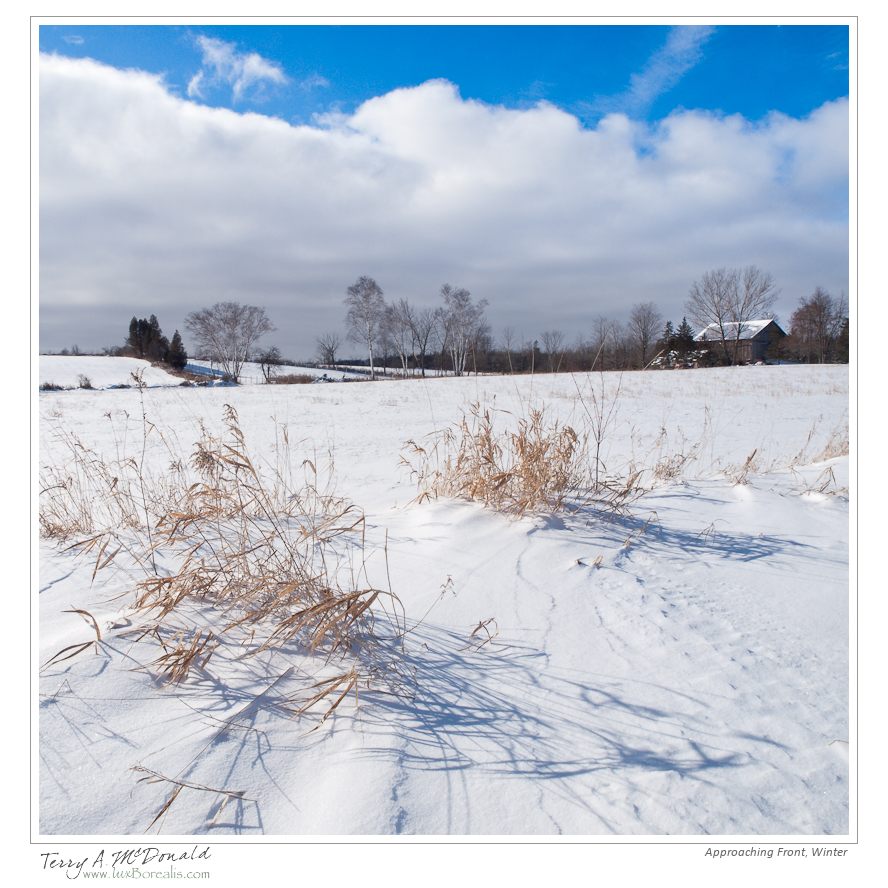
Approaching Front, Winter
I have a sensor that is 4036 x 3024 pixels in dimensions: a 4:3 ratio. However, I recognize that some compositions “work” better as a square, a 1:1 ratio. Other scenes benefit from being closer to a 16:9 ratio or even 2:1, letterbox style. I’m not going to ignore a scene I visualise as a square format just because I’m carrying a rectangle! I shoot it with my rectangular sensor and crop to what I originally saw: a square. However, when doing so, I maintain image quality by carefully composing to make best use of the width of the sensor. For most of the images I choose to crop, I do so because that’s the way I saw it in the field. I made the exposure knowing that the scene before me doesn’t fit the format I’m using.
I suppose I could force each and every composition into the 4:3 rectangle of my camera, but, to me, that seems wrong. My goal as a photographer is to “reveal the art inherent in nature” not to force nature into the proportions of a pre-determined rectangle. While making that forced composition is, in itself, an excellent exercise in seeing, it shouldn’t dictate every photograph one makes.
From my perspective, the bottom line is this: if one is pursuing photography as a visual art, a creative outlet for self-expression, then one should not be constrained either by the legacy of previous photographers or by the technical absolutes imposed by sensor or film proportions. Art, in itself, is a vehicle for free-thinking, not a recipe book for re-creating what others are already doing or have done. “Rules” such as, “compose for the aspect ratio of the viewfinder” and “never crop” (or, for that matter, the “rule of thirds”) were created to guide us, in particular those who are developing their talents and style; they are not meant to be absolutes.
-

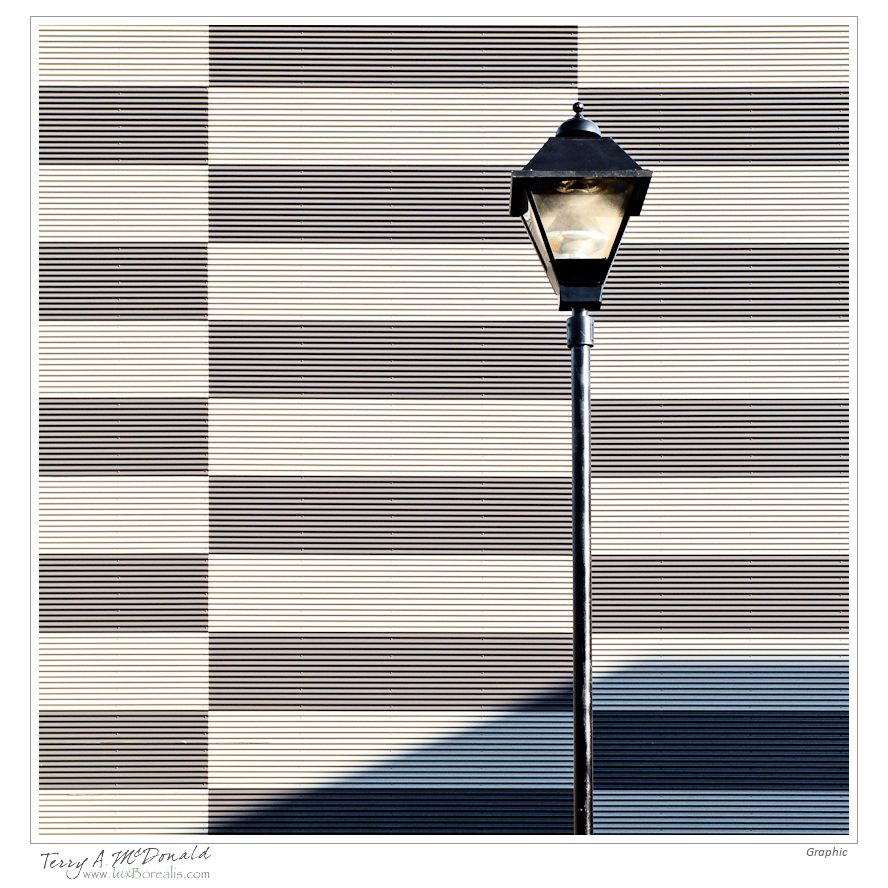
- Graphic
-

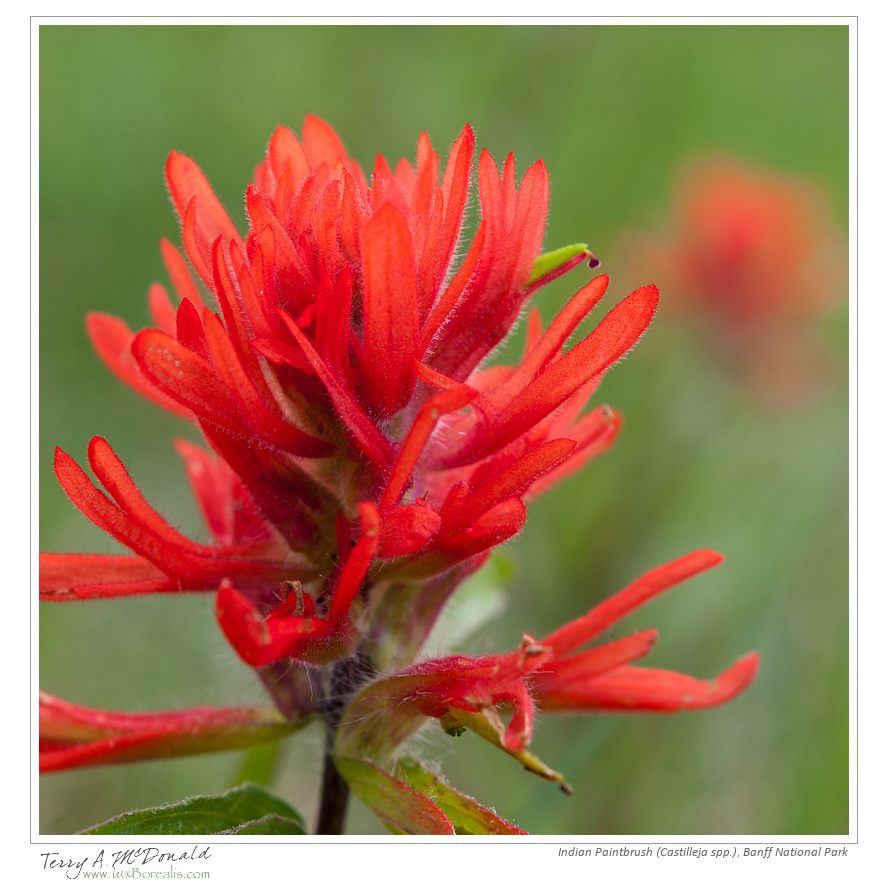
- Indian Paintbrush
-

- Tiffany Falls, Niagara Escarpment

-

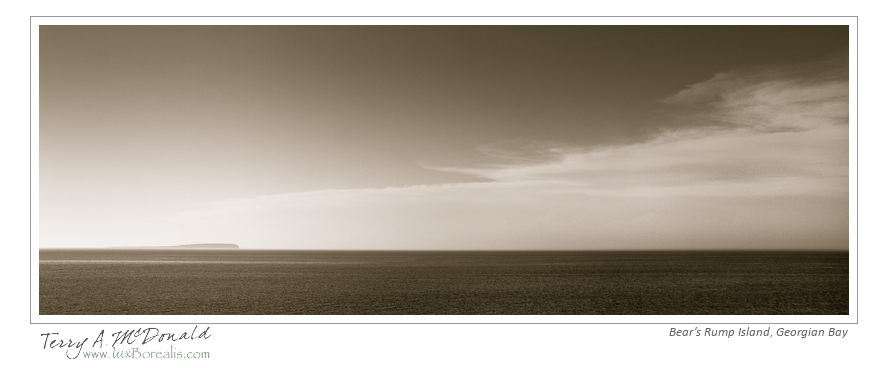
- Bear’s Rump Island, Georgian Bay
-

- Rock and Light VII

-
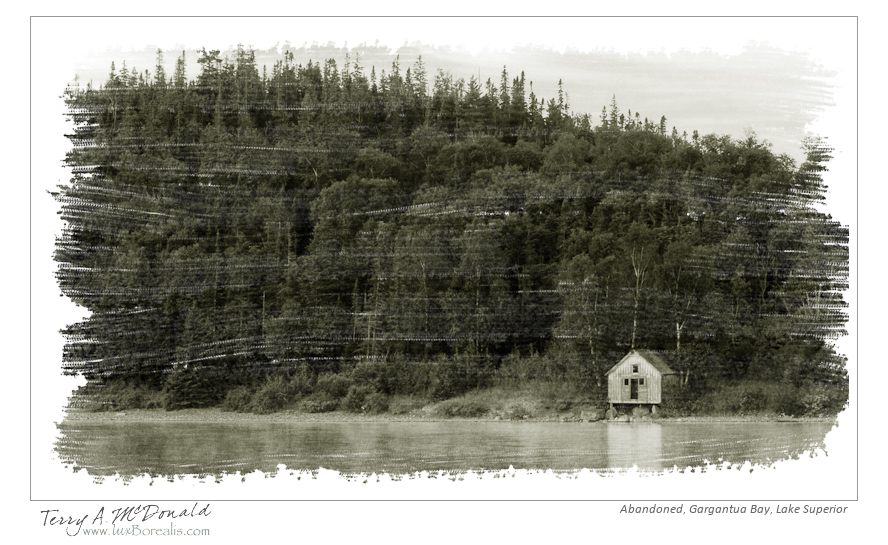
- Abandoned
-

- Baraka and his extended family
-
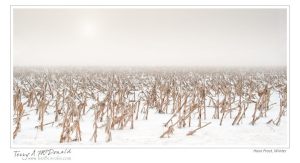
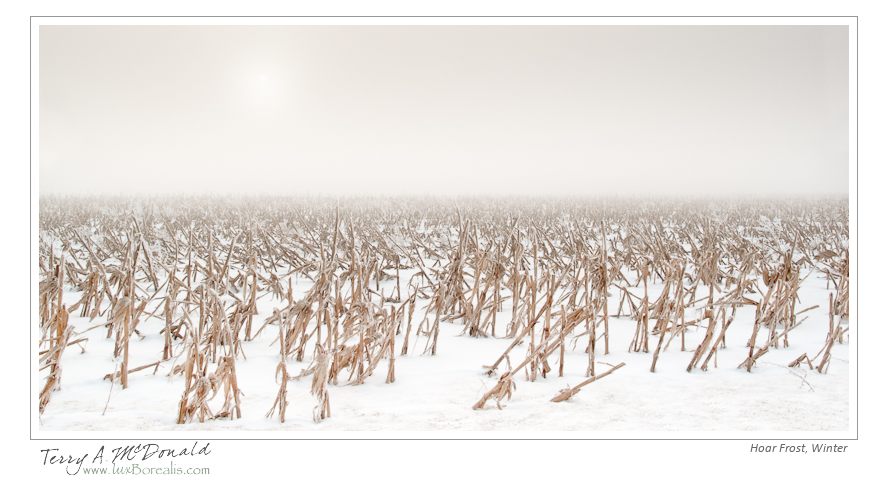
- Hoar Frost, Winter
-

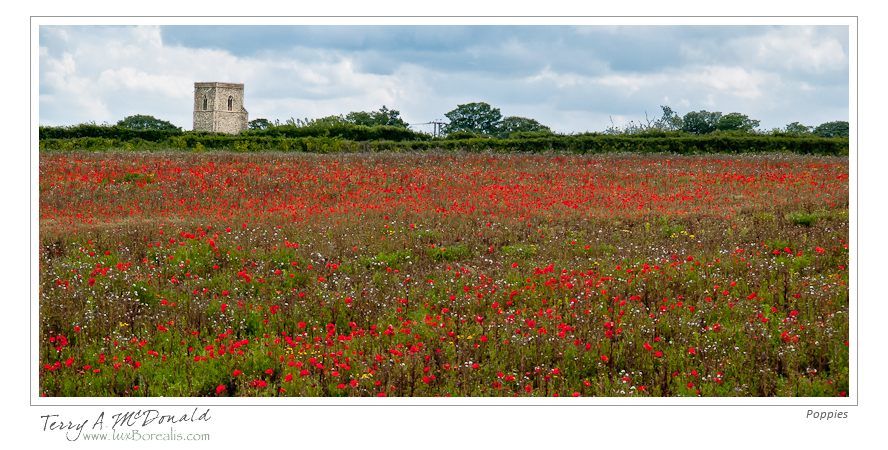
- Poppies
-
- Kilimanjaro

-

- Lone Surfer

-
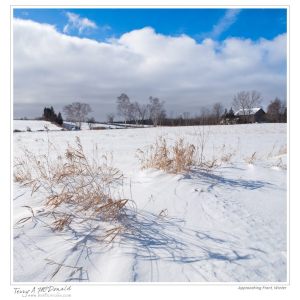
- Approaching Front, Winter
Winter Photography Workshop 2012
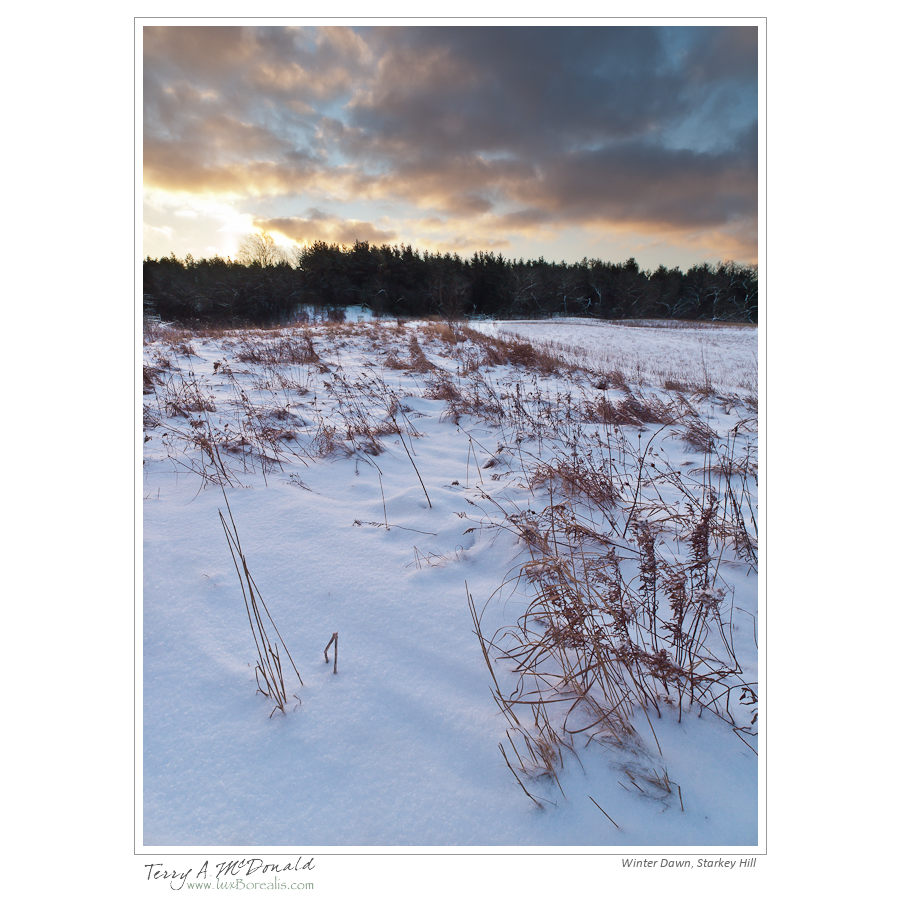
Winter Dawn, Starkey Hill
What a day! What a group! Ten photographers from all parts of southern Ontario – Burlington, Guelph, Hamilton, Mississauga, Owen Sound, Pentanguishene and Thornhill – all ready to go well before sunrise.
The sky was brightening as we assembled at the Starkey Hill parking lot, and I think we were all a bit concerned about how this day would turn out. This year in southern Ontario, those who appreciate winter have been conditioned to expect the worse type of winter weather for photography: gloomy skies, windy, rain and spring-like temperatures. What would today bring?

Chris Marson
As the sky brightened the low cloud cover began to disperse and the day dawned just as the weather forecasters had predicted: cold with bright skies and ,as a bonus, 2cm of fresh, light, puffy snow with no wind – perfect conditions for a Winter Workshop in Nature Photography.
Almost immediately we began shooting. As the sun rose behind the Galt-Paris moraine, we were treated to a wonderful foreground of brightening snow and the dried remains of wildflowers edging a farm field. The farm house itself was also an ideal focal point with the sweep of the field edge in the foreground and just enough stubble to prevent the field from losing detail.

Gordon Framst
After a good hour just metres from the parking lot, we made our way up the moraine and into the forest. Sunlight was everywhere providing many opportunities for creative work. Through the plantation of coniferous forest we went (with its bold chickadees looking for a handout) and on to the maple-beech forest “out back” where the sunlight streamed through the open canopy. At first, the riot of shadows and light was overwhelmingly complex, but gradually we began to see the shapes and textures that define the essence of nature photography. My goal was to get the group looking less for “subjects” and more for the textures and shapes that support what we trying to photograph, in particular, the triangles and diagonal lines that give photographs structure and three-dimensionality.

Paul Lamb
Before we knew it, three hours had passed and we began heading back to the parking lot and on to Arkell United Church to warm up and fuel up with lunch. Over lunch we uploaded photos to our laptops and began the afternoon choosing and editing six images to present to the group. Many great images came from the morning field session which spawned discussion about seeing photographs, composition, exposure and all the potential that exist “out there”. It’s always refreshing to see how a group of people photographing in the same place can come up with such a diversity of photographs. Well done!
Thanks to all who attended. I hope everyone went away with new information and a desire to try new ways of seeing. If you weren’t able to make it and still want a Winter Workshop, don’t forget that the Dundas workshop runs on Saturday, january 28th. As time is limited, call me to sign up. As well, I have the Lightroom workshop running Sat. Feb. 18 and 25 – see the website for details.
For now, take a moment to view this gallery of images from the day. Clicking on any image will open a slideshow-style presentation. Enjoy!
-

- Paul Lamb
-

- Paul Lamb
-

- Paul Lamb
-

- Terry Suthers
-

- Terry Suthers
-

- Marty Tannahill
-
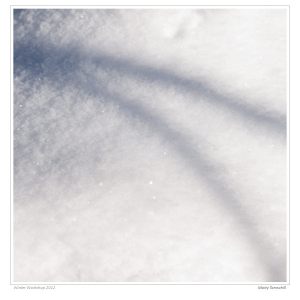
- Marty Tannahill
-

- Marty Tannahill
-

- Chris Marson
-

- Chris Marson
-

- Chris Marson
-
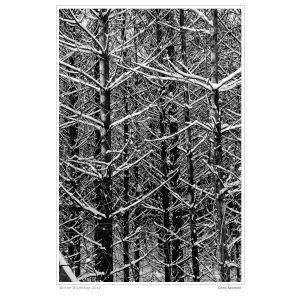
- Chris Marson
-

- Ingrid Liem
-

- Ingrid Liem
-

- Ingrid Liem
-

- Chuck Edwards
-

- Chuck Edwards
-

- Gerry Bachiu
-

- Gerry Bachiu
-
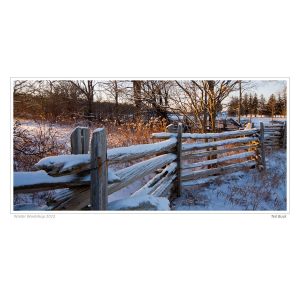
- Ted Buck
-

- Ted Buck
-
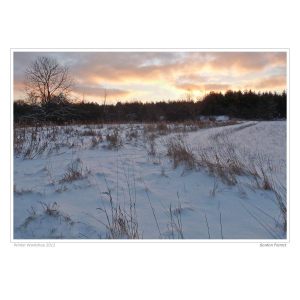
- Gordon Framst
-

- Gordon Framst
-

- Terry McDonald
-

- Terry McDonald
-

- Terry McDonald
-

- Terry McDonald
-
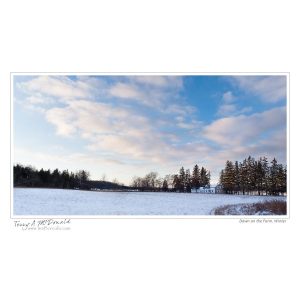
- Terry McDonald
-

- Terry McDonald
-

- Terry McDonald
-

- Terry McDonald
-

- Terry McDonald
 luxBorealis Blog