Cheltenham Badlands
Victoria Day holiday Monday started at 4:30am. A quick bowl of cereal was followed by a knock at the door. Kerry Little had arrived and we were on our way to the Cheltenham Badlands. Our goal was to be there before sunrise – no problem.
The day dawned clear with a slight and unexpected wind; the previous two mornings had been so calm. Oh well -not to worry – the rocks certainly won’t blow around!
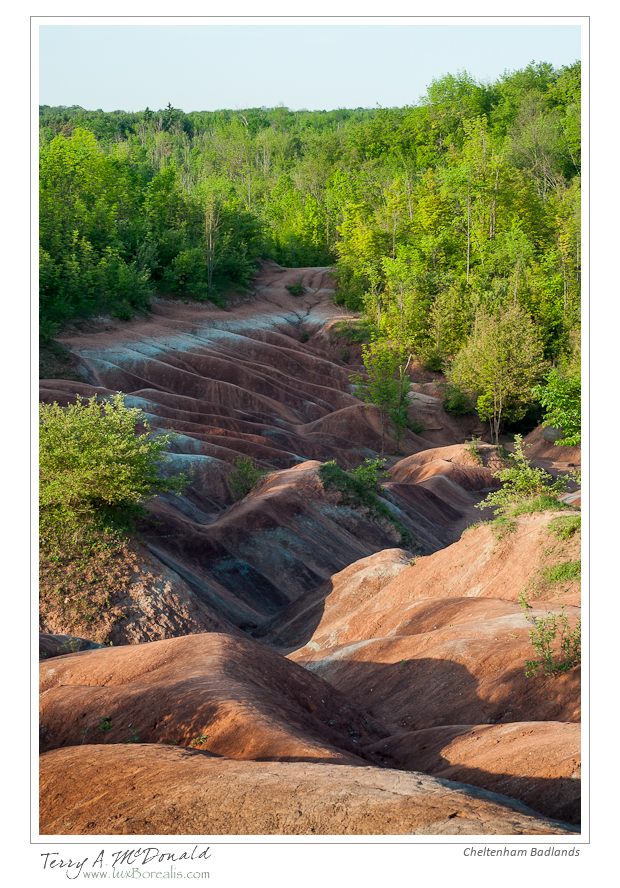
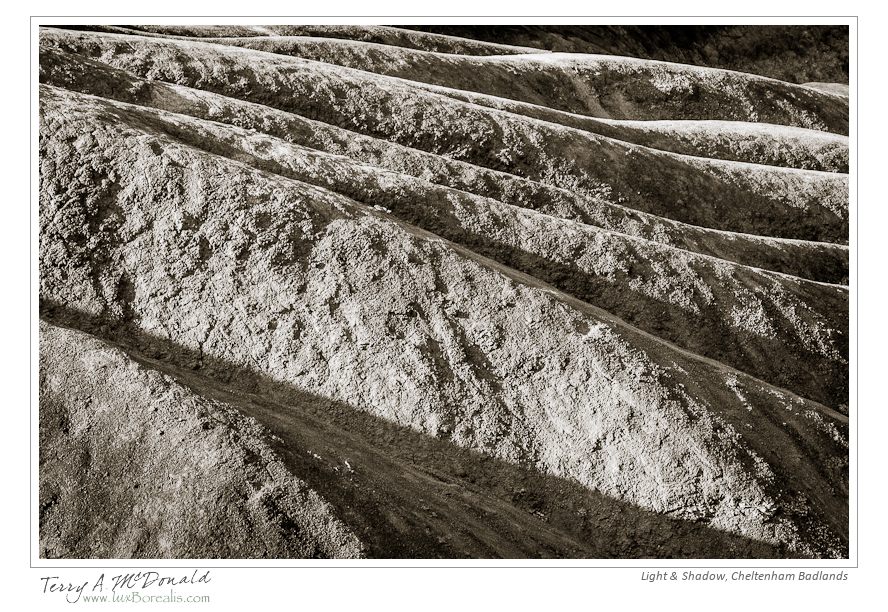
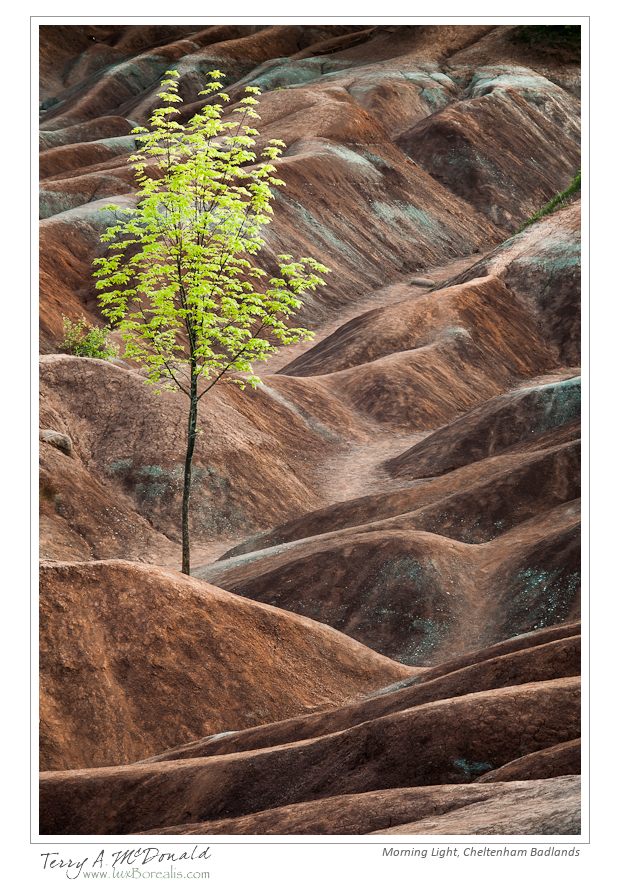
Cheltenham Badlands are a small and rather unique feature along the Niagara Escarpment of exposed and eroded “red” and “green” Queenston shales. While you won’t find any hoodoos like there are out west (Alberta Badlands, Yoho National Park hoodoos and US Badlands), the colours, textures and contrasts of the undulations and hummocks are wonderful subjects in themselves. I prefer the subtle lighting of early morning before there is direct sunshine on the site, however, with a keen eye, dramatic photos can be made at any time of day and season.
I am still shooting with the D200 loaned to me by Kerry, and used a selection of lenses from both of our gear bags: 20mm, 50mm, 85mm, 105mm, 80-200mm and 300mm. I briefly used Kerry’s D3 to get a sense of the 20mm on a full-frame body – wonderfully amazing – I am so looking forward to working with the incredible perspective provided by a 20mm.
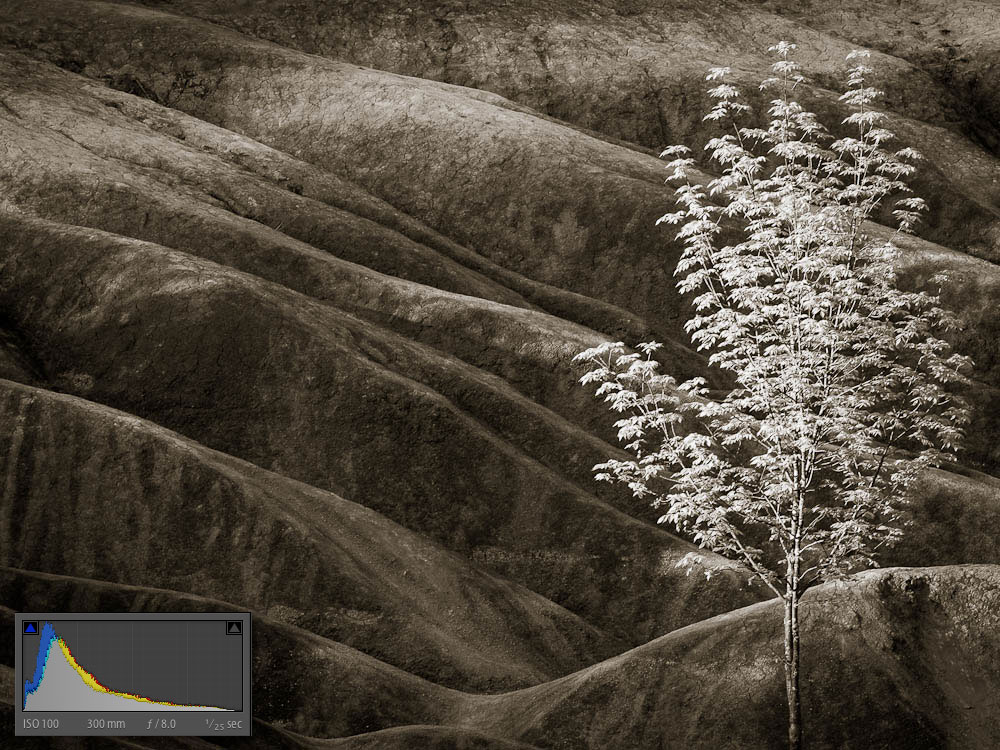
All shots were made on tripod allowing the use of small apertures for great depth-of-field. Shutter speeds ranged from a few seconds to about 1/40th. Most of the raw images were exposed-to-the-right creating distinctly washed out images that retained full detail without the spectre of noise in the shadows. Here is a “before” and “after” sequence, along with the histogram for each, to give you a sense of how this works. After editing the colour version, I went on to create a black-and-white version that I also added some subtle brown/sepia toning to.
Lightroom 4 is truly a marvel to work with. I can be much more precise with the “processing” of each image, allowing me to recreate more precisely what I “saw” in the field. Besides the before-after shots, I’ve included a few other shots from the day.
-
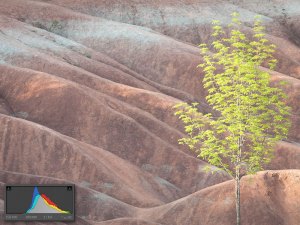
- Original “raw” capture
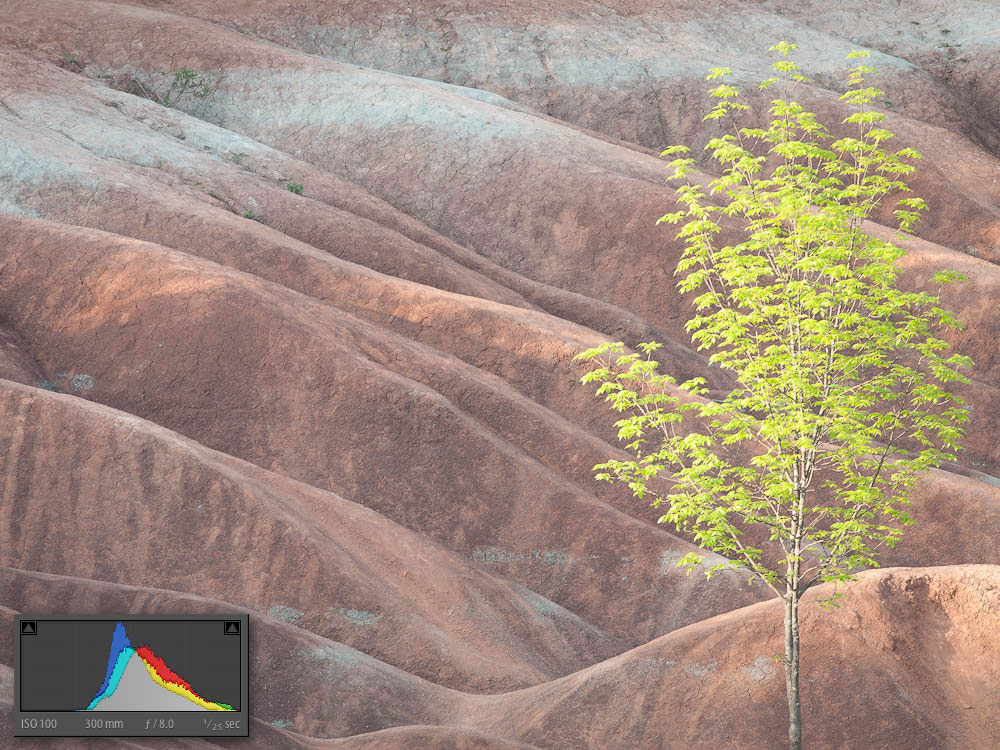
-

- Colour edit
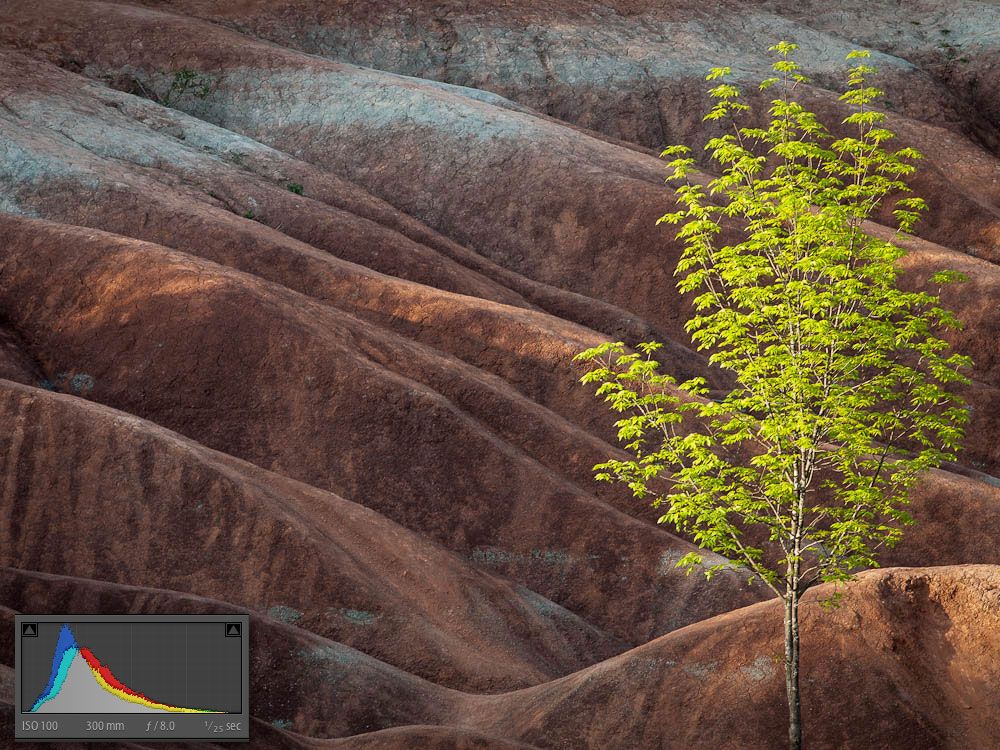
-
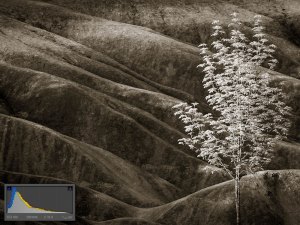
- B&W edit with toning
-
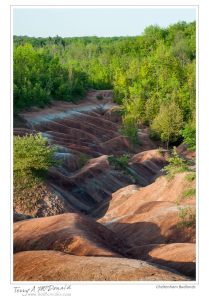
- Cheltenham Badlands
-
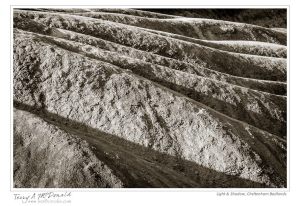
- Light & Shadow
-
- Morning Light
-
- Weathered Skin
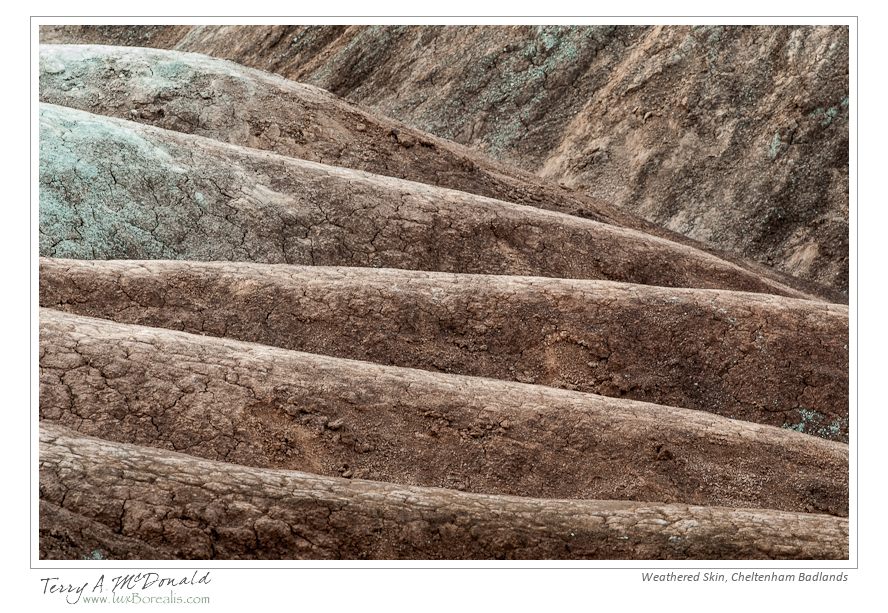
Lightroom 4 is truly a marvel to work with. I can be much more precise with the “processing” of each image, allowing me to recreate more creatively what a “saw” in the field. Here is a selection of other photos from the day:
Nikkor 300mm f/4 AF-S – Amazing!
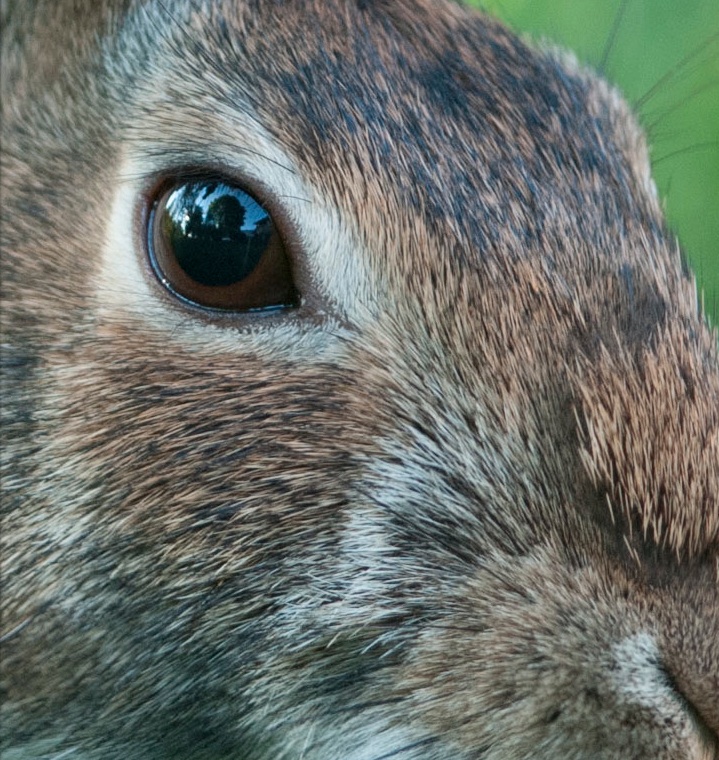
Unmanipulated 100% view
Twenty-five years ago I owned a 300/4 manual focus for my Nikon FM and FM2. It was a great lens, but as way leads onto to way, my Nikon gear was replaced with Pentax 67 gear. It’s funny, though, how things come full circle…
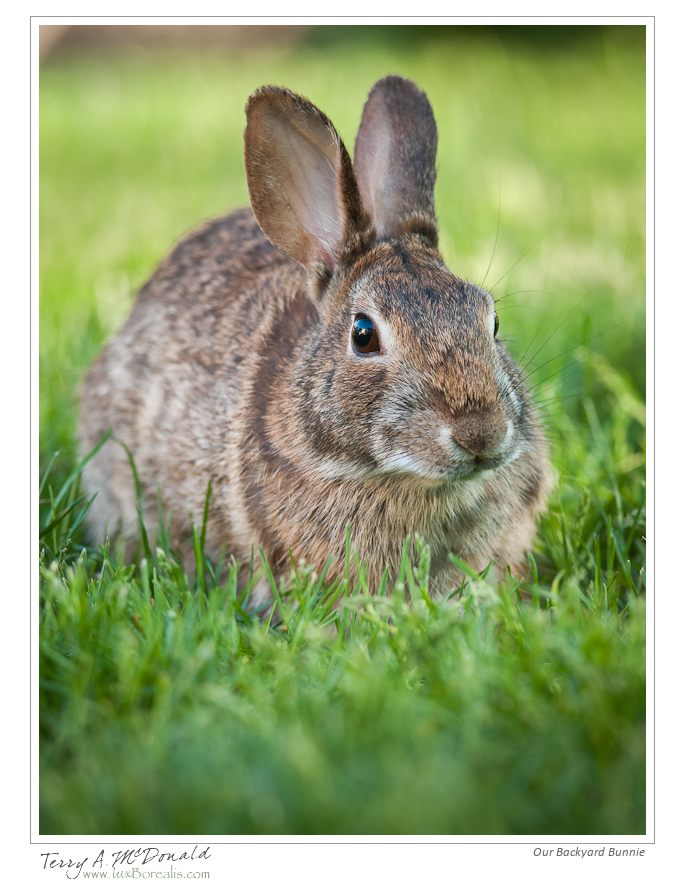
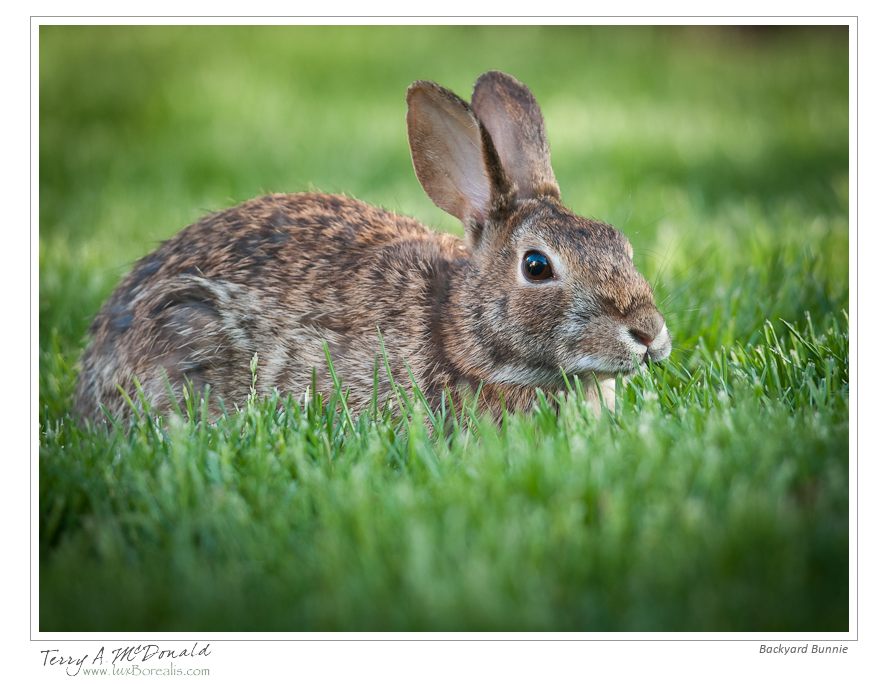
I took ownership of this new AF-S version of what has always been an amazing lens in the Nikkor line-up and it is just as good now as ever. Here are a few shots made last night in our backyard of our resident Eastern Cottontail. In fact, I have made two screenshots showing two raw files at 100% with no manipulation – both shot on a Nikon D200 I am currently borrowing 9prior to the arrival of the D800e.

Unmanipulated 100% view
Maybe I’m easy to please, but I was more than pleasantly surprised at how sharp these images were. They were shot in evening light at f/4 with shutter speeds of 1/100 and 1/125 using an ISO of 400. I can tell I’m really going to love this lens. The bonus is that on the D800e, it can used full frame as a 300mm or in DX mode as a 450mm – still with a 15MB file size! Here are two images processed from last night’s shoot. Enjoy!
Dundas Valley Spring 2012
I spent a beautiful (albeit windy) Saturday morning leading my Nature Photography class from Mohawk College through a small part of the Dundas Valley in hopes of shooting some close-ups of spring wildflowers and other nature photos. I think we all came away with some good photos, but I must admit to being rather disappointed with the day. While there were quite a few Jack-in-the-Pulpits, there was an almost complete lack of anything else.
To me, this is discouraging in such a typically bountiful area as the Dundas Valley. While there were many patches of mayapples, we saw only one clump of trilliums. While one could argue the flowers were finished early, there weren’t even any tell-tale clumps of leaves of trillium plants. Even dog-toothed violets (trout lilies) were in short supply (no flowers, of course, as they are long gone, but very few scatterings of leaves). Instead, vast areas of the forest were covered by mats of either forget-me-not or garlic mustard. From a photographic stand point, these worked quite well, but as a naturalist, I am rather concerned that these aliens have choked out native species of this area.
Even ferns were in short supply. There were very few in the forested area and no Christmas ferns at all; just a few around the mossy boulders.
Oh well… I’ve posted four photos below. As it turns out, my wife Laurie had a wonderful morning birding in the Valley, having seen wood ducks, orioles, eastern bluebirds, a rose-breasted grosbeak and a myriad of warblers, including a number of palm warblers.
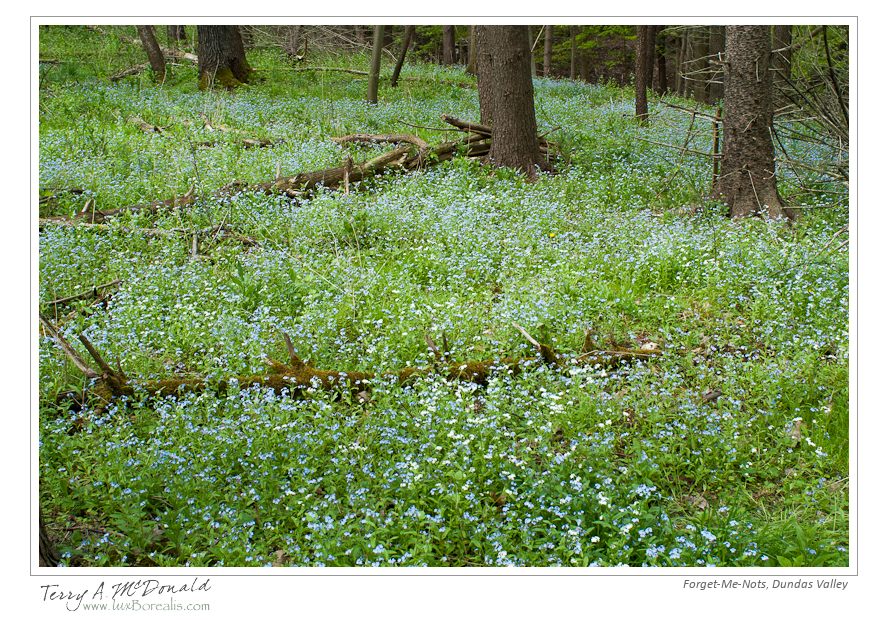
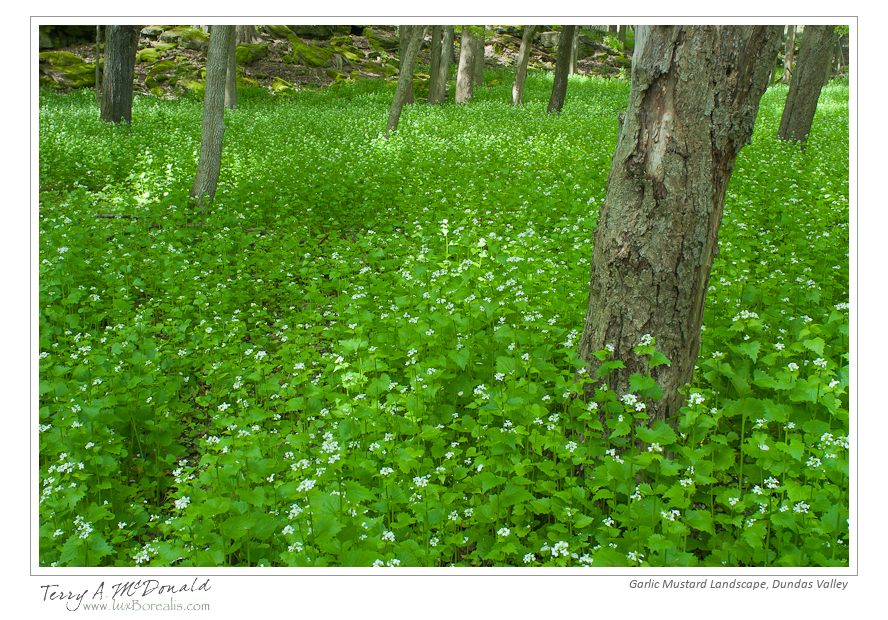
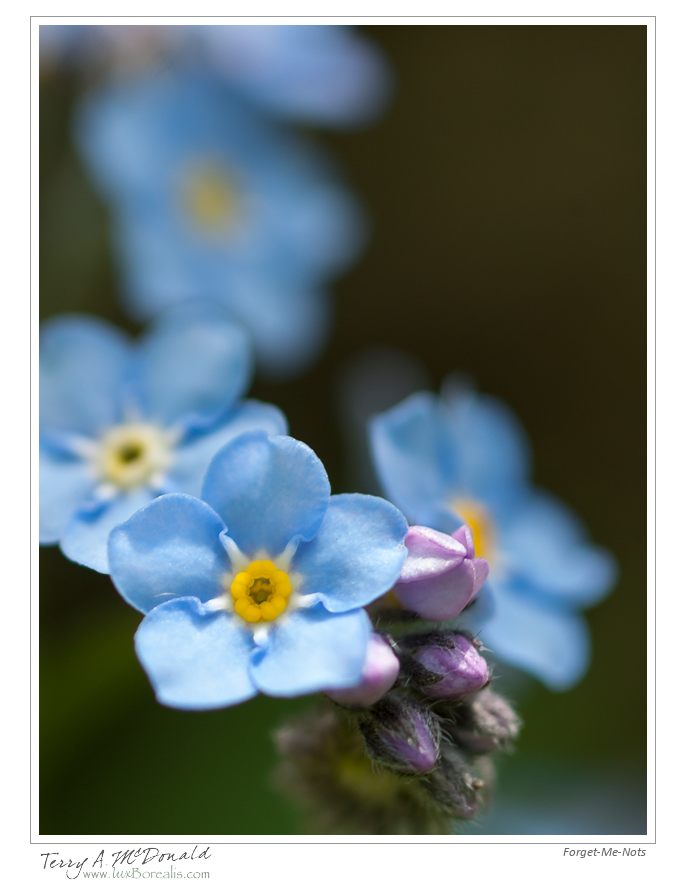

Some 105mm Micro-Nikkor photos
 I’m still awaiting my D800e…perhaps just as well so Nikon has a chance to iron out a few bugs 😉
In the meantime, I’m using a D200 that belongs to my friend Kerry Little – many thanks! – to explore the prime lenses I’ve purchased. I am thrilled to be getting back into close-up and macro work with the 105 Micr-Nikkor, which, of course, is a 150mm on the DX camera. Wow – great working distance and wonderfully tight close-ups.
 Our daughter turned 16 last week (yikes!) which brought a beautiful bouquet of flowers including two Protea. Our love of these beautiful and intricate flowers came with our trips to South Africa – their native land. Our two trips – both in April, their autumn – brought many close encounters with these flowers in the wild. Spectacular! They are incredibly ornate and colourful and make ideal subjects for photographers.
With these being cut flowers, I could move them to an east window after the sun had passed, giving strong, but filtered light. I shot on a tripod allowing for precise composition and the longer shutter speeds needed for small apertures. It was a luxury to be able to rotate and move the vase to get just the right views, framing and focus – something I don’t have the option of doing when photographing in the field!
Nikon D800 – “Should I upgrade?”
I have been asked by a number of people about whether they should upgrade to a Nikon D800. They are understandably attracted by the amazing potential that this camera holds for higher quality digital photographs and video. Once they get past the shock of its price, they start thinking about that state-of-the-art 36mp sensor – bigger has to be better, right?
Well perhaps, but not for everyone. There are a few things you need to consider before jumping on the D800 bandwagon:
- How often do you enlarge photos to 16″ or more? The 36mp sensor in the D800 is 7360 x 4912 pixels. At 300ppi, it will produce uncropped prints of 16.4″ x 24.5″ or at 360ppi (for Epson printers) uncropped prints 13.6″ x 20.4″ in size. If you are making prints this size or larger on a regular basis, then the D800 is for you. Some have asked, “But wouldn’t downsizing from this file size result in better prints as well?” Quite possibly, yes, but the difference at print viewing distance would be minimal and perhaps only visible to someone who really knows what to look for (which is not the vast majority of people who buy large fine art photographs). By the way, I am speaking in terms of uncropped prints, because a photographer who is working towards mastering the craft will routinely compose to either fill-the-frame or at least fill one dimension to allow the other dimension to be cropped. Do you do this as common practice? If not, then perhaps the D800 is not for you.
- Do you shoot raw or jpeg format? Many pros shoot jpegs as that’s what their job demands: grip and grins that need to be processed and sent out immediately or news hounds that don’t have time (or the necessity) for post-capture fine-tuning. Even many wedding photogs are still shooting only jpegs. While it may be controversial for me to say this, but if you are shooting jpegs and you are not a pro – in other words if you are shooting jpegs because they are more convenient than doing some post-process work on your photographs – then the D800 may not be for you. The D800 is all about image quality. The photographs you are capable of producing will not improve with more megapixels, only their size will increase. If you are not willing to put the time and effort into fine-tuning raw image files, then the shortcuts you take in producing jpegs may well prevent you from taking full advantage of the benefits the D800 offers. Don’t get me wrong – the D800 produces amazing jpegs, but if it’s only jpegs you want – pre-processed and pre-sharpened with a truncated colour depth – then the D800 is not the ideal machine for you.
- Are you prepared for full-frame? This goes along with the next question. Your 18-55mm or 18-200mm zoom will not cut it on the D800 unless you use the camera only in DX mode. If that’s the case, you’d be better off with a D7000. If you are not prepared to upgrade your DX lenses to FX, then don’t consider a D800.
- Do you have lenses that will resolve to 36mp? Most of the kit lenses and cheap zooms produced by Nikon and the various 3rd party lens manufacturers will not resolve 36mp well enough from centre to corner to take advantage of the D800 sensor. While they will capture 36mp of data at full-frame, they will not resolve detail in ever one of those 36mp, even if the detail is in the original scene. Like the previous question, if you are not prepared to invest in lenses that resolve 36mp of detail, then you should rethink your decision to buy a D800. For more information, have a look at the work lensrentals.com is doing or the discussions on the Luminous-Landscape Forums here and here.
- Is your technique refined enough to get the quality from 36mp you are expecting? A number of D800 users have, in just this short time, realized that to get the most out of the D800 you need impeccable technique. Hand-held shots do not seem to be as sharp as they were with 12mp because even the smallest of movements are now being recorded. Diffraction at f/16 and f/22 is more noticeable. You may find that working on a tripod becomes the norm when using the D800 – would you be happy with that? You may also find (as other D800 users have) that each lens will need its autofocus fine-tuned. As well, many D800 users are making active use of live view for focussing. Are you prepared for that kind of precision?
- As a corollary to Q 6. (and there is no insult intended) – would you recognize the additional image quality provided by a D800? Many photographers are quite satisfied with their on-screen results and the prints they are producing. In your current photography, do you recognize that you have reached the image quality potential of your current system? If not, then the D800 is not for you. Do you recognize the flaws in IQ with your current system and wish to go beyond what you can currently achieve? If so, then perhaps the D800 is the way to go.
- Are you prepared to buy larger, faster memory cards? A standard raw file from a D800 is almost 75mb. your current 4GB card that may hold nearly 300 12mp raw files will now only hold 53 D800 raw files. Even the jpegs at highest quality are over 20MB in size. You will need to invest in larger capacity memory cards with faster write speeds, not just for raw files, but for video as well.
- Is your computer system and image management application up to processing 36mp files? Further to Q. 7, that 75mp raw file you’ve just captured will open in Photoshop at over 200MB – and that’s before you add any layers! Is your system up to manipulating these files? Realistically, however, most serious photographers will have already migrated to using a non-destructive workflow offered by Lightroom, Aperture and Capture One. But even there you will notice a speed hit, particularly when it comes to generating 1:1 previews (don’t do this upon Import, but rather only as needed) and when retouching. Be prepared for a slower work-flow!
Your investment of $3000 (+ tax!) for a D800 body may end up costing you a whole lot more if you haven’t thought things through thoroughly. You will need larger, faster memory cards; you may need a few new lenses or at least one of the more expensive high-optical-quality Nikkor zooms (and the circular polarizing and other filters for them); you may need a new computer system or at least a pile more ram. You may also need to invest in Lightroom, Aperture or Capture One to avoid the humungous file sizes generated by a Photoshop workflow. And, if you haven’t already adopted a non-destructive workflow, that may also be a learning curve you need to take on.
My decision to move from my 12mp Olympus to the D800e was not taken lightly. Nor was it taken without a hard look at (a) what style of photography excites me; (b) where I would like to go with my photography; and (c) how well my technique, workflow and equipment fit the requirements of a D800. As I have said before in posts, I come from a background of using manual, mechanical 6×7 and 4×5 cameras with prime lenses. I am quite happy to use a tripod and slow my methods down to squeeze from every scene as much image quality as possible– in fact, that’s where I thrive. For me, using a D800 will be like going back to my medium and large format days but with the added convenience of digital processing and printing, video capture and, when needed for extra reach from a telephoto, DX capture at 15mp.
I am greatly excited by the prospects and am anxiously awaiting the arrival a D800e body.
 luxBorealis Blog