Photo Workshops and Courses
Point-and-Shoot–Digital SLR–Digital Darkroom
–Explore Outdoors–Fine Art Courses and Workshops
Through the advent of digital, I’ve noticed some significant trends in photography.
- photography has become much more available to people. By using cell phones and inexpensive compact cameras that do not require the expense of film developing and printing people are freer to shoot anything (for better or worse!);
- photography has become much more technical. Yes, you can still “point & shoot”, but there are many more buttons on the average camera today than at any time in the past;
- people are able to produce more higher quality images on a regular basis, due to the accuracy of auto exposure, autofocusing, face detection, image stabilization and the improvement of program modes and auto ISO;
- unfortunately, there are still huge technological barriers to people actually enjoying the photographs they take. It’s easy if you only want to see your photos on the LCD screen of your camera or mobile, and while uploading and printing may seem easy, it is more complex and time -consuming then dropping off a roll for printing. As well, storing photos so that you can find them again is an even greater headache.
Cameras, however, are still far from perfect, and the decision-making technologies in them still allow significant room for user error. For me, this is a good thing because if cameras were perfect, I would be out of work.
Point and Shoot: The average point & shoot user still ends up with a number of photos that are, at best, only average. Many are still poorly exposed – not due to user-error but rather camera-error. In the end, cameras are just machines (computers, really) that simply respond to commands. Luckily, with just a few hours of coaching, virtually anyone will see dramatic improvement in the photos they take. And, by extending that coaching to the on-screen editing of photos even more dramatic improvement are possible.
The bottom line is that with a few evenings of hands-on practice, you will see marked improvement in your pictures. If you’re new to photography, take a Starter course t really understand what’s happening when you take a picture and what you can do to ensure greater success. For those who feel more confident, take the Advanced courses starting in March.
Digital SLR: Over the years, with improvements in camera technology, I’ve often wondered if demand for photo courses and workshops would decrease. It hasn’t and I credit this to those who have this burning desire to create. Each of you are experimenting far more than ever and discovering new ways of using photographic technology to produce images. This is great. You are pushing your equipment further and demanding more. However, despite this amazing technology, there are still gaps between what you see and what you get and that’s where a photo course or workshop comes in.
The DSLR courses are also split into Starter and Advanced. With a much more advanced piece of technology in your hands, there is more to consider so we’ll start with the basics and move into the complex.
Digital Darkroom: Photography doesn’t end with taking pictures. Even more can be done to enhance great images through the use of a good photo editing program like Photoshop Elements. For this reason, I offer a 4-session course to get you immersed in digital editing. Alternatively, you can get your feet wet with the Understanding series – one-session mini-courses on File Management, Picasa, iPhoto and Picnik.
Explore Series: Getting outdoors with a field session is the best way to learn nature photography. We’ll start in two weeks with a Winter Wonderland workshop and continue in the spring. The outdoor field session is bookended with classroom sessions to introduce and wrap-up our shooting weekend.
Lastly, the Fine Art Series will challenge you to start looking at the world in a different way. Photography is, ultimately, an art form that allows you to visually express yourself. Confidently expressing that vision is helped with specific exercises and assignments that force you to actually “see” and not just “look”.
Join me for a great winter and spring of photography and begin turning snapshots into photographs you are truly proud of.
Exciting Photo Tours and Safari Developments
This week has been a great one for planning photo tours and safaris.
On Tuesday I sat down with Stephanie and Karen from Expedia CruiseShipCenters in Waterloo to begin planning a photo cruise for 2011 – probably January-February and probably to the south Caribbean where you will find gorgeous scenery and flowers and the wonderful colours of the islands.
This evening my friend Allan Phillemon and I sat down to start working on a photo safari to his home country and my home-away-from-home: Tanzania. What a spectacular place: Kilimanjaro – the jewel of Africa, the magnificent Serengeti Plain and Ngorongoro Crater, not to mention the wildlife that is accessible at all times. If you haven’t seen my photo of Tanzania – have a look here. Allan is also known as Kiliman (http://www.kiliman.com/) because of the excellent guided climbs of Mt Kilimanjaro. In fact, it was Allan who made all the arrangements for the IMAX crew for their ascent of Kili in making the film Kilimanjaro. Allan and I are looking at November 2010 and February 2011.
Travelling to these places is wonderful enough in itself, but a photo tour or safari designed specifically for photographers allows us to “take it up a notch”. Planning is done from the start to accommodate the needs of photographers — photogenic destinations; more time to get to know places; getting out when the lighting is ideal; plus photo tips and a workshop-like atmosphere where photographers are prepped ahead of time and questions answered in the field as they arise. A real win-win situation for all.
So start dreaming, start planning and start saving – there will be great opportunities for travel and photography in the coming year.
Image-A-Week-2010-01
It’s now 2010 – a full decade after the millennium – can you believe it?
Something else that’s unbelievable – although if you know me, it’s completely believable – I was out photographing first thing New Year’s morning. We were visiting my sister-in-law who lives in the beautiful part of Ottawa called Sandy Hill. Most of the area has large, turn of the (20th) century brick homes; some with wide, sweeping verandahs, some with great little circular windows, some with turrets. The area is full of character – ideal for photography. Throw in a good dose of Canadian snow and there are the makings of some great photos.
Before I show you one of the photos, I found it interesting that I had difficulty selecting just one photo. One photo doesn’t seem to encapsulate the morning very well because it was such a mixture of old and new, formal and informal, with random elements and design elements. so, the one photo I chose has combinations of that, yet ti does not show the lovely character of the homes in the area. These images really “hang” best as a group. However, I will stick to the intent of an Image-A-Week.
Here is that one photo:

Crab in Snow
You can see the rest of them here: Gallery – New Year’s Morning, Sandy Hill, Ottawa
All of the photos are monochrome – black-and-white tinted to give them some warmth. All too often, photographs that include snow are left cold or tinted blue. To me that just panders to the stereotype of cold winters. Sure winters are cold and snow means it’s below freezing, but that doesn’t mean the photograph needs to be cold, too.
I love winter! I don’t want people to think “cold”. I want them to look beyond their bodily discomfort and see the beauty in winter. Those who know me will also say that I’m the crazy one who goes out without a coat. True, but never without a warm, cosy sweater or fleece on nor without gloves and a scarf! That being said, when I’m out photographing in winter conditions, I make sure I’m covered in fleece and Gortex – right to the over-mitts!
So this winter – get dressed for the cold and get out there and make some truly beautiful photographs. On the same note – my Winter Wonderland workshop is just weeks away. You’ll want to get signed up soon to take advantage of the discounts – luxborealis@mac.com or 519.265.4151.
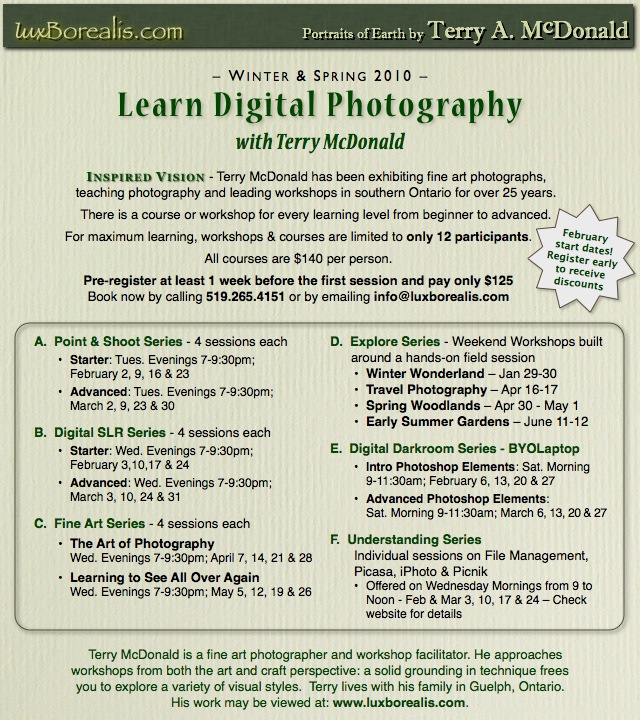
luxBorealis 2010 Winter and Spring Workshops Announced
If you are interested in photography, taking a photo course or participating in a workshop is one of the best ways to see significant improvement in a short period of time. Not only do you get immediate feedback but you will be working with a group of like-minded people who are all striving to improve.
My workshops are directed towards your interests, which is why course and workshops groups are kept to a maximum of 12 participants. As well, from beginner to advanced, there are courses for each level of learning allowing you to opt in where you most feed comfortable. If you are interested in the technical, try the Point & Shoot or DSLR series. Perhaps you are more into the art of photography – try the Fine Art Series where we explore the Art of Photography and Learning to See All Over Again.
To learn about the file management and editing, take the Digital Darkroom – BYOLaptop series. This is offered at two levels – beginners can take the Understanding series as individual sessions where we look at File Management, Picasa, iPhoto and the great online editing app called Picnik. For more advanced photographers, sign up for Photoshop Elements Introductory or Advanced offerings. If there is sufficient interest, I will run a course specifically for Photoshop and/or Lightroom – so email if you are interested!
In the Explore Series, we get our feet wet with combined field and classroom sessions. Friday evening in the Intro Session followed by a Field Session Saturday morning. Saturday afternoon we wrap things up by looking at and discussing images from the morning. The first workshop is Winter Wonderland on January 29th and 30th when the snow will challenge us with exposure and delight us with the great photos possible.
Each 4-seesion course or Explore Series workshop is CDN$140 per person. If you register a week or more in advance, the cost is reduced to CDN$125. All workshops and courses take place in Guelph, Ontario. Please note: this price is exclusive of travel and accommodation costs. If you require overnight accommodation, a list of local hotels, motels and B&Bs will be provided.
Happy New Year! – What’s your photographic resolution?
So 2010 is almost upon us.
What are you going to do differently in 2010? What are you going to challenge yourself with?
It is so easy to get into a rut. If your job is secure and your family is healthy, we often find ourselves a few years down the line wondering what we’ve achieved. I don’t mean that we should feel the need to start a new life or make an impact on the world. It’s just healthy to be thinking of what we can do to stimulate our lives or our hobby.
If you work in photography, try something new this year – a new technique or a new way of looking at the world. If you’ve never tried shooting and processing raw images – try it! If you’ve never explored the nuances of black-and-white – try it! Try shooing everything for one month with your zoom set at its widest angle. Some of the trendier things to do right now include 365 Clubs (an image a day for a year) or, along the same lines but perhaps designed for those who have a day job – contributing to a 52 Club (an image each week). Try printing your ten best photos from 2009 then framing or “plaking” or 5 of them. How about publishing a book of your 20 best images from 2009. Remember that family trip you took last summer? Put together a book of images and publish it – one for each of your kids so they have it as a reminder. But don’t try all of these at once. Taking on too much at once can cause you to drown in change and projects.
What ever one thing you choose to change or try for the first time, stick with it until you have mastered it. I believe it was photographer Minor White who once said that it takes a full ten years to learn your craft. It’s not a whole craft you’re learning, it’s just one change, so maybe you could accomplish it with some degree of satisfaction in two or three months. Fred Picker, another of America’s black-and-white photographers felt you needed to repeat a task 100 times before you could confidently store it away as “second nature”. He was referring to processing stacks of 4×5 sheet film by shuffling them in a tray of developer in the pitch dark without scratching them. While nothing we do today in photography takes that kind of care a dexterity (after all we’ve all learned Command-Z or Control-Z), there are certain skills that do demand repetitive training. Photoshop routines come to mind such as masking or sharpening or healing brush or black-and-white processing.
At this time of year, just about everyone who feels the need for personal growth is setting for themselves some kind of goals or “resolutions”. Even if you’re a hobbyist, try setting some goals for your photography. Write down two or three things you would like to accomplish this year that are within your power. Winning a photo contest is not really within any one individual’s power no matter who you pray to, so make them personal growth or personal vision goals. Have you ever done a family portrait? Have you ever studied the changing light on a venetian blind as the sun glides across the heavens? Have you ever tried night photography or stars or the city or the moving cars on a highway? How about puddles – have you ever tried to shoot 15 different images of puddles? Here’s my favourite – and, no, my name isn’t Rover – try shooting 15 different images of a fire hydrant. Or shadows in the snow; or a photo essay of your city; or…
A year from now, revisit those goals to discover where they have led you. You may be surprised that the pathway wasn’t as straight as you expected and that somewhere along the way you ended up in an entirely different albeit equally satisfying place.
All the best to you and your family for 2010!
— Terry McDonald
 luxBorealis Blog