Night Sky and Star Trails over Ferragudo, Portugal
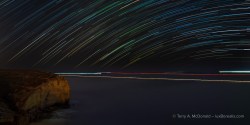
1240 words; 4 photographs; 7-minute read
It sure is quiet out here with only the crash of waves and the low rumble of a fishing boat off the coast. Otherwise, dead silence. It’s 1:30am and I’ve walked the 10 minutes from our rental villa, through the coastal scrub, to the edge of the cliffs high above the Atlantic Ocean
When planning this trip, I thought, ‘Wow! Only the Atlantic Ocean to the south — a perfect dark sky for astrophotography.’
So much for expectations. I was shocked at how bright it is out here! I could see without the aid of my headlamp! Oh well, I’m here now. Better make the most of it.
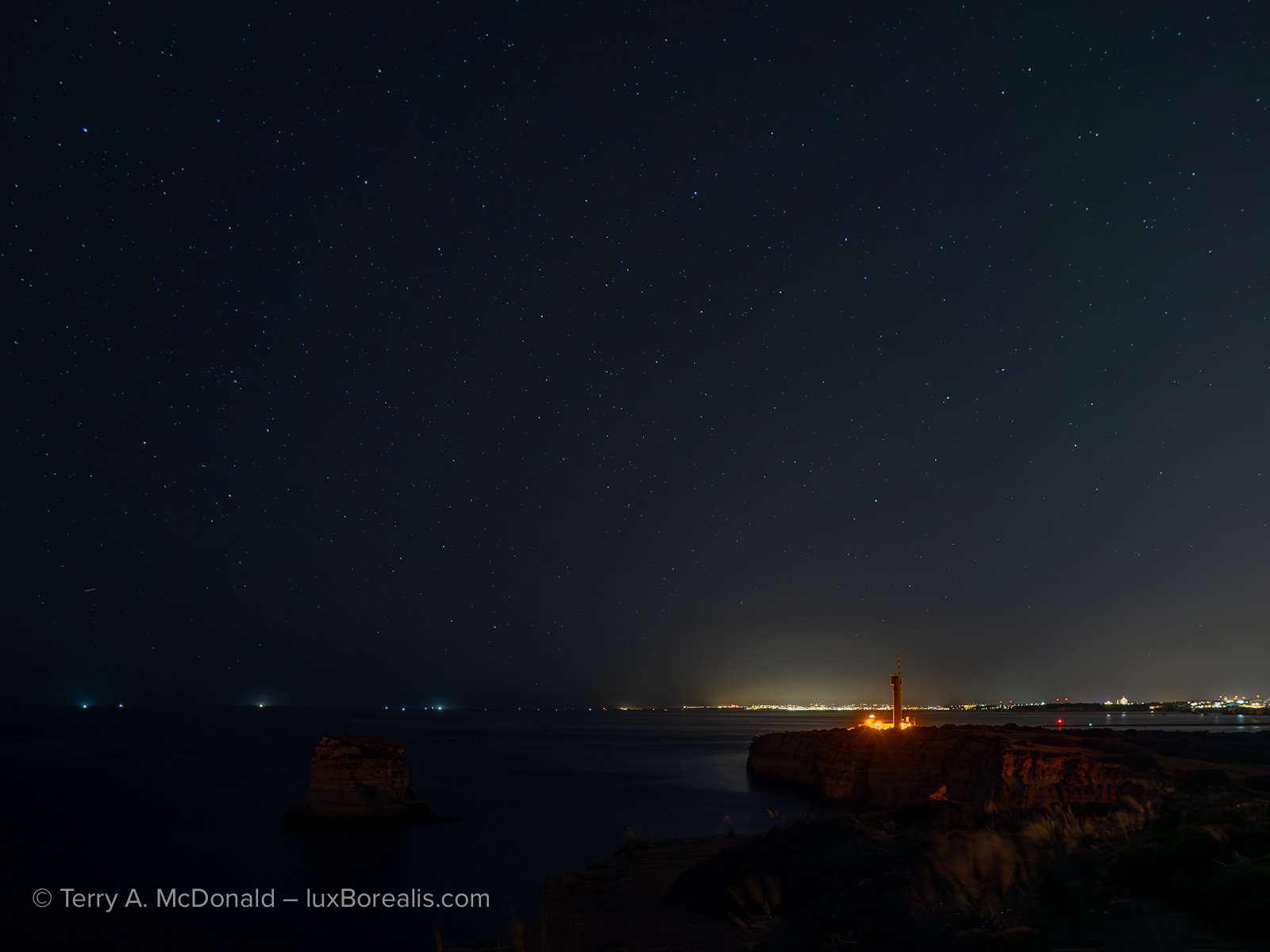
Olympus OM-1 w/ Leica DG Summilux 9mm/1/.7 • ƒ2.8 @ 10sec. • ISO 400 • Lightroom
It doesn’t look terribly bright, but this is 3 EV less exposure than the photos below, looking in the other direction .
To the bottom of the OM-1, I added the HLD-10 vertical grip and battery holder. This moves the active battery away from the sensor to reduce heat which reduces sensor noise. To the front, I attached my Leica DG Summilux 9mm/1/.7 from Panasonic. The set-up was atop a Benro ball head on my Manfrotto 055 legs.
Now for a composition. Initially, I wanted a horizontal, and for it to include one or two of the sea stacks off the coast. But with the light coming in from Portimao and the Ponto do Altar lighthouse, my hopes vanished. There was also a very brightly-lit fishing boat in that direction.
Instead, I turned southeast to capture some of the headland and the beach below me at Praia do Caneiros. At 25m high (80 feet), my hope was that tonight wasn’t when the cliff decided to give way and plunge into the sea! Believe me, in the dark and only a metre from the edge, every movement was carefully and purposefully made, especially with three gangly black tripod legs!
Capturing the Stars Above
Ready for action, I set the camera up for a few stills. StarrySky AF worked its magic by autofocusing on the stars. You’ll find it on the Menu at AF > 1 > [*] AF MF. This can also be changed on the LCD menu or using the AF button on the top left of the OM-1. Other settings included:
- M (Manual) → ƒ2, ISO 3200 to start;
- Drive set to Silent Self-timer 2sec.
- Noise Reduction On: Menu > Camera1 > 3 > Noise Reduction
- S-IS from Auto to Off: Menu > Camera1 > 8 > Image Stabilizer;
- Dimming the LCD Brightness: Menu > Gear > 3 > Monitor adjust;
- Night Vision to On: Menu > Wrench > 2 > Night Vision;
I’ve added each of these settings to a My Menu to make them easy to find. As back-up, I also keep them on a Note on my phone.
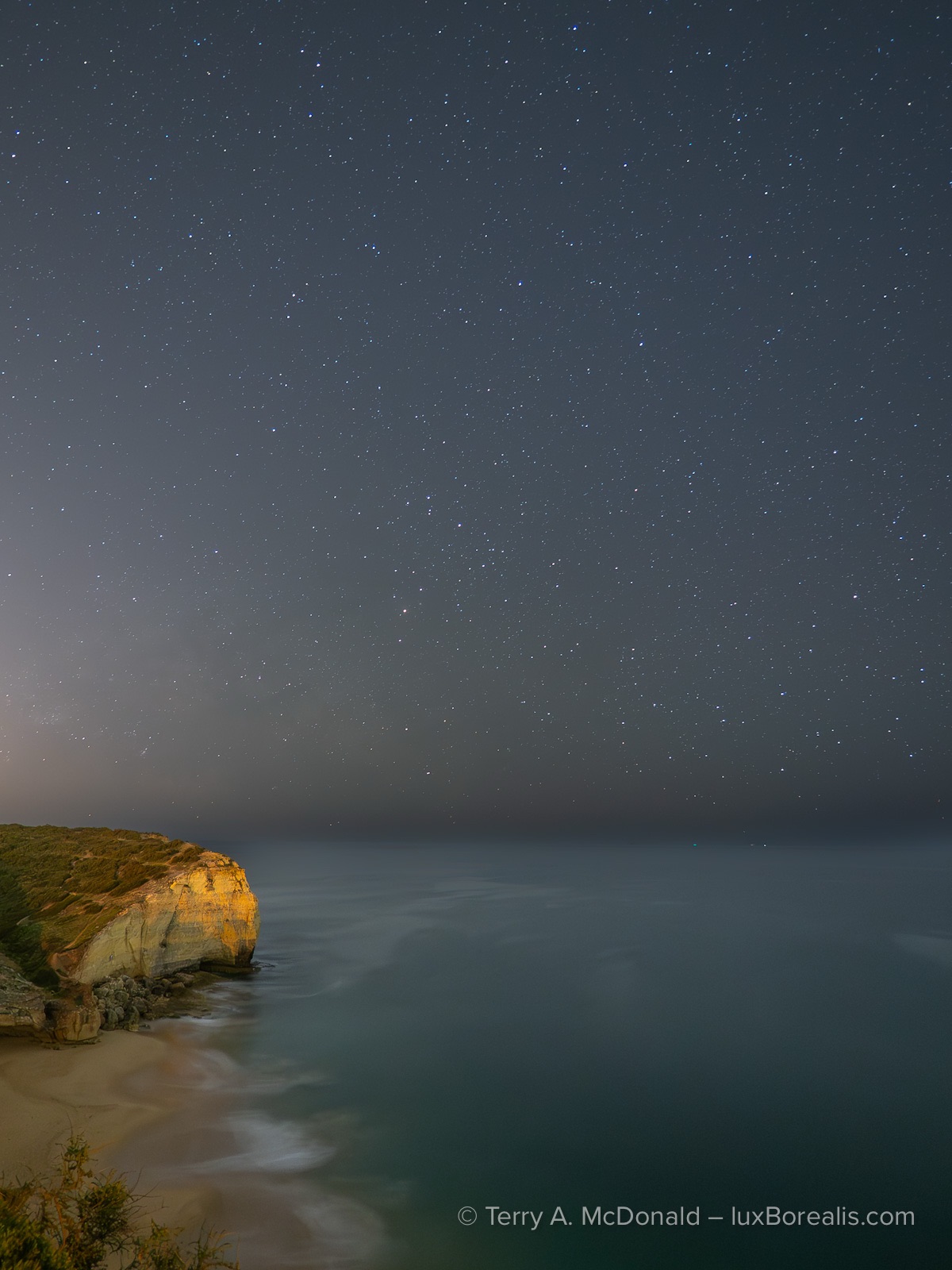
OM-1 w/Summilux 9mm/1.7 • ƒ2 @ 20 sec • ISO 3200 • Lightroom
A bright exposure, the light from the villas down-the coast is evident on the left side.
My first few exposures were experimentation. The Rule of 200 with a 9mm lens (or for 35mm sensor users, the Rule of 400 with an 18mm lens) told me that 22 sec was the maximum I could use and keep the stars as points of light. So, I started with 20sec at ƒ2, ISO 3200; followed by 10sec, 5sec, then 5sec at ƒ2.8. Given how well the lens performs at ƒ2, I changed the ISO and shot at 5sec at ISO 1600, then 800.
I wasn’t happy with the amount of light coming from all the villas down the coast to the east, but it wasn’t as bad as the view west with the lighthouse and Portimao. I’ll just have to ‘do the best with what I’ve got’.
One bonus of the bright lights of Portimao was that they gave an appealing blush of light to the next headland, allowing some detail to show.
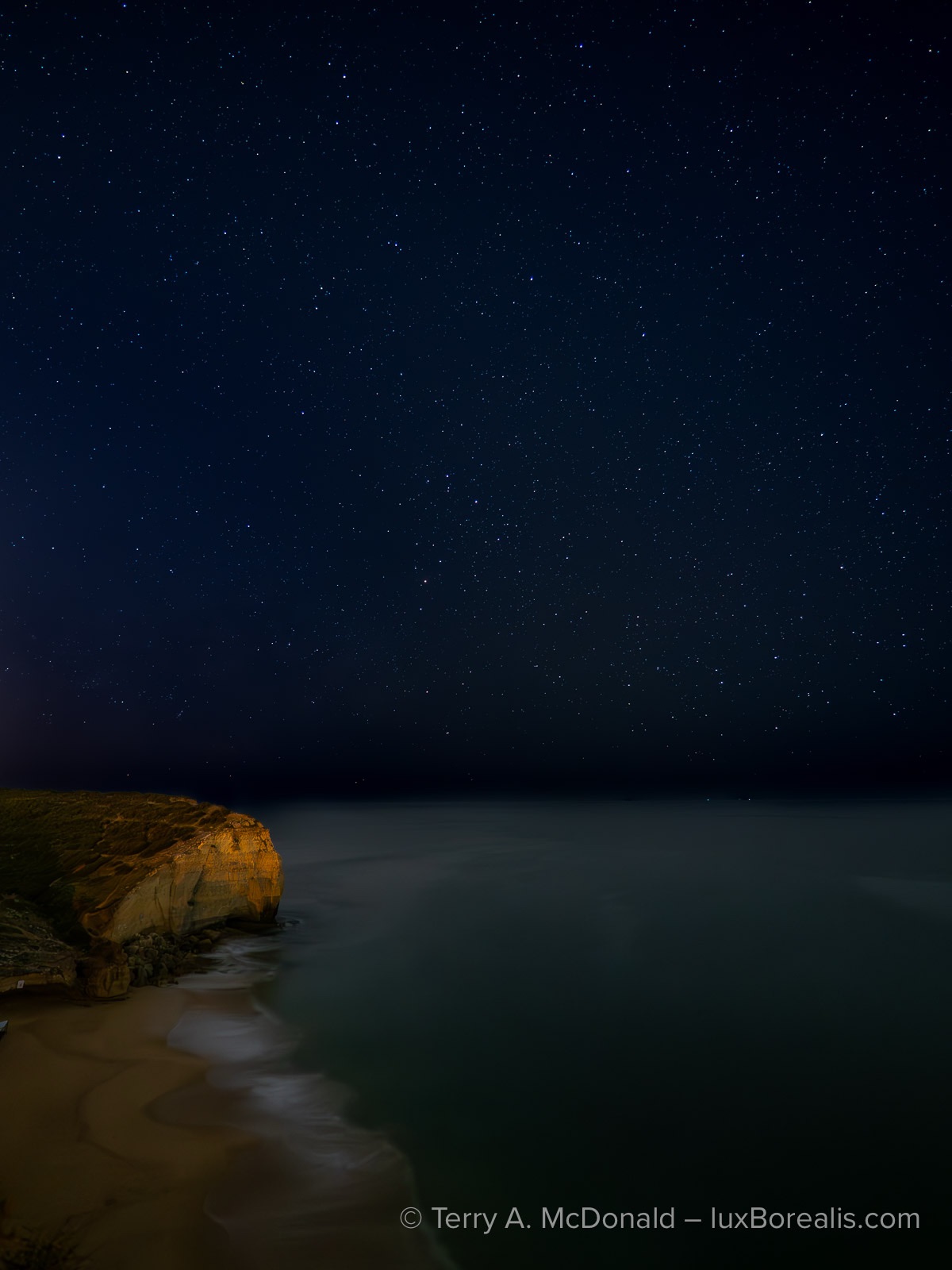
OM-1 w/ Summilux 9mm/1.7 • ƒ2 @ 10sec. • ISO 3200 • Lightroom
This is still a work in progress, but for now, it works for me! I love the ethereal glow coming from the ocean. A 10sec. exposure gave noticeably sharper pin points of star light and it seemed to balance tones better than 5sec. However, it took three radial masks to adequately reduce the glow from down the coast and I’m still not 100% happy with it.
Star Trails using Live Composite
Now, for some star trails. I was looking forward to the results from a southern exposure as I’m more used to looking north with stars arcing around Polaris.
Knowing I’d be “standing around” waiting for a long exposure, I had brought my folding chair with me, which just fits diagonally in my checked luggage. I also had a book downloaded to occupy my time while waiting.
Star trails are traditionally captured on digital sensors as a series of frames that then get composited using software such as Affinity Photo. Photoshop, Helicon or Zerene. However, the OM-1 offers Live Composite, which does it all live, in-camera, as you are watching on the LCD. And, it spits out a raw file, not a JPEG—perfect!
I planned for the exposure to go for a full hour. I made sure the aperture was set to ƒ2, and the shutter speed at 60sec. I selected ISO 400, having successfully used it with my star trails over Fundy National Park — Fireflies and Night Sky — back on 1 July of last year.
I changed from M to B (Bulb) and selected Live Composite. Following the on-screen directions, I released the shutter and let it do its preparations. A minute later, it asked me to begin. I released the shutter again and voilà, Live Compiste started.
A minute later I could see the first frame on the LCD. Brilliant! Each successive minute after that, the star trails were extended and I sat down and read my book.
At 45 minutes, I checked the progress and — Wow! — it looked great. Another 15 minutes later I ended the exposure, after which the camera performed a 60-second reduce noise routine. I packed up, and headed back. In the last 30 minutes or so, a wind had begun and, being only 14°C, I was starting to get chilled, despite my fleece and light rain coat / wind breaker.
It was 3:30am. No exciting processing now. It could wait until morning.
And here is the result:
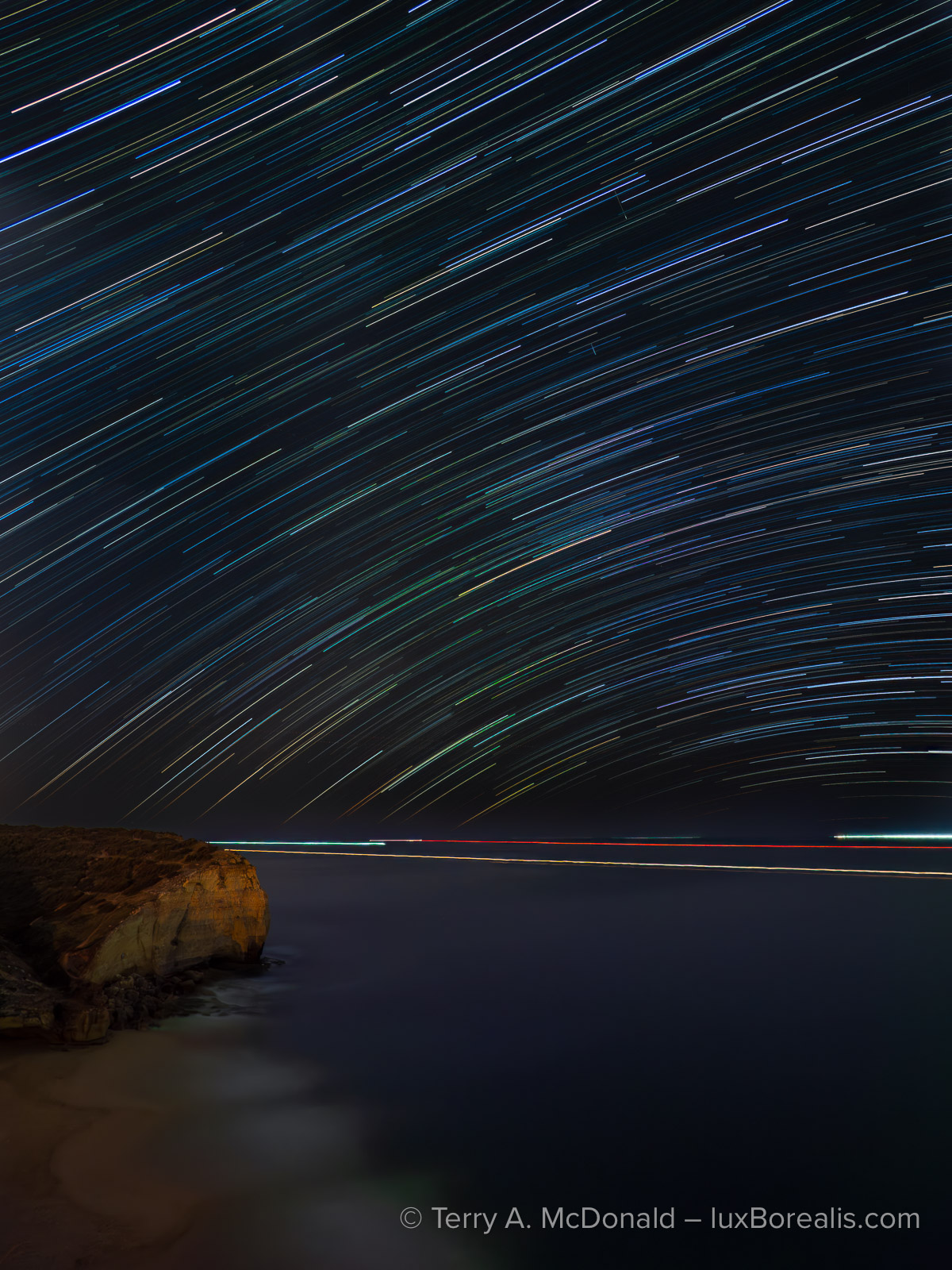
OM-1 w/ Summilux 9mm/1.7 • ƒ2 @ 60 x 60sec. exposures • Live Composite • ISO 400 • Lightroom
I’m not sure if I like the boat traffic. Nor am I enamoured with the two small satellites. Downsized to 1600px, which this is, causes the image to lose some of its detail. In fact, it looks a bit ragged. Normal size it looks great. I used 2x Generative Upscale from within Lightroom and this photo enlarges beautifully to 24×32″; 48×64″ would be stunning.
Stay tuned. I think I’ll try another area a bit down the coast, hopefully with less unwanted light. I’ll also be posting some landscapes of the cliffs and beaches with that gorgeous blue water.
Thanks for reading. Be sure to continue the discussion by adding your COMMENTS, questions or observations and feel free to SHARE this post with others.
NOTE: This blog is completely free and does not include commercial affiliate links. To help keep it free, consider buying me a coffee . . .

Discover more from luxBorealis Blog
Subscribe to get the latest posts sent to your email.
 luxBorealis Blog
Thank you,
Timothy