Wildlife and Bird Photography—On Safari in Tanzania, Part 3
Apologizes for the slow materialization of this post. There has been much to write on the photography front with articles on M43 as the Sweet Spot in modern photography, Raw File Optimization, and Navigating the AI Juggernaut, amongst others. So, casting my mind back to our final few days in Tarangire has been difficult, but oh, so pleasurable.
The two articles previous to this are:
- Wildlife and Bird Photography—On Safari in Tanzania, Part I: Arusha National Park; and
- Wildlife and Bird Photography—On Safari in Tanzania, Part 2 – Tarangire National Park
Back to Tarangire . . . with Allison
Our daughter Allison joined us for our last two weeks in Tanzania. It was a wonderful trip down memory lane with her, re-visiting the school we taught at and where she first started school. We visited with her Year 1 and Year 2 teachers and her carer while Laura and I were teaching. The reunions were special as they had not seen Allison since she was a young girl of 8!

3:25pm, 3 Oct; OM-1 w/ 100-400mm at 342mm (684mm efov), ƒ8 @ 1/640, ISO 800; raw file processed in Lightroom

2:06pm, 6 Oct; OM-1 w/ 100-400mm at 400mm (800mm efov), ƒ8 @ 1/1000, ISO 1600; raw file processed in Lightroom
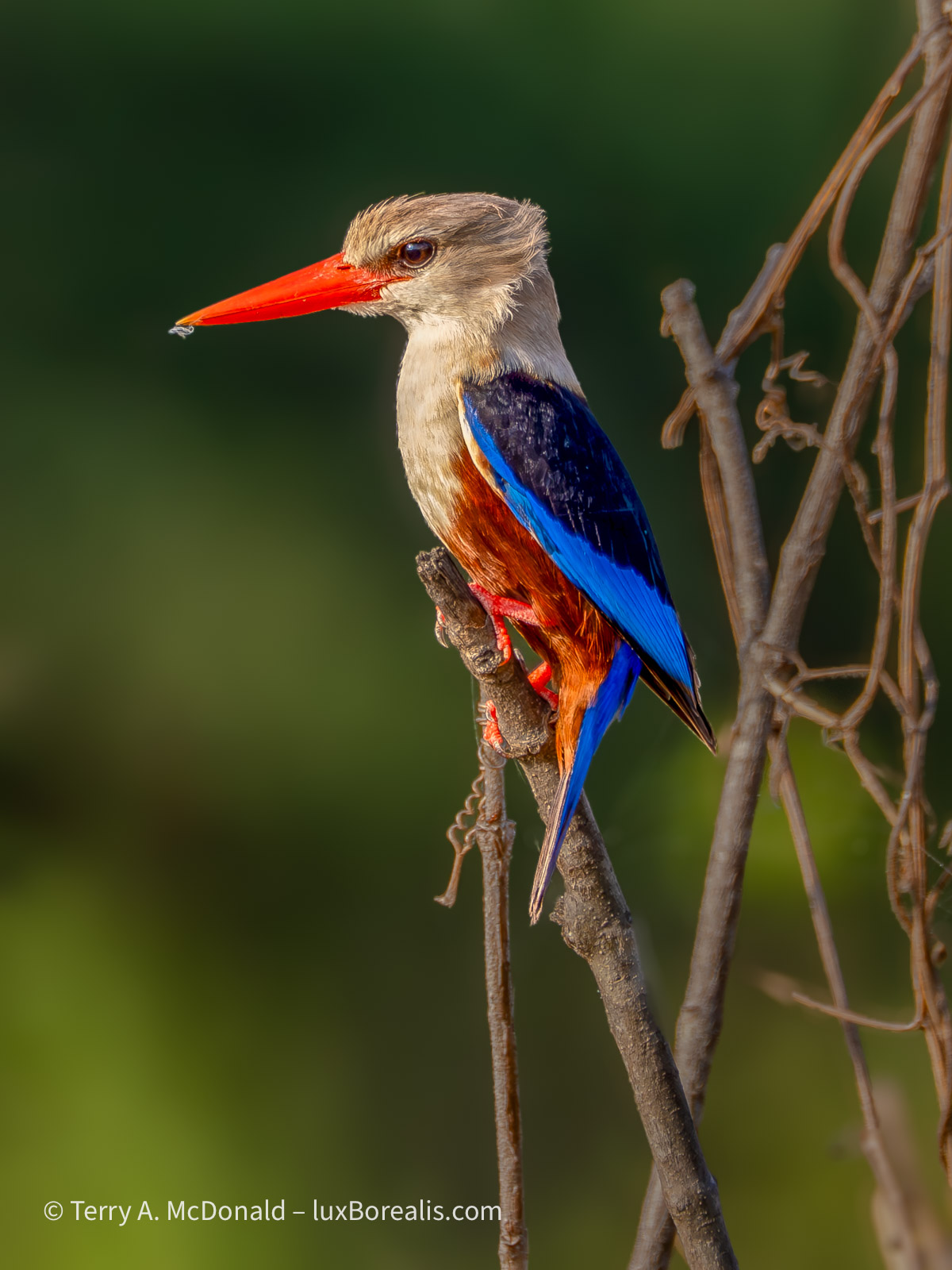
5:06pm, 6 oct; OM-1 w/ 100-400mm at 400mm (800mm efov), ƒ8 @ 1/320, ISO 200; raw file processed in Lightroom
Having Allison with us on safari was equally great, as she pushed us a bit. Early morning wildlife drives, afternoon drives that extended right into evening—she was a positive influence on getting us out at the edges of light. And it paid off in terms of seeing and photographing wildlife, as it always does!
Like our previous safari, at some point, we expected to see wildlife around Tarangire Safari Lodge—our favourite place in the whole world! In the past we’ve seen elephants, many bird species, warthogs, and zebra around the tents. This time it was elephants and a lion. The elephants were looking for water and they are ingenious. The water system serving the tents is all under ground with underground access points to drain the water when repairs are needed. In their clever way, the elephants have discovered how to remove the small cement covers to the faucets and turn the faucets on, providing them with a small fountain to drink from.


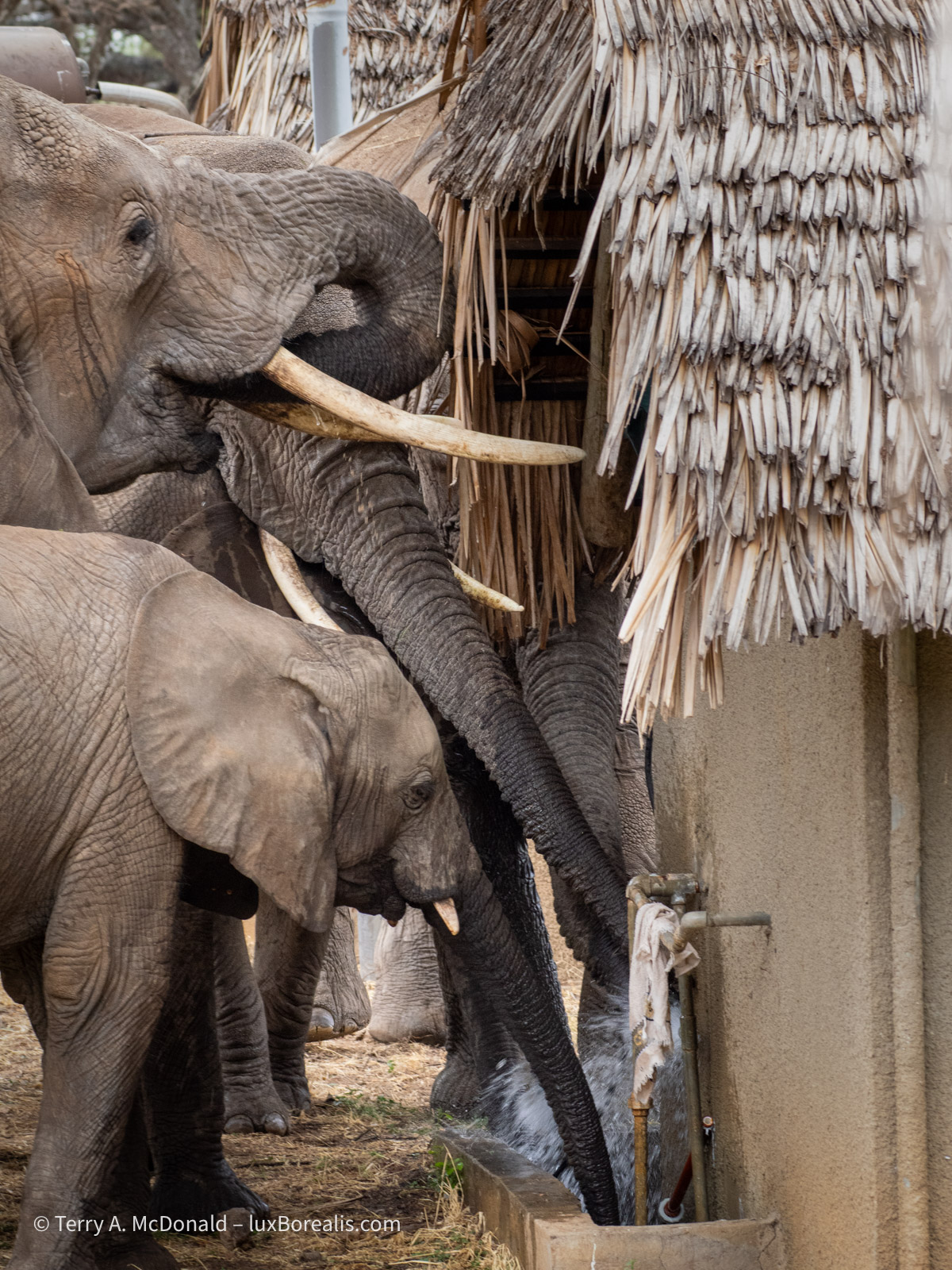
However, when that didn’t work, they found another method and it happened to be Allison’s tent. One elephant calmly picked up a foot and gently applied pressure to break One of the the water lines going into the washroom, providing all the water they could drink. It was most entertaining, though not for Brenden and his fundis (tradesmen) who had to first drive the elephants off, then make repairs.

One afternoon, while enjoying downtime at the lodge, one of the workers alerted everyone to a potential threat—a lioness had parked herself at the base of the water tower, right at the end of the lodge grounds. The lodge is not fenced simply because the most dangerous of wildlife, lions and leopards, would simply jump them or find ways over them along tree branches. In the case of elephants, they would simply walk through them.
From a safe distance we watched the lioness, pestered as she was by a cloud of flies. (Maybe they could smell her last dinner on her!) A few moments later, one of the workers came by in an open safari truck and offered to bring us closer. Definitely!

Allison really was a magnet for lions, and for elephants, too. We saw more lions and elephants the ever before, and they were closer and more spectacular than we could ever hope for.
Out on a drive early one morning, we encountered a group of elephants just coming up from the river. A few had crossed the road ahead, so we stopped to watch the remaining herd members. Rather than following the leaders, they spread out and walked on either side of us, coming quite close, but never in a hurried, worried or unfriendly manner. We were just part of the landscape.

8:07am, 4 Oct; OM-1 with M.Zuiko 100-400mm; ƒ8. ISO 800; raw files processed in Lightroom
As if often the case, while we were watching the elephants, serendipity struck when two male lions popped out of nowhere. They made their way across the road and along a ridge down towards the river. Only one of the two came into the open enough for a photo.

7:12am, 4 Oct; OM-1 w/ M.Zuiko 100-400mm at 400mm (800mm efov); ƒ8 @ 1/640. ISO 1600; raw file processed in Topaz PhotoAI and Lightroom
Our best encounter with lions occurred a few days later and lasted well over an hour. It involved two sleeping males and later, a female. We had been watching the two males sleeping down on the sand of the river floodplain. Seeing lions is always exciting, spotting two males, together is even more so. But watching them sleep is, well, tiresome. We waited and waited for something to happen. From time to time, they would roll over, brush a few flies away, but otherwise they just slumbered along, so we eventually carried on our way.
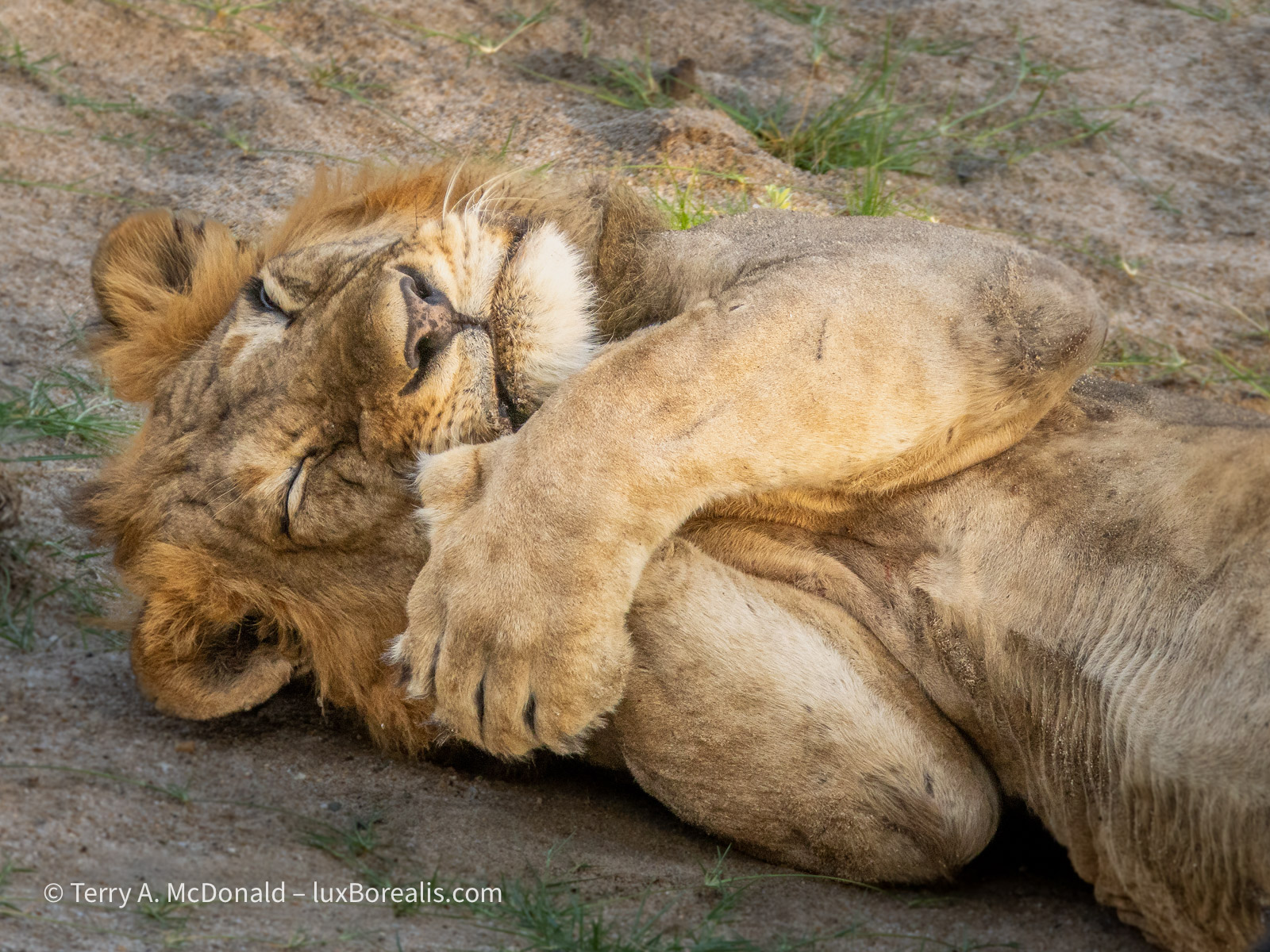
5:33pm, 6 Oct; OM-1 w/ 100-400mm at 328mm (656mm efov); ƒ8 @ 1/320, ISO 800; raw file processed in Lightroom
Not five minutes down the road, what should Allison see but a lioness padding along the river floodplain towards the males. So, we high-tailed it back, negotiated our way in amongst the two other trucks we had left behind, and voilá, some action. She nosed greetings at them, they rolled over, then she climbed the river bank and pulled herself up a large acacia tree to keep watch over the surrounding area—us and the two male lions.
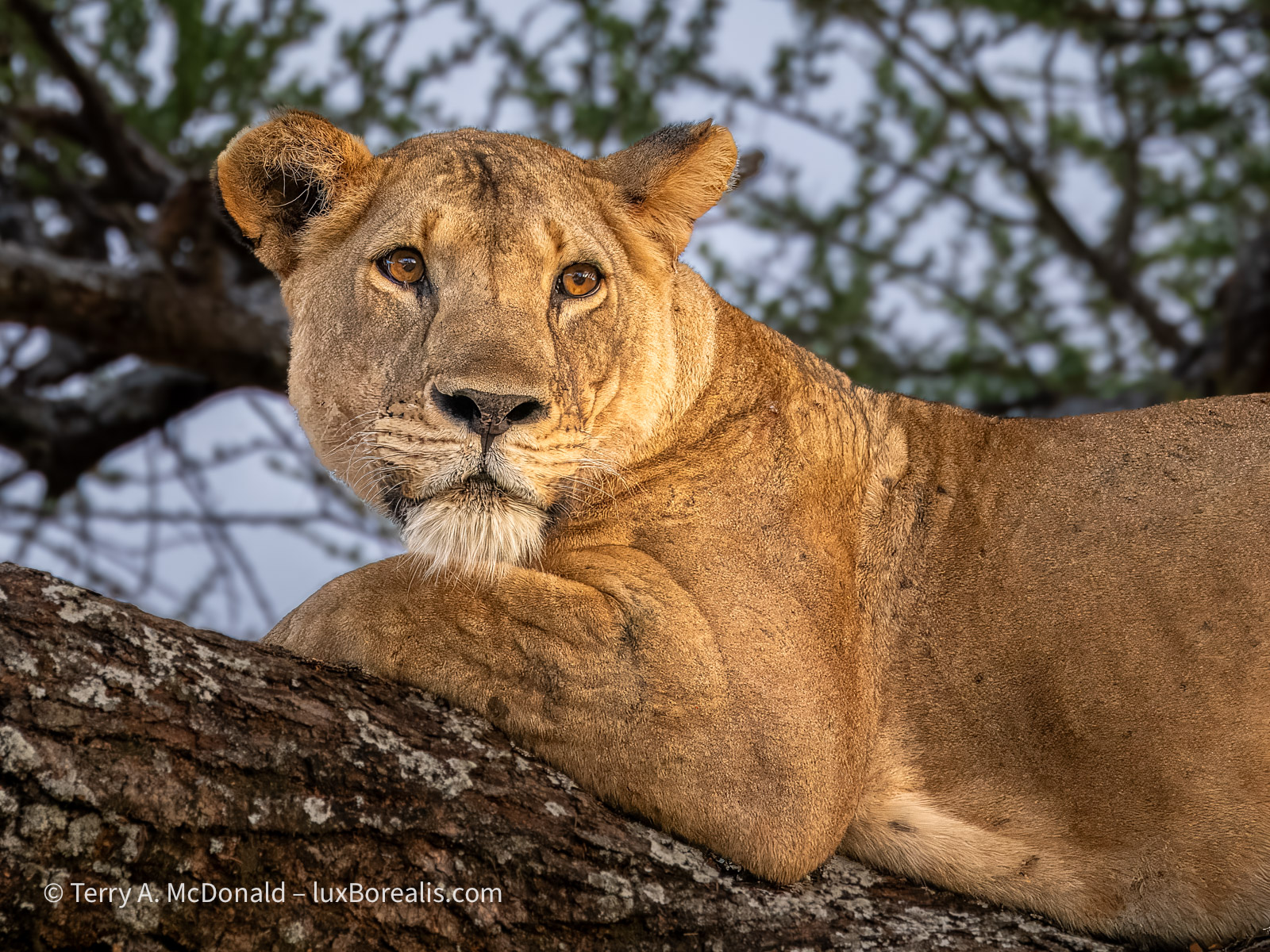
6:29pm, 6 Oct—As the sun set, the dwindling light began causing some concern. Increasing the ISO and reducing shutter speed was offset by bracing against the window frame of the truck, trusting the OM-1’s stabilization and begging for complete stillness in the truck.
OM-1 w/ 100-400mm at 400mm (800mm efov); ƒ8 @ 1/25, ISO 3200; raw file processed in Topaz PhotoAI and Lightroom
But the female’s presence must have stirred things up between the two males as they became active and followed her up the river bank. One of them padded between the safari trucks, over to the acacia, and climbed up into a notch where he then kept vigil, as the sun set. Sadly, that meant we had to get back to the lodge.
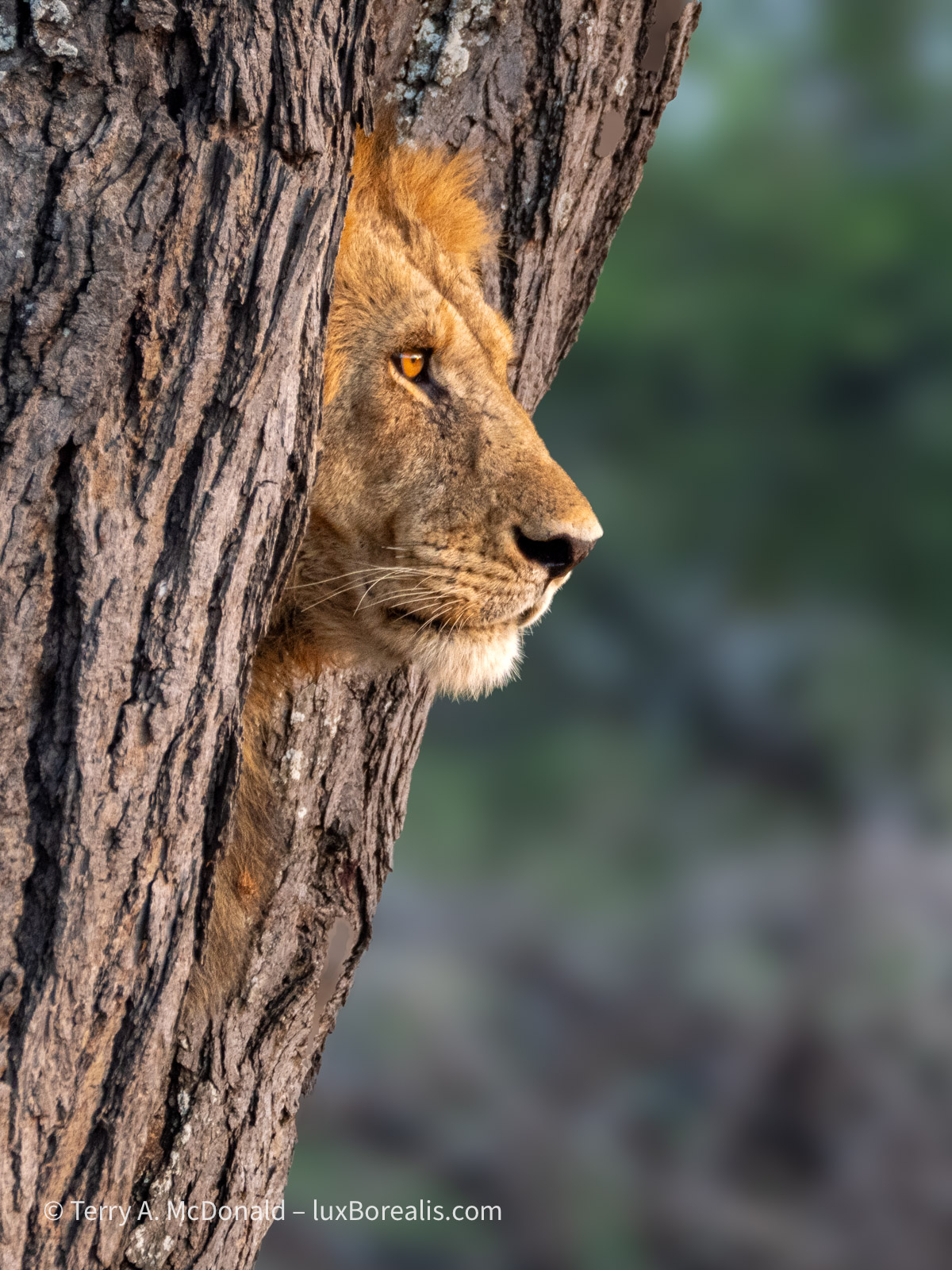
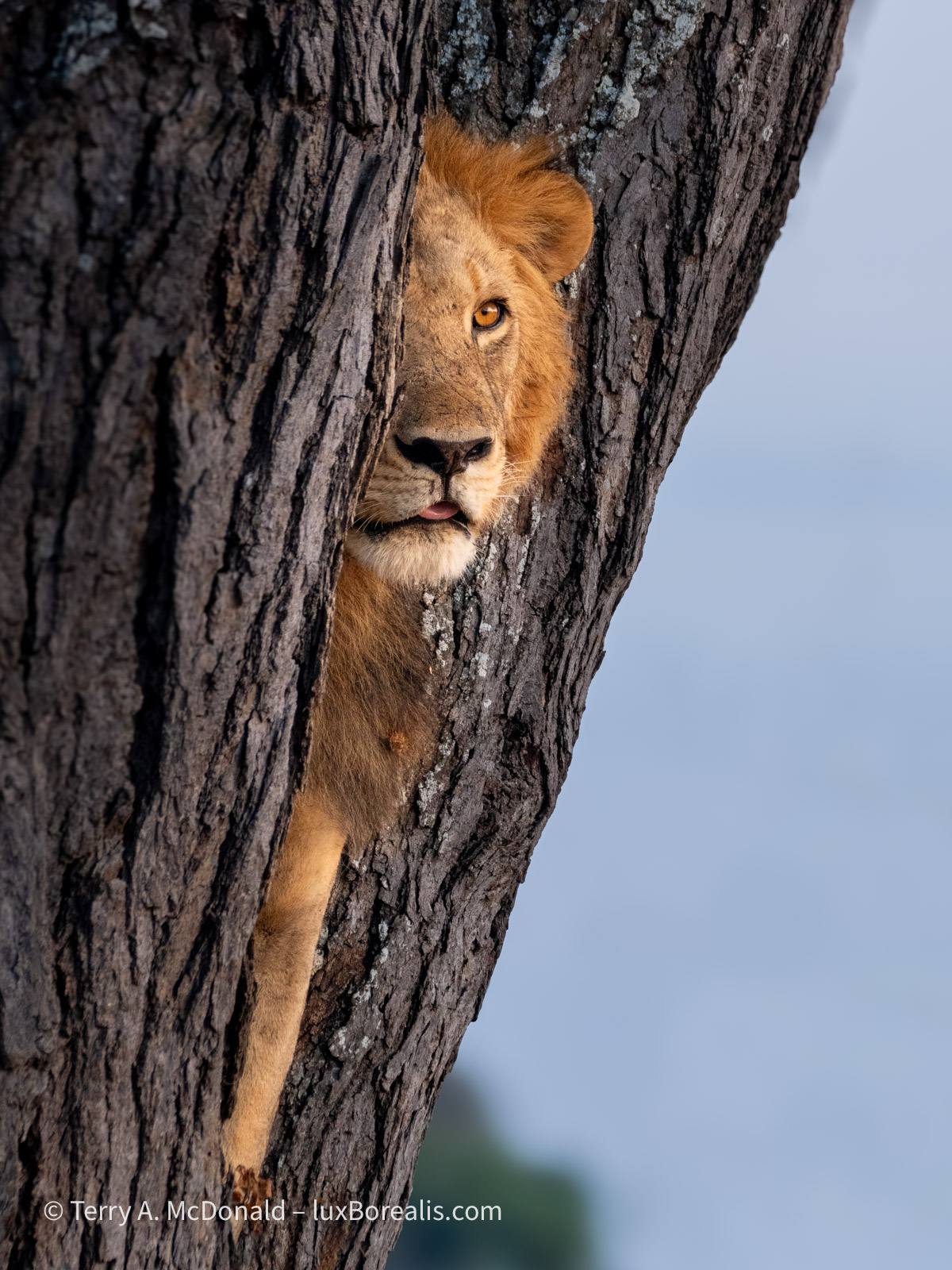

Evening Vigil (Panthera leo)
6 Oct; OM-1 w/ 100-400mm at 292mm (584mm efov); ƒ8 @ 1/80, ISO 3200; raw filea processed in Lightroom
It gets dark very quickly at the tropics, and as the night settled, we ended up having to negotiate our way through a massive herd of Cape buffalo—not the most pleasant of encounters as Cape buffalo are the most unpredictable of large beasts and are known to charge at safari vehicles. Laura took it slowly, yielding to them a few times as they passed across the road, then continuing when there was a passage wide enough. Hair-raising, but exciting at the same time.
Birds are everywhere, and the number of different species is truly amazing. Eagles, vultures and herons & egrets are the largest and there must be half a dozen species of each. But there are also dozens of smaller species of all types. One evening, the vultures were especially active as they began gathering and roosting at the tops of doum palms.

5:43pm, 5 Oct; OM-1 w/ 100-400mm at 218mm (436mm efov); ƒ8 @ 1/200. ISO 1600; raw file processed in Lightroom
We had two opportunities to watch Secretary Birds, strutting through the tall grasses. With their long black legs, they humorously appear to be wearing yoga tights! The second time was one evening, and there were two of them. At first, we thought they were hunting snakes for dinner, but when they began picking up sticks, we realized it was for nest-building. Sure enough first one, then the other flew to the top of an acacia to add their finds to the pile, then perform a mating dance.
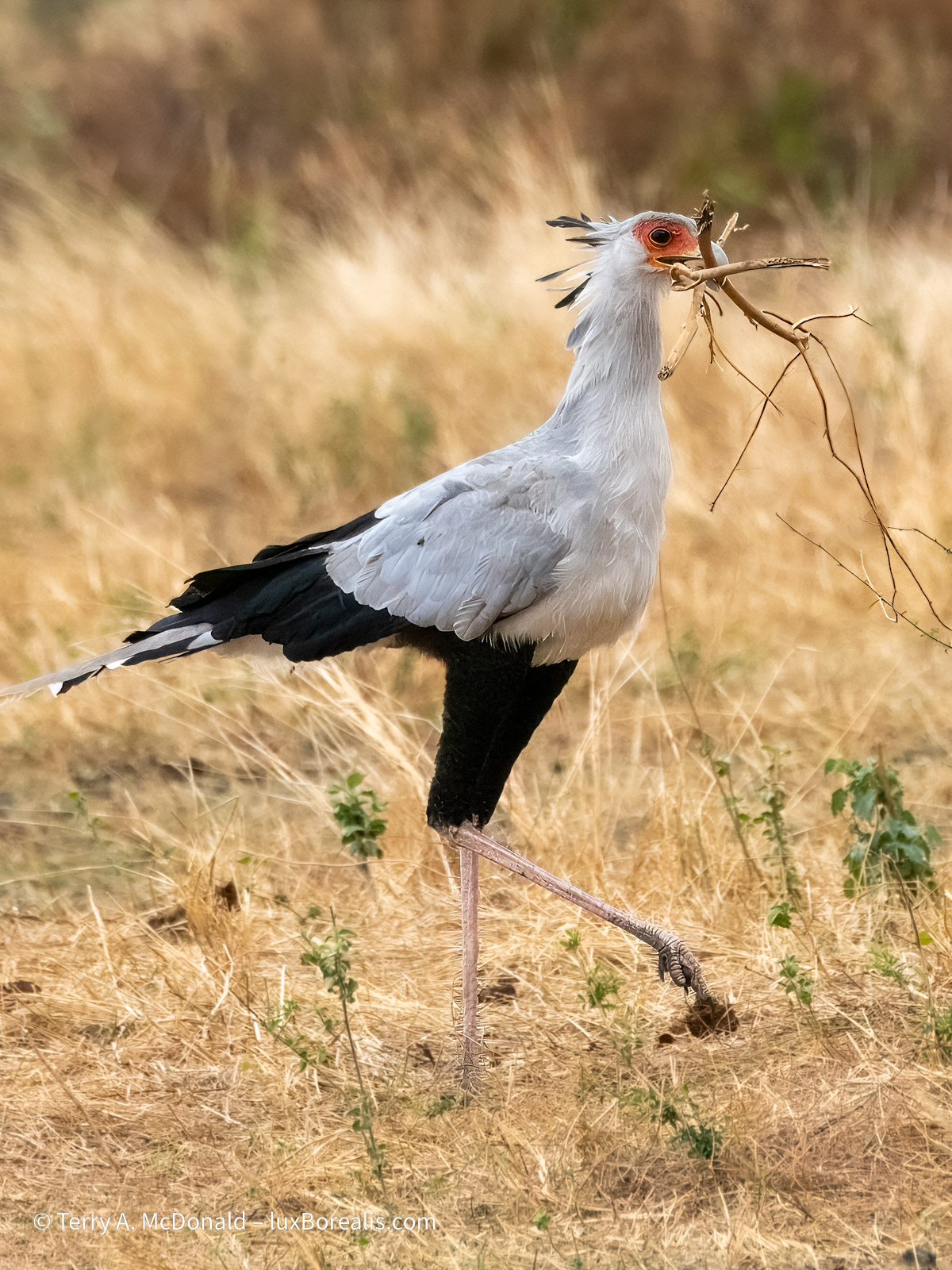
4:47pm, 5 Oct; OM-1 w/ 100-400mm at 342mm (684mm efov), ƒ8 @ 1/1250, ISO 1600; raw file processed in Lightroom and Topaz PhotoAI

5:02pm, 5 Oct; OM-1 w/ 100-400mm at 342mm (684mm efov), ƒ8 @ 1/640, ISO 800; raw file processed in Lightroom
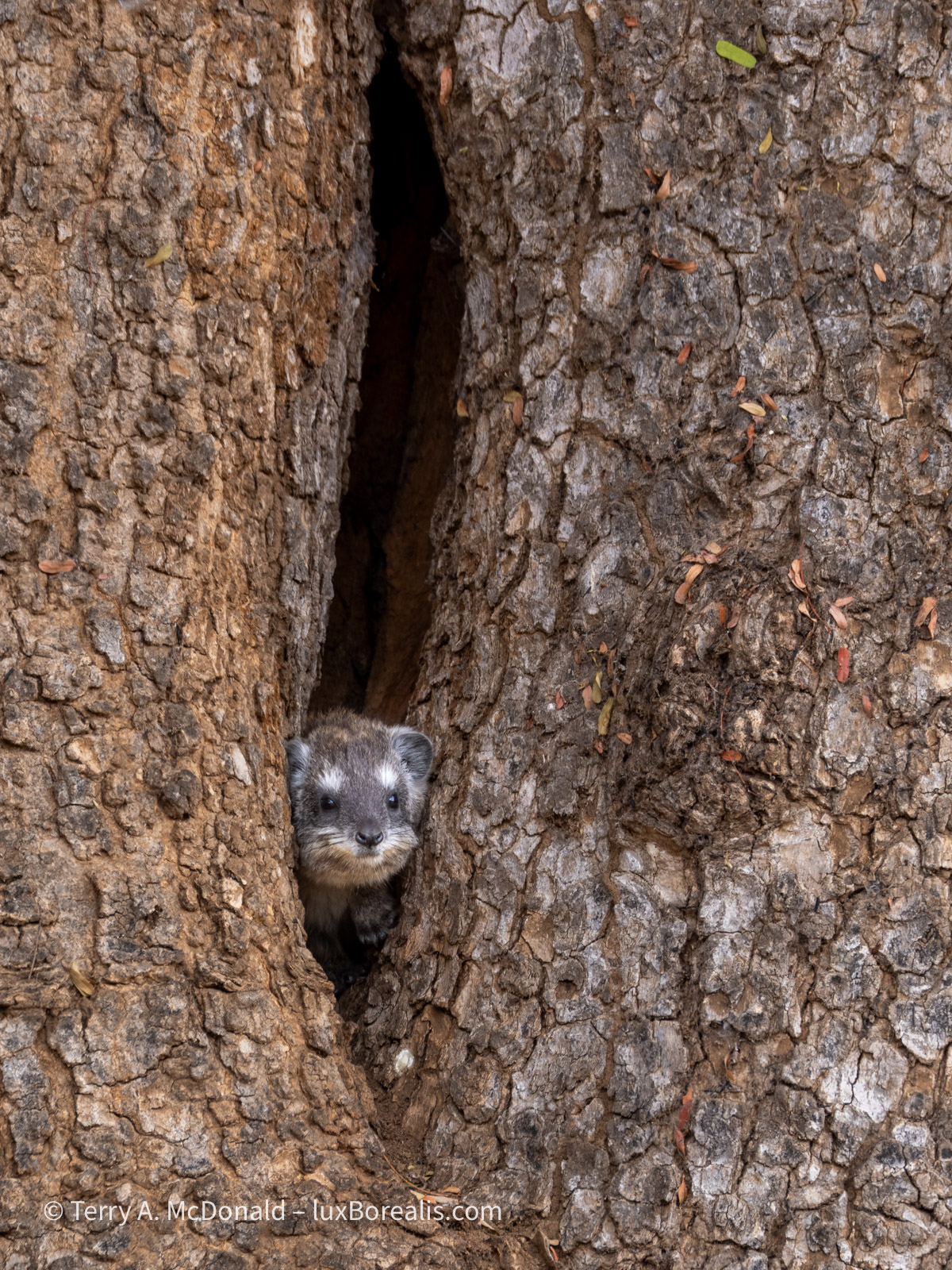
If you can believe it, this is the closest living relative of the African elephant, and one of our favourite small mammals.
11:51am, 5 Oct; OM-1 w/ 100-400mm at 400mm (800mm efov), ƒ8 @ 1/80, ISO 200; raw file processed in Lightroom

5:01pm, 6 Oct; OM-1 w/ 100-400mm at 400mm (800mm efov), ƒ8 @ 1/400, ISO 400; raw file processed in Lightroom
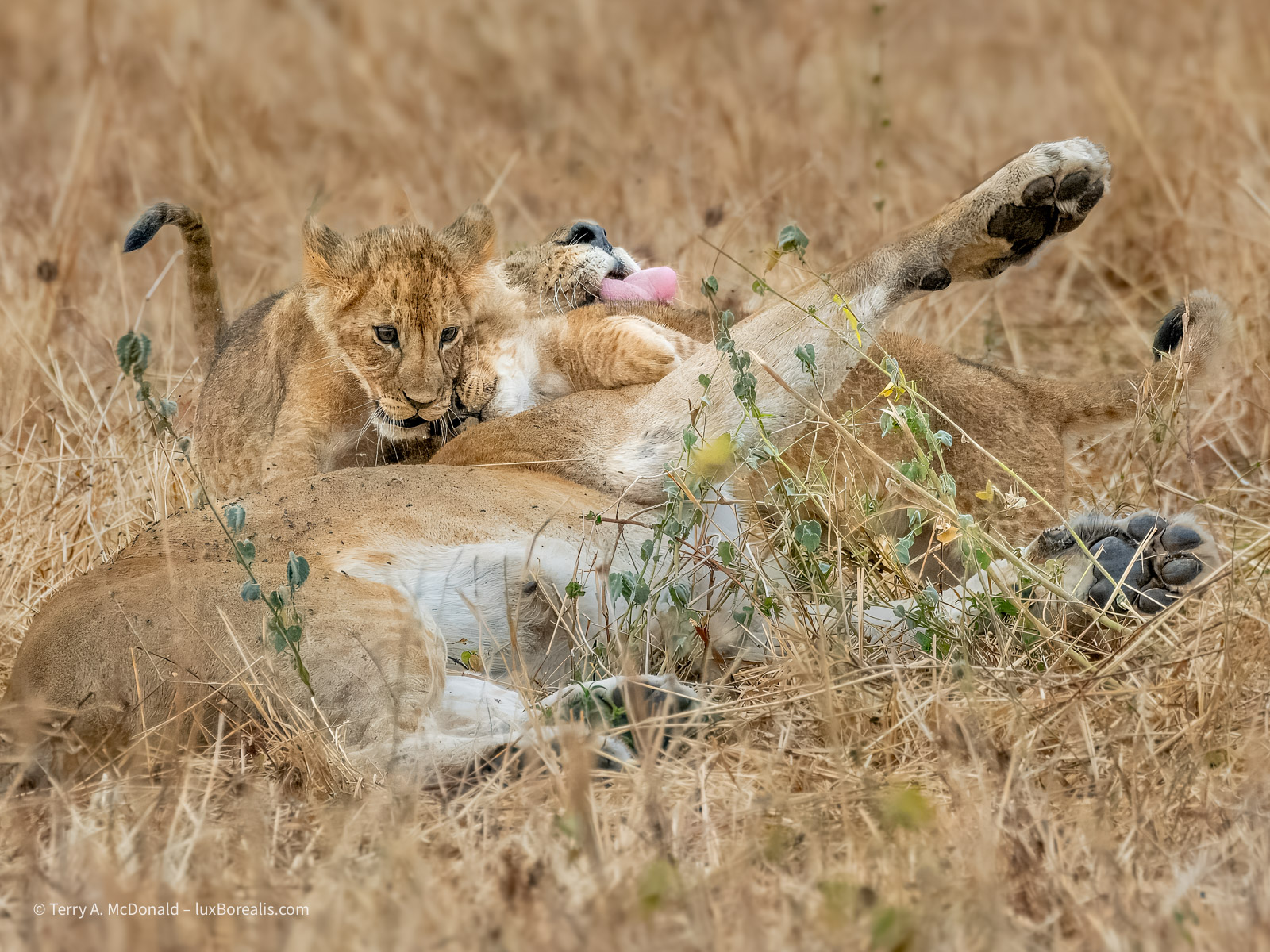
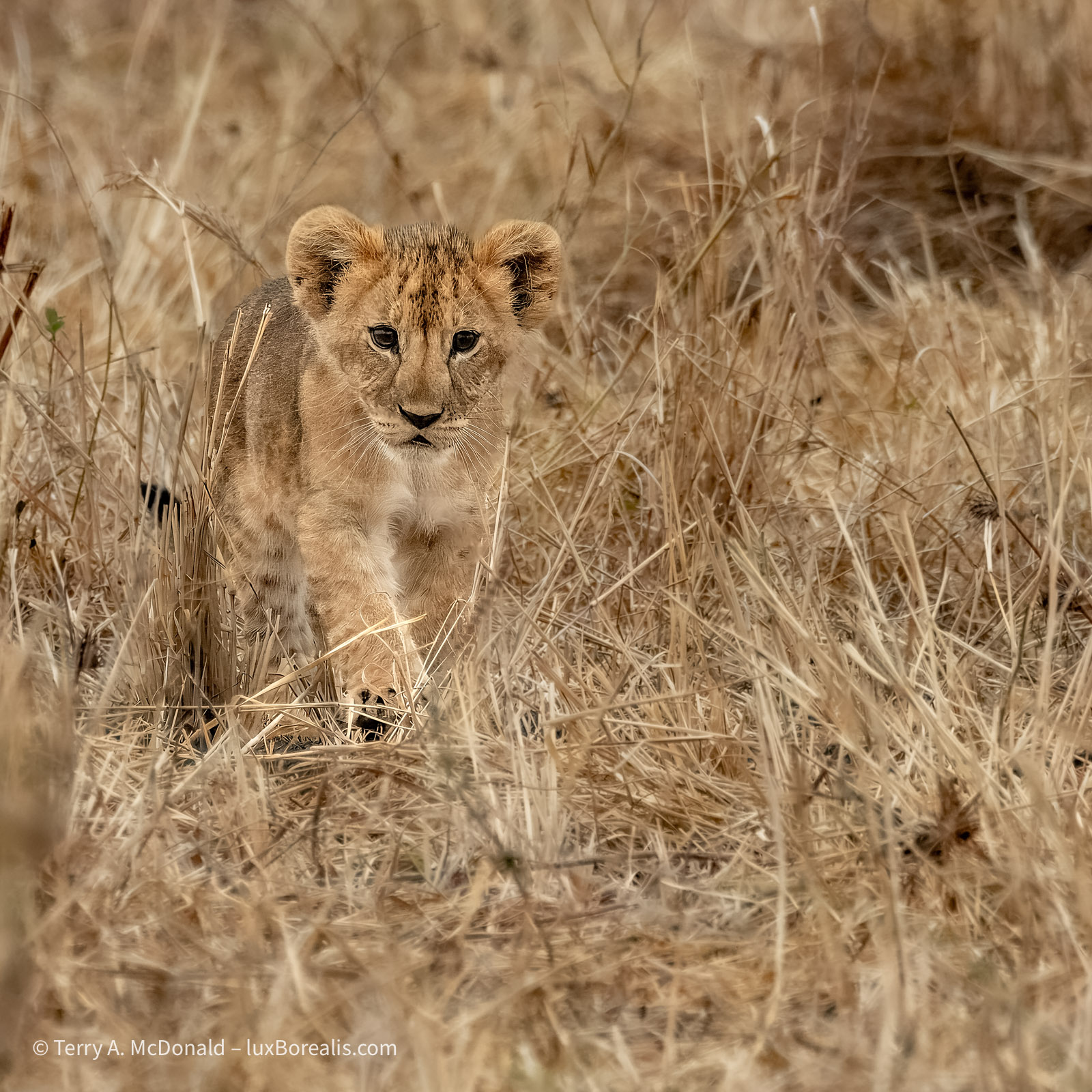
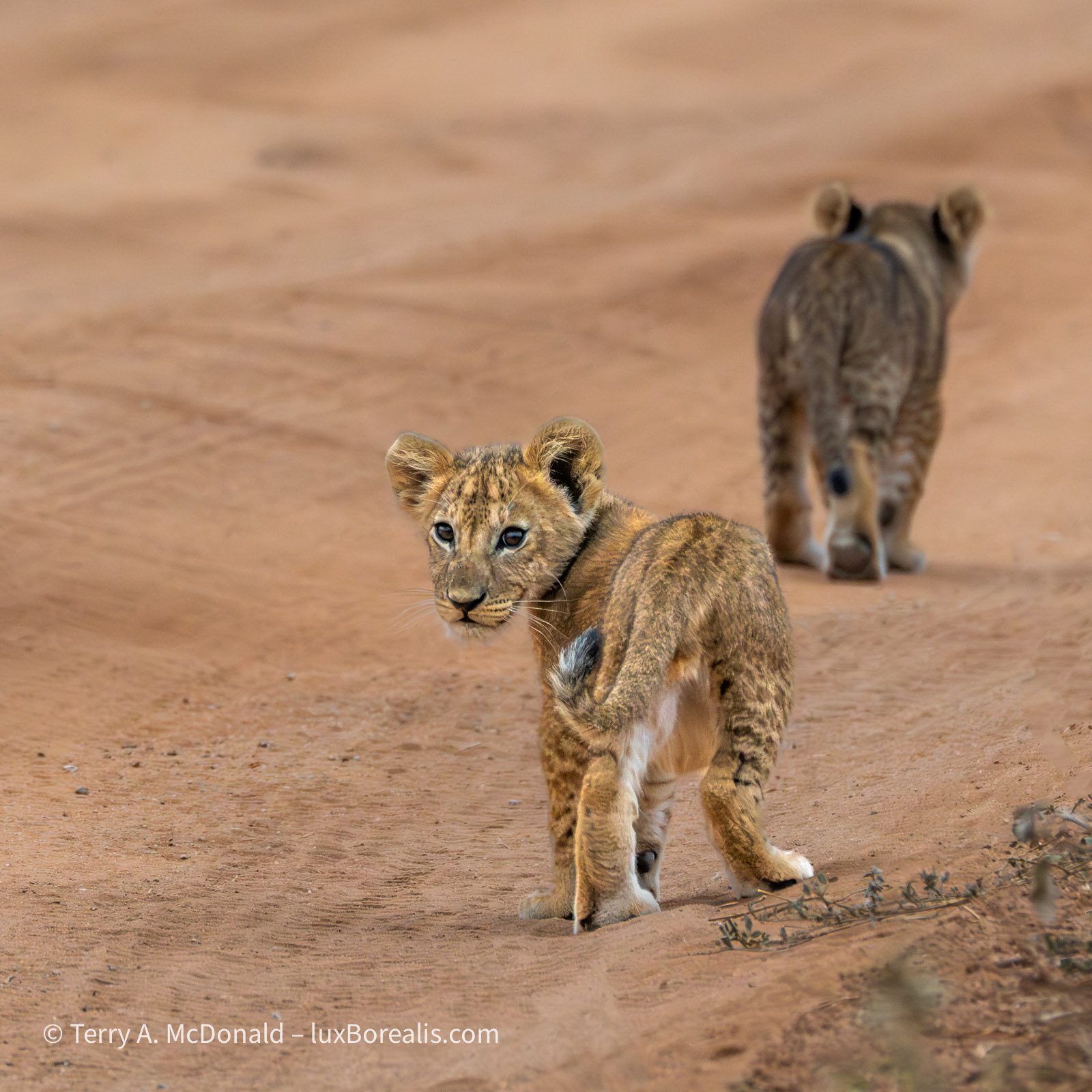
One of the best encounters with lions came on our last morning. Despite it being gloomy with grey, cloudy skies, Allison had us up and out by 6:30am. There is no better time for wildlife than first thing in the morning and last thing in the evening. Sure enough, not 200 metres from the lodge, she thrilled us by spotting a lioness making her way through the tall grass, less than 50 meters from the road. What a find and we wondered if it was the lioness we had seen at the water tower. Suddenly, Allison squealed with even greater delight—there were two young cubs with the lioness. If you’ve even seen a house cat mom and two rambunctious kittens, then you know exactly how these three were interacting. Mom was strolling across the plains, and her two kittens were playing and chasing each other and gambolling along without a care in the world.
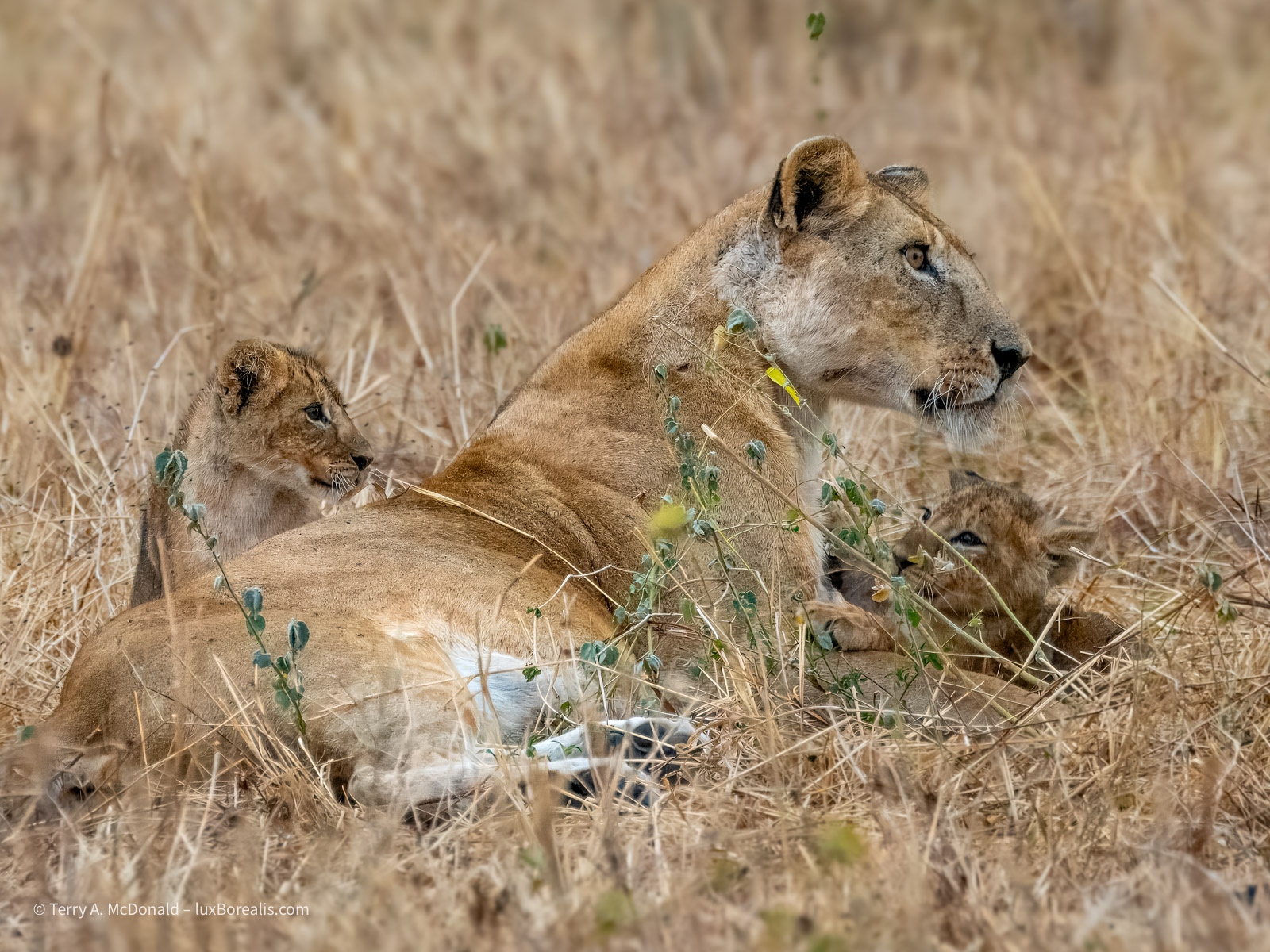
Lioness and cubs
6:47am, 7 Oct; OM-1 w/ 100-400mm at 400mm (800mm efov); ƒ8 @ 1/400, ISO 3200;
Raw files processed in Topaz PhotoAI and Lightroom
Eventually she stopped and laid down, probably to given them a rest, but they played on, climbing on her, then scampering away. Amazing! We had them all to ourselves and followed them at a respectful distance for almost half an hour before they headed across the main road and along another before heading into grasses too tall for us to see them—a truly memorable encounter!

6:02pm, 5 Oct: Near dusk, a mother or older sister elephant playfully sprays water for a youngster. OM-1 with M.Zuiko 100-400mm; ƒ8. ISO 800; raw file processed in Lightroom
Lion Cubs
6:46am and 6:53am, 7 Oct; OM-1 w/ 100-400mm at 400mm (800mm efov); ƒ8 @ 1/400, ISO 3200; raw files processed in Topaz PhotoAI and Lightroom
But, alas, we had to return home. Our hearts were truly heavy as we made our final drive out of Tarangire National Park—quintessentially wild Africa in so many ways.
Our six weeks in Tanzania weren’t only spent on safari—in fact most of it was spent visiting with friends, colleagues, and former students, all of whom are now 20 years older, running businesses and with families of their own. We owe an enormous debt of gratitude for the wonderful hospitality we enjoyed everywhere we went. Nashkuru sana, kila kitu! Our friends Maria and Manfred Lieke hosted us for three of those weeks as well as Allan ’Kiliman’ Philemon for three glorious days at his lodge in Karatu.

6:15pm, 5 Oct; OM-1 w/ 100-400mm at 342mm (684mm efov), ƒ8 @ 1/640, ISO 800; raw file processed in Lightroom
One of our weeks was spent up in Longido visiting Project TEMBO (Tanzania Education and Micro-Business Opportunity). It’s a Canadian-based, Tanzanian-run, grassroots organization devoted to helping Maasai girls and women meet their educational and business goals, and one we have supported since it started more than 20 years ago. Seeing first-hand and experiencing the successes of the dedicated volunteers was truly heart-warming—and worthy of an upcoming blog post.
We spent our last few days in Moshi, at the foot of Kilimanjaro. Gabi and Aat VanderWel toured us around and we enjoyed a couple of down days, just chilling. Each morning I was up before dawn, to see if the clouds might part for Kili to make an appearance—and she did not disappoint, especially on our last morning as we packed for our flight. However, it was disappointing to see how devoid of snow and glaciers she has become over the last 20 years of global climate change. The difference was obvious.
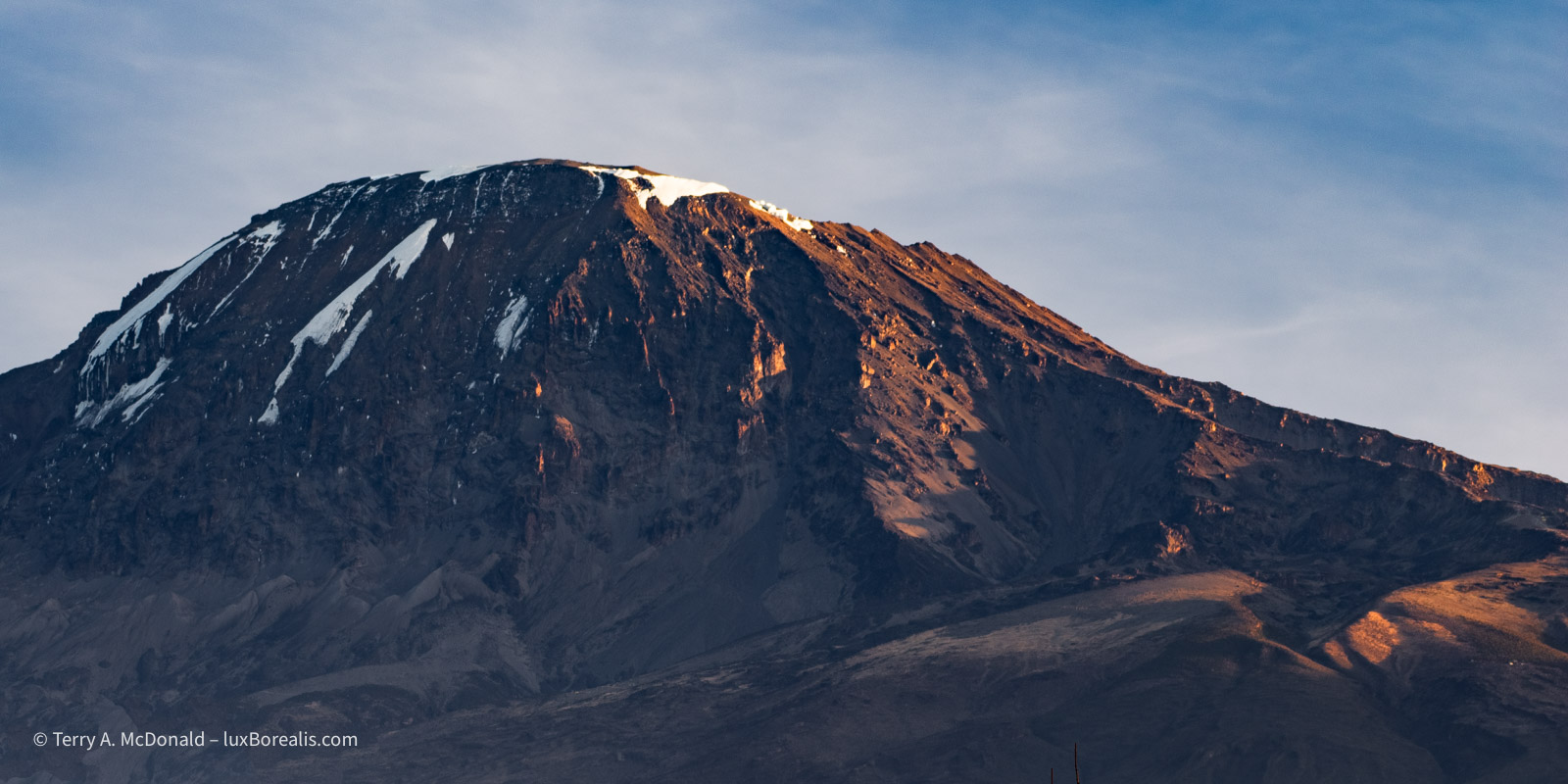
6:21am, 14 Oct; OM-1 w/ 100-400mm at 100mm (200mm efov); ƒ8 @ 1/50, ISO 800; four-photo panoramic; raw files processed in Lightroom.

5:25pm, 14 Oct—Our view of Kili from the air as we cruised north from Kilimanjaro International.
OM-1 w/ M.Zuiko 12-100mm/4 PRO at 70mm (140mm efov); ƒ4 @ 1/2500, ISO 200; raw file processed in Lightroom.
Thanks for reading! Please add your questions, comments, or discussion about safaris and travelling to Tanzania, wildlife and birs photography and equipment used in the COMMENTS below.
This work is copyright ©2025 Terry A. McDonald and may not be reproduced
in whole or in part without the written consent of the author.
Please SHARE this with other photographers or with your camera club,
and SUBSCRIBE to receive an email notice of new blogs.
Have a look at my work by visiting www.luxBorealis.com and consider booking a presentation or workshop for your Nature or Photo Club or a personal Field & Screen workshop at Workshops.
Discover more from luxBorealis Blog
Subscribe to get the latest posts sent to your email.
 luxBorealis Blog
Trackbacks