First Look at Total Lunar Eclipse Photographs

. . . and a review of the experience.
Last night was a long one, but well worth it. Over the course of six hours, from before midnight to just before 6am, I took photos every 20 minutes or so, depending on the ‘action’ in the sky above. Some were made 5 to 10 minutes apart. Exciting, yes, but also a real learning experience.
I used my M.Zuiko 100-400mm ƒ5-6.3 IS lens, which is equivalent to a 200-800mm in 35mm sensor terms. It pulled the moon in, but it still did not occupy even ¼ of the sensor. I tried a few shots with the MC-14 1.4x Teleconverter, but I wasn’t entirely happy with the sharpness. With the OM-1 attached, the lens was firmly mounted on a sturdy Manfrotto tripod. As expected, according to the research I did ahead of time, exposure varied widely. Thanks also to a graphic shared on FB by Peter Baumgarten which also showed the variance in exposure over the event.
All metering was done using the OM-1s Spot Meter mode—essential for this kind of work. I altered exposure with each shot—+1EV, neutral, and –1EV, sometime –2EV—but the images that seemed best were at normal exposure for the dim Moon and +1EV for the bright Moon.
Trying to keep the Moon in focus was a problem I shouldn’t have had, but I messed up. When the Moon was bright, I used single-point AF to lock in the focus, then switched to Manual so the AF wouldn’t need to keep focusing. However, twice I inadvertently changed the focus when zooming between 400mm and 100mm and back again—Duh!—and had to re-acquire focus on a decidedly dim Moon near Totality. As a result, some photos are not as sharp as I would like them to be.
Then there is the motion blur to content with. At ISO 3200, the slowest shutter speed occurred at Totality, a measly ⅖ of a second. Not great for a moving target! I could have opened up ⅔ EV to ƒ6.3 and brought the speed up slightly but, as is always the case with photography, I decided to trade a slightly sharper slightly blurred image for a less-sharp, slightly blurred image. Oh well!

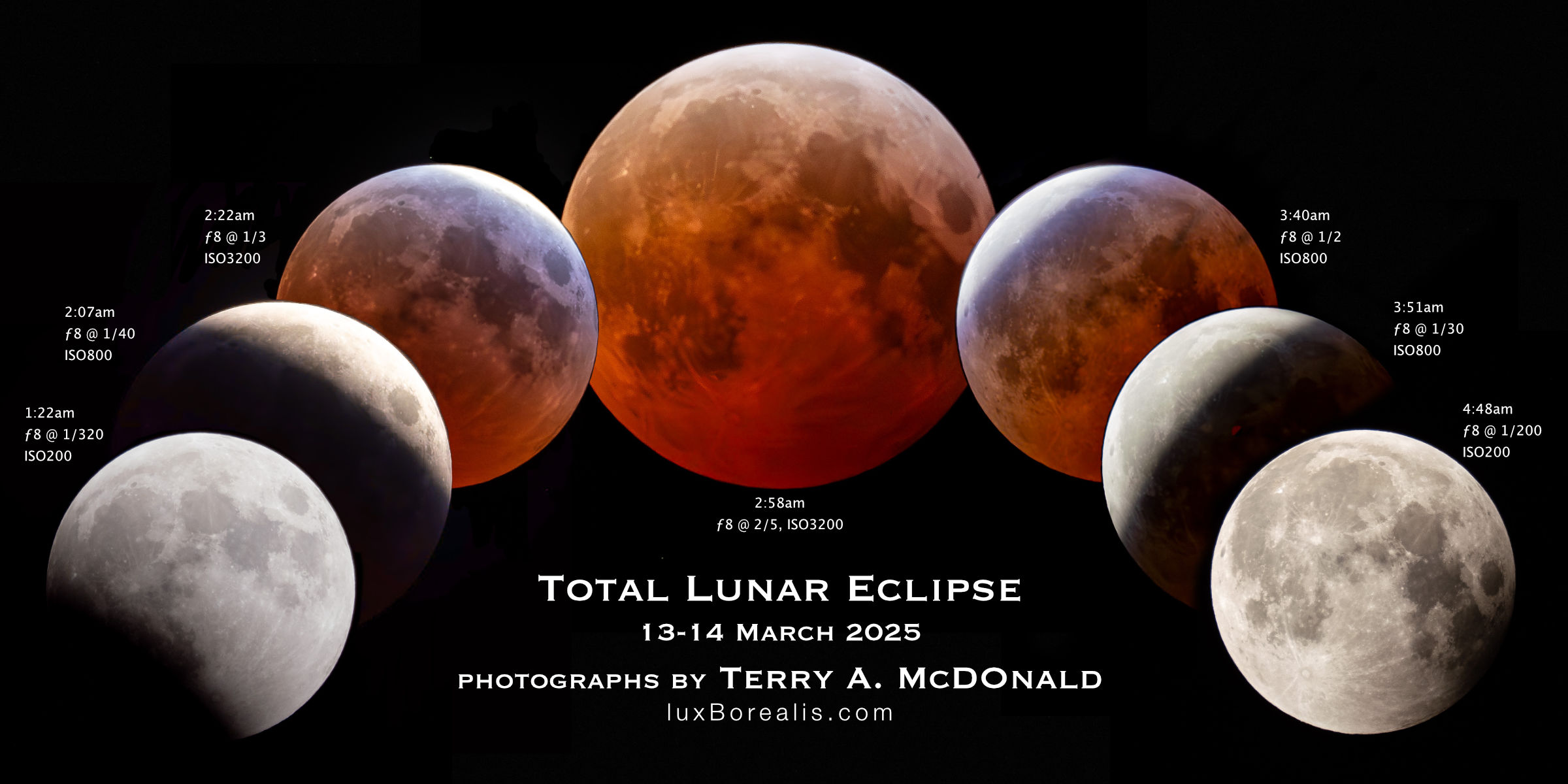
The files were processed in Lightroom (not Classic), with the ISO 800 and 3200 shots run through Enhanced Noise reduction, then sharpened. It took a fair bit of work with exposure, contrast, highlights, shadows, white and blacks to nail just the right balance of black sky, shaded details and the over-exposed highlights that occur just before and after Totality—the Japanese Lantern effect, I am told.
The files by themselves look good but, as individual photographs, they don’t really tell the story. I knew I would be making composites; it’s just a matter of deciding whihc photos and how many to add. The composites above were made in Affinity Photo by placing individual files on a background of the night sky—one of the frames I shot at 100mm.
I have plans for a few different composites that are still in the works. Earlier Thursday evening, just at sunset, I went around to five locations in Guelph, shooting ultra-wide landscapes at 8mm, with 80% sky. My goal is create composites with these photographs to put the Eclipse into context that people might recognize. More and more people I’ve spoken with either forgot the Eclipse or didn’t manage to get out of bed for it, so this will help them see what all the excitement was about. The five base landscapes were all shot specifically including the South and Southwest sky, exactly where the Eclipse occurred. PhotoPills AR really helped to ensure correct alignment.
The landscape composites will be fun to do, but will take more work extracting the Moon from each file, without the surrounding black sky—something for this weekend.
If you had a Eclipse experience, be sure to tell us about it in the Comments section below.
Thanks for reading! Please add your questions, comments, or discussion about the Lunar Eclipse, and/or the equipment and techniques used in the Comments below.
This work is copyright ©2025 Terry A. McDonald
and may not be reproduced in whole or in part without the written consent of the author.
Please SHARE this with other photographers or with your camera club,
and SUBSCRIBE to receive an email notice of new blogs.
Have a look at my work by visiting www.luxBorealis.com and consider booking a presentation or workshop for your Nature or Photo Club or a personal Field & Screen workshop at Workshops.
Discover more from luxBorealis Blog
Subscribe to get the latest posts sent to your email.
 luxBorealis Blog
Trackbacks